|
November 01
Galloping through childhood
- by Emmanuelle
The Pony Farm is well
known to many children who grew up in Auroville. Emmanuelle is one of
them. What is the future of this children's paradise?
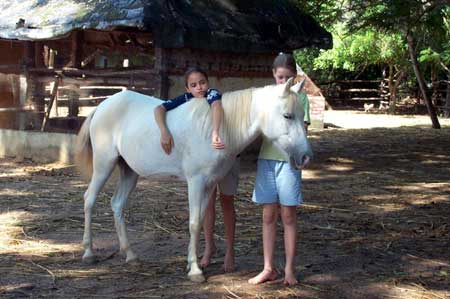
I will always carry with me
vivid memories of the long hours of my childhood spent galloping on pony
back, with friends, through open fields, the wind blowing in our hair.
Those moments were an initiation into the joys of belonging and being
one with nature. Today, some twelve years later, a new generation of
Auroville children has replaced ours in spending many happy hours at the
Pony Farm with their friends, the ponies.
The Pony Farm in Kottakarai,
was started in the mid-eighties by Gaya and Achilles. The first ponies
to find a home there were those that had previously belonged to
individual Aurovilians. Gaya and Achilles left for Germany, and
Nicolette took over management in the mid-nineties. One month ago,
Nicolette in turn left, and Lea, with her twenty year-old daughter Sara,
were appointed caretakers.
Today, the Pony Farm is home
to eighteen ponies and horses of different breeds. About twenty-five
children of Auroville, from the age group of 7 to 12 years, come to the
Pony Farm a couple of times a week to take riding lessons.
Lea, not only runs the place
but also gives riding lessons to the children, while Sara and Madeleine,
a long term guest, take them on ride-outs.
Lea, in giving her riding
lessons, follows the Hemphling Method: "It is about following the
soft way: natural, bareback pony and horse riding." This is a
method that has always, to a certain degree, been followed at the Pony
Farm, and it stresses the importance of the relationship and
communication between the pony and rider. "There are two ways of
dominating a pony," continues Lea, "either you break its will
through classical training, or, by developing your own personality, you
gain your pony's respect, and from that point it listens to you. This is
the method I want to follow with the children, although I am still
learning it myself. This method is also about working on oneself, and
with time, the children will see the results."
During the school holidays,
the children spend their days at the Pony Farm. This September, for the
mid-term two week holidays, they were there from 7 A.M. to 4 P.M. almost
each day. They would groom the ponies, brushing their coats and cleaning
their hooves, help to feed them, and then either take riding lessons in
the corral, or go for long rideouts. If it was a particularly hot day,
upon returning the ponies were given a bath, and after that, the
children themselves went for a dive in the Pony Farm swimming pool.
It wasn't much of a holiday
for Lea, though: "To have some fifteen children shouting for your
attention all day is quite exhausting. At the end of the day, I
basically had to chase them out to have a bit of peace and quiet. But we
did have a great time: we often rode to the Solar Kitchen to have lunch
together, and the children really enjoyed themselves."
They sure did. They are all
very happy with Lea, who has so much energy and so much patience (which
is essential if you're dealing with that age group!), as their new
'riding teacher'.
A new riding school, The Red
Earth Riding School, was started in Auroville some eighteen months back.
The approach of this school is classical, and more 'professional'. The
children are taught to ride with saddles and are trained to take part in
shows and competitions. While the Red Earth Riding School has become
equally popular, there will always be those children who continue riding
at the Pony Farm and who are more attracted to bareback, free and
natural pony and horse riding. And of course there are those families
who cannot afford to pay for an individual pony/horse, as the Red Earth
Riding School mostly works on that basis.
Almost continuously the Pony
Farm has faced financial difficulties. In the early days, SAIIER (Sri
Aurobindo International Institute for Educational Research) paid a big
part of the Pony Farm's expenses. Then that funding stopped. For Gaya
and Achilles, who had to continue feeding and taking care of the
twenty-odd ponies, this period was quite a struggle.
In the mid-nineties, the
children's parents paid for the riding lessons. Since a few years,
Auroville's Central Fund is contributing towards the expenses with Rs.
6,000 a month. This helps, but it only represents a fraction of the
monthly expenses. The parents of the children contribute Rs. 600 a
month, which leaves the Pony Farm with the recurring challenge of having
to cover a deficit of about Rs. 10,000 each month. It would be a great
help if some well-wishing individuals or Auroville unit holders could
contribute a monthly sum.
Many of the ponies at the
Pony Farm have been there since its beginning, and some of them are
getting very old, and cannot be ridden any longer, yet they still have
to be fed and taken care of. Many of the ponies are also only big and
strong enough to carry children up to ten years old, and as the children
grow up and continue wanting to ride, that becomes a problem. Lea has
been thinking that getting a couple of 'Katavari' horses, a local breed,
which is sturdy and resistant, could be a solution. However, the present
financial situation makes it impossible.
In spite of the present
problems, the Pony Farm continues running and Lea is still positive and
optimistic about the future and sure that things will work out.
Says she: "I think the
Pony- Farm should be like a second home to the children, where they feel
happy to be with their friends, the ponies." To the children it is
already very much a 'second home'.
|