|
October 01
Coping with change
- by Tejas
Auroville business can only meet the demands
of the ever-changing market if new entrepreneurial skills are developed
and a new type of business economy is actively promoted.
Asked to comment on the
extent to which the forces of globalisation tend to affect the
performance of Auroville's commercial units, Angad, of Mantra pottery,
answers with two observations. "There is tremendous potential for
India to make a bid for global markets along with other developing
countries like China," says he. "With the developed world
showing an increasing tendency to outsource the bulk of its
manufacturing, there is scope for any player who is ready to respond
appropriately. That, for us here in Auroville, is a wonderful
opportunity to exploit. But we have also to deliver. And for this we
should be prepared to play by the newly evolving rules of the
game." And, he adds, "The days of easy profits seem to be
over."
Valerie of Filaure and Prema
of Auromode, both garment manufacturers, agree. It is no longer
sufficient to have capital, resolve, ability and dreams. You now also
need inventiveness at a dizzying pace together with financial and
managerial flexibility to make the best bid to get the order.
These newly evolving rules
of the market are governed by changing parameters. In the past, products
resulting from a combination of quality and originality commanded a high
price. Today, the customer of the new global market demands the very
best in quality for the lowest possible price. Intense competition,
greater market awareness and more buying options have cumulatively
engineered this change in buyers' attitudes. This pressure to provide
high quality at competitive prices necessarily lowers profit margins.
To cope with these changes,
new tools of production and management have to be embraced. Adaptation,
however, is seldom a uni-dimensional affair. It demands a movement as a
whole and not in parts. " If pricing is going to be offered as the
competitive edge, then a complete overhaul and re-look at other related
factors is necessary too. This calls for critical management," 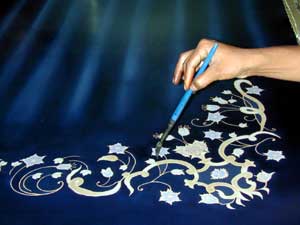 declares
Prema unequivocally. "Cheap labour, which is one of the main
attractions for overseas buyers to cultivate producers in India, is no
longer as cheap as it used to be. It is becoming increasingly a
price-qualifying factor. In labour intensive manufacture, the need to
uphold quality means that more qualified people are involved in the
production line. We then need to either recruit capable staff or upgrade
the skills of existing ones. These investments add to costs. It calls
for very efficient management of resource and manpower." declares
Prema unequivocally. "Cheap labour, which is one of the main
attractions for overseas buyers to cultivate producers in India, is no
longer as cheap as it used to be. It is becoming increasingly a
price-qualifying factor. In labour intensive manufacture, the need to
uphold quality means that more qualified people are involved in the
production line. We then need to either recruit capable staff or upgrade
the skills of existing ones. These investments add to costs. It calls
for very efficient management of resource and manpower."
The adoption of new
technologies is an important aspect of changing market contexts.
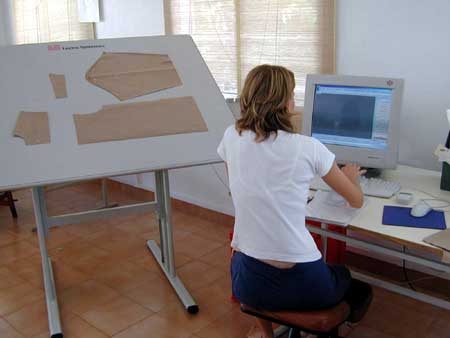
"Computer Aided Design (CAD) is becoming more important to our work
and is likely to become central to it in the years to come,"
reveals Valerie. "The market of the future is becoming very hard to
pin-point. CAD could give us the leverage we need to make our manoeuvres
in this ever-shifting scenario. With it Filaure can seriously consider
both product customisation, sampling collections, pattern-making and
even design consultancy". In fact the new economy is being
characterised more and more the world over by such auxiliary activities.
 Harish
Joshi of Imagination, a maker of handloom textile products, has
discovered another way (albeit by accident) of adapting to these
changing dynamics. His unit has been affected by a severe drop in
business. Long-standing buyers have gone into mute mode and a few
potential customers are driving very hard bargains because they have
other and, possibly, cheaper options. Harish
Joshi of Imagination, a maker of handloom textile products, has
discovered another way (albeit by accident) of adapting to these
changing dynamics. His unit has been affected by a severe drop in
business. Long-standing buyers have gone into mute mode and a few
potential customers are driving very hard bargains because they have
other and, possibly, cheaper options.
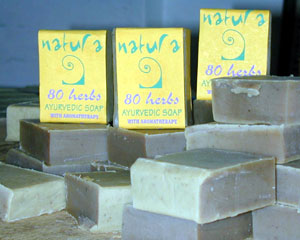
"I am forced to activate survival measures," he says. These
include laying off surplus staff, delaying infrastructural expenditure,
however vital, and developing a new product line - handmade soaps. The
reasoning is simple. "This product has long-term demand, and is
produced as cheaply as we can. Though the profit margins are low, they
provide a steady turnover, which, in the end, is the life blood of a
unit," declares Harish.
Innovation is another way to
cope with changing markets. Mantra has been developing a new range of
pottery products besides its regular line. This has given it access to
new markets, even if only for a while, for both competition and copying
are intense. "You 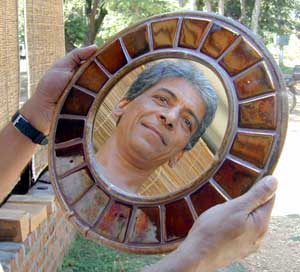 have
just that bit of head start before someone begins to cash in,"
laments Angad. Abha of Shradanjali, a maker of floral stationery and
decorative items, encounters the same problem, as does Guy of Radiance,
a maker of lanterns and decorative crafts. However, he reveals yet
another coping strategy. This is the targeting and cultivation of the
niche market, which simply means developing exclusive products for an
exclusive market. "The problem with this," he confides,
"is that such niche markets are trend driven. Its exclusive value
is subject to changing market trends." have
just that bit of head start before someone begins to cash in,"
laments Angad. Abha of Shradanjali, a maker of floral stationery and
decorative items, encounters the same problem, as does Guy of Radiance,
a maker of lanterns and decorative crafts. However, he reveals yet
another coping strategy. This is the targeting and cultivation of the
niche market, which simply means developing exclusive products for an
exclusive market. "The problem with this," he confides,
"is that such niche markets are trend driven. Its exclusive value
is subject to changing market trends."
Diversification and
innovation, it would seem, are emerging constants in this new economic
drama - unless one manages to hold some kind of product exclusivity,
either by way of design or production technique. Prema seems to have
just such a secret weapon in her arsenal. Auromode's hand-painted silk
scarves, she points out with pride, are the only of its kind being made
in India.
Commercial units that wish
to survive in this time of globalisation, then, will have to be very
professional. "That," says Manou of the Auroville Board of
Commerce (ABC) "is exactly what is lacking in many units."
Along with that, most units - over 80% - are still very small in terms
of capital outlay, turnover and profits. Almost as an aside, he adds
"Our avowed spiritual aspirations keep getting in the way of seeing
business in a positive light. Yet, business, if done in the right
spirit, can be as much a part of one's spiritual path as any other
activity."
Money is the forbidden word
in our community. Yet it takes up much of our time and thinking. The
continuing attempts to spiritualise moneymaking have only resulted in a
kind of materialistic myopia and collective hypocrisy. Perhaps we give
money more attention than is needed. It is after all just a means to an
end. And the more we have of this means, the better for all. Why can't
we face this truth?
Ulli, the former manager of
Shuttle, thinks this is true indeed. He goes on to point out that over
the past years Auroville has had no new business undertaking that was
singular or outstanding in some way, good enough to run with the best.
"It's time we ask ourselves why we do not attract top calibre
entrepreneurs, those who are knowledgeable in emerging cutting edge
fields and who can lead us to participate in the new global
economy," iterates Ulli. "For this to happen we should take
the pains to create the right climate for such a species to come to
Auroville. A climate that is stimulating and supportive rather than one
that is limited by its own confusion and absence of clarity. What we
have now is essentially a cottage industry economy that by its very
nature cannot meaningfully upgrade or upscale beyond a point. Such a
production system represents a waning industrial type of economy. It is
based on cheap unskilled labour and high running costs. As such it
cannot hope to compete in the markets of the future beyond a specific
level, no matter what trimming and pruning is done. Auroville has to
resort to a new economy that is capable of taking advantage of the
emerging info-economy and develop a system of wealth generation that is
based on knowledge, expertise and leadership. What affects the world
will affect us and the global trends and demands will dictate the way we
do business eventually," says Ulli.
Manou believes that, apart
from developing knowledge based industries, Auroville's future
businesses should also focus on sectors like organic and chemically-free
food production, traditional and natural health care products,
appropriate building construction materials, non conventional energy
systems and natural fabrics. In the service sector Auroville could
provide consultancy in the fields of water conservation, afforestation
and renewable energy systems. Another development may be the areas
relating to culture and entertainment, which could turn into promising
business propositions in the long run.
Mother spoke about Auroville
as a self-sustaining township. Ultimately, all our business, whether
targeting outside customers or providing for the city itself, should
work towards this objective.
|