|
October 02
Affordable Housing
- by Abha and Dirk
Can construction costs be brought down or is
fundraising required?
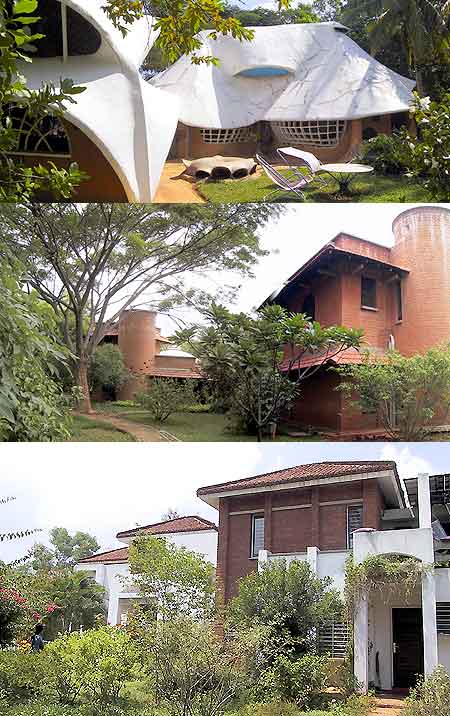
Given the steadily rising costs of construction in
Auroville, the need for affordable housing solutions is more urgent than
ever. While the main cost of any building is related to the quality of
construction expected by the house-occupant or architect, other major
expenses relate to infrastructural and site development costs. According
to the latest housing guidelines, the built-up area for an individual
should be within 65 square metre (the Auroville Master Plan eventually
calls for only 30 square metre space for each new resident in the
high-density city area) and the end price of a housing unit should not
exceed Rs 10,000 per square metre. For most people in Auroville this
price range is beyond their means, a fact that has been recognized by
many architects and builders. There is presently a strong movement
towards collective housing projects where semi-collective facilities
allow for lower construction and running costs. Unfortunately, how to
further reduce construction costs is a contested issue among various
contractors and architects.
Finding the Rs 10,000 per square metre rate
unacceptably high, Dharmesh, who works with the Development Group, asks,
"Why does one need to spend so much on a house when a cheaper
alternative can be built? Not everyone can afford granite floors or
ceramic tiles. Traditional terracotta works just as well, and looks just
as aesthetic." Paradoxically a new residential housing project
coming up in Grace under architect Helmut precisely provides this type
of finishing: plain white-washed walls inside, terracotta flooring and
the use of country tiles on the roofs. Yet, the cost for these houses
still exceeds the ceiling level. Another idea that Dharmesh proposes is
that 5% of the overhead costs can be cut if the various project holders
of big residential or office complexes sit together and work out a
collective plan of buying the materials, and have a common team of
supervisors to monitor the construction. However, Vijay, a contractor
who recently joined Auroville, explains that he gets the materials at
the same low price, and that a centralized material procurement unit
only would add an additional overhead on the material cost and it may
result in the delay of actual construction process. Thirdly, Dharmesh
suggests that architects and contractors should simply take a
maintenance as he does, instead of charging their high percentages.
Without collective-oriented housing solutions,
finding any clear-cut solutions to reduce construction costs remains a
challenge. The onus, whether in an individual or collective housing
project, is on the individual architect or contractor to skillfully use
materials and space in an innovative manner.
Designing affordable collective housing projects
based on Auroville's ideals of integrated living will allow a large
number of Aurovilians and Newcomers with little or no means to obtain a
decent place to live. Yet Auroville is still far from being the
self-sustainable "city the earth needs", and therefore
resources for partially-funded housing schemes need to come from the
"rest of humanity". Partly innovative, experimental and
environmental projects like Maitreye and Creativity are two collective
housing complexes that attempt to reduce costs through professional
fund-raising efforts.
Maitreye attempts to provide reduced-cost housing
in a medium-density project. Costs will range between Rs. 2 to 2.5 lakhs
for single resident dwellings not exceeding 45 sq. m. There are options
for an extra floor in case of couples or families. To keep the costs low
there will be efforts to approach different agencies for financial
support for common facilities and infrastructure. Creativity, a project
that professes to be "an experiment in intercultural, interactive
community living for fifty people," has a similar approach.
Presenting itself as "an integrated model of multiple
eco-systems" (waste- water treatment plant, rainwater harvesting
system and a solar energy system) and "an important Research and
Development project" it has already succeeded in attracting 45% of
the total estimated cost in grants and donations. This amount will cover
the project's extremely high infrastructure costs and common facilities.
The participants of the project have till now been able to raise only
25% of the remaining 56 % of construction cost. If successful, it may
very well become a precedent for future collective housing projects. For
affordable future housing in Auroville isn't merely a matter of cost
reduction, but more and more a matter of policy, vision and fundraising.
The added percentages
|
|
This schedule is based on a
basic construction cost (material plus labour), of Rs
6500 per square metre, an average for medium-density
housing projects. |
|
Particulars |
Percentage |
Amount |
% on Basic |
| 1. Basic construction cost |
100% |
Rs. 6500 |
100.00% |
| 2. Infrastructure |
20% of 1 |
Rs. 1300 |
20.00% |
| 3. Architect's fees |
5% of 1+2 |
Rs. 390 |
6.00% |
| 4. Contractor fees |
15% of 1+2 |
Rs. 1170 |
18.00% |
| 5. Housing Service |
10% of 1 |
Rs. 650 |
10.00% |
| 6. Auroville Fund |
2% of 1-4 |
Rs. 187 |
2.88% |
|
Total |
Rs. 10197 |
156.88% |
|
|