|
October 02
Towards undivine anarchy?
- by Alan
The Auroville housing
situation
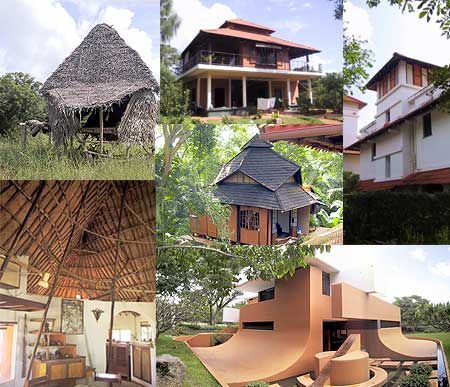
Practicality and
imagination: these two strands informed Auroville's experiments with
housing in the early years. The first settlers looked at what had
already been done by the local inhabitants - huts with mud walls
thatched with coconut leaves or straw - then tweaked it to accommodate
their rather different needs. The result? The Auroville 'capsule', an
airy, lightweight hut resting on granite pillars: it could even be moved
from place to place.
Yet, from the very
beginning, this 'indigenous' line of development was paralleled by a
'visionary' line. The sweeping concrete curves of Last School, the
soaring cantilevered wing of the Bharat Nivas auditorium, the fluid
forms of Auromodèle - all these, in their attempts to herald the new,
the futuristic, paid little attention to traditional materials and
conditions.
Today architecture has
clearly shifted away from the visionary and towards the practical end of
the spectrum. Most of our institutional architecture is bland, and many
Aurovilians live in somewhat featureless houses and apartments. These
changes reflected a number of factors: changes in occupation (computer
work replacing land work), an increased desire for security, cleanliness
and comfort, a new wave of Aurovilians arriving with different
expectations and desires regarding housing. The 'gentrification' of the
capsule was also an expression of Aurovilians' deeper connectedness to
the land, the flip side of which was an increased sense of
proprietorship: 'my house', 'my land'.
In the early days this
didn't seem to matter. Land was scattered over an area of 20 square
kilometers, so there was plenty to go round. Only land bought near the
centre was left vacant or temporarily afforested: it was "for the
future, when the city begins". In the early 1990s that moment
arrived. In an effort to kick-start the urbanization of Auroville, new
land was bought and existing land made available in the Residential Zone
for a number of new projects. Trees were felled, bunds leveled, roads
laid, and settlements like Prarthna, Vikas, Arati, Surrender, Invocation
and Prayatna mushroomed up.
Meanwhile the Development
Group, concerned that the town plan would go by the board and realizing
that Auroville would never reach 50,000 inhabitants if things didn't
change, began drafting planning regulations. Temporary structures were
banned in the city and minimum densities specified for different
sectors. Newcomers were encouraged to buy into the new city housing
projects. Not all of them jumped at the chance. The apartments were not
cheap nor were they designed for children, while many of the new
medium-density communities smacked too much of the urban landscapes
newcomers were fleeing in the West. Suddenly the Greenbelt, which for
years had been viewed by some Aurovilians as a kind of Punishment Park
inhabited by the Red Foot tribe, became desirable real estate. Bemused
greenbelters, clambering out of compost pits, were confronted by
elegantly dressed apparitions in designer sunglasses enquiring about
where they could build their dream houses. Often they narrowly avoided
being composted themselves…
As the population increased,
and the land available and the possibility of constructing one's own
accommodation decreased - the greenbelters were the next to draw up
guidelines, reaffirming the greenbelt was not for development and
defining who could live there - the screw tightened further. At the
mercy of rapidly increasing construction prices, bounced between the
rather different agendas of the Entry Group, Housing Service,
Development Group, architects, developers and Auroville communities,
house-hunters could be seen wandering disconsolately backwards and
forward like disembodied souls.
Some became perennial house-sitters, shifting their belongings every few
months. Others found temporary accommodation with friends or in
storerooms. Aurovilians in dire straits who had been allocated newcomer
housing units refused to move out until alternative accommodation could
be found. Something had to give way. In the event what suffered was both
the authority of the Development Group as a few unauthorized
constructions crept up, and the ideal that accommodation in Auroville
once constructed or purchased could not thereafter be sold or let. It
began as a concession: newcomers to the community who moved into an
Aurovilian's house could deposit the cost of that house in a special
fund, so allowing that Aurovilian to build elsewhere in the community.
However, as this did not allow an Aurovilian to be financially
compensated if he or she left the community, this concession was soon
overtaken by borderline or unofficial transactions which saw people
(sometimes not even Aurovilians or newcomers) purchasing - at
suspiciously high rates - the contents of a house (moveable assets,
unlike fixed assets, are not the property of the Auroville Foundation),
or simply the house itself. Meanwhile the renting out of rooms to
newcomers (coded as "contributions towards accommodation")
became another unofficial means of supplementing Aurovilians' income and
easing the accommodation crisis.
The losers in all this are
those who, like some Tamil Aurovilians and Auroville youth, have nothing
to sell or rent and don't have the means to purchase or rent the
accommodation on offer. The choice for them seems stark: stay here and
live like a second-class citizen in sub-standard accommodation or leave
to earn the necessary funds elsewhere. As for those young Indian
students, full of energy and idealism, who would like to become
newcomers, the message seems to be at present, 'Come back when you've
made your millions'.
There have been attempts to
eliminate the worst excesses of the present anarchic housing situation.
The Funds and Assets Management Committee has drawn up the Auroville
Housing Policy. This reaffirms that all houses, apartments and immovable
assets created on Auroville land are owned by the Auroville Foundation
and therefore there can be no private ownership of houses or apartments
in the community. The Development Group, in its efforts to control
spiraling prices and inequitable housing patterns, recommends a maximum
construction price per square metre for all accommodation in the city,
and specifies 65 square metres as the maximum space allowance for an
individual (a couple are cosily allocated 100 square metres). Meanwhile
the Housing Service attempts to supervise house exchanges, 'sales' and
the allocation of houses which have been vacated. It uses the income
from the 10% surcharge on all new constructions above four lakhs in
Auroville to repair some sub-standard accommodation and even to allocate
new accommodation free to a few fortunate individuals. The newly-formed
Tamil Housing Fund is also trying to raise funds to provide housing for
those with little means who are living in sub-standard or temporary
accommodation (of the 25 or so most urgent cases, the vast majority are
Tamil Aurovilians). The Housing Service also administers the newcomers
housing project which provides some newcomers with temporary housing for
the first two years against payment of a fairly substantial deposit or a
monthly sum. As for the youth, two settlements have been constructed
specifically for them (with the condition that they vacate their rooms
at a certain age), while they may also benefit from housing projects in
which those with more resources subsidize accommodation for those with
less.
At the same time, a number
of supposedly more affordable housing projects are coming up in the
Residential Zone. The problem here is that 'affordable' sometimes means
that the lucky occupant gets to pay for all kinds of unexpected extras
not included in the basic price - like the finishing and infrastructure,
contribution to the Housing Fund etc. - which markedly increase the
final cost.
For many people, the ideal
remains that accommodation of a reasonable quality should be available
for all those who genuinely want to live the experiment which is
Auroville. At present we are far from achieving that. In the short term,
then, it seems the emphasis should be upon ensuring that those
Aurovilians in genuine need, and those with limited means who would like
to join the community, have access to decent accommodation. And this
implies, among other things, that the community needs to be more
creative in its fund-raising, that architects more readily take up the
challenge of wedding beauty to simplicity, practicality and
affordability, and that resources are more efficiently used. Why, for
example, can't more architects share common office facilities? Why isn't
there a central bulk purchasing and storing service for building
supplies? Why is supervision on Auroville construction sites so
notoriously lax? Why is it so difficult for the layperson to get
information about the real costs of construction and the advantages,
disadvantages and costs of different building materials and methods?
And then, of course, there
is the issue of density. So far the Development Group's attempts to
legislate minimum densities for different sectors of the Residential
Zone have resembled King Canute's vain attempts to turn back the waves.
All too often, once the first houses spring up in a new project the new
inhabitants suddenly discover they need more and more space around them.
We all know about the neighbour from hell - and sound insulation in the
tropics is a real challenge. But could it be, at some fundamental level,
that our need for space and for the personalization of our environment
is actually a refuge, a retreat, from the demands of the yoga, or from a
community process in which we have lost trust? If this is so, the
problem - and thus the solution - may ultimately lie more within than
without.
Ah, there's the rub.
October 2002
|