|
September 2002
From the heart of a dry south India
(This is an
edited version of a piece which originally was published in the
newsletter of the Singapore Sri Aurobindo Society)
Joss writes
about Auroville and its environs in the midst of a long hot summer
In thirty summers it
has never been this dry. The Kurrukoppilli seeds fell earlier this
year, the cashew crop was a failure, and there is hardly a mango
on the trees. All morning we were scrambling around in a merciless
thorn scrub forest, searching for seeds and wild animal scats. It
was 43 degrees. At midday we sheltered in the meager shade of an
ancient fertility tree festooned with colourful cloth wish bags
and listened to stories from an old villager who was mending his
fish trap with a vine from the forest.
A scattering of brown
and white quills on the ground indicated the possible drama of a
spiky encounter. When threatened the porcupine rushes backwards at
its foe, impaling it. It can kill a tiger or panther.
There is so little
unmanipulated habitat in this part of the world. We search for
seed and plant material in small mostly degenerate patches of
evergreen forests and scrub jungles. In Auroville the arks of
biodiversity that we have created become more detailed as we wait
for better times when wild, indigenous, natural and sacred will be
appreciated again. Much time is spent dealing with so-called
wasteland, looking out for spaces that nobody really wants, where
we could plant a bit of indigenous vegetation. Good land, for most
people, means it is OK for agriculture, and it seems the word
'cultivation' generally implies a movement away from natural
processes. Anyway, we know that parts of more than one hundred
wild plants in Pitchandikulam are edible without even cooking, and
that still 400 species are used as medicine by people in our
bioregion.
In the early morning
light old squirrel nests sway high in the leafless bamboo.
Everywhere seeds are silhouetted, shining, swelling, falling,
exploding, flying off in the already hot breeze following the
summer rhythms, the pattern language of rejuvenation. Tiny
mosquito size bees swarm around an old log in the forest. The
honey is strong and sour. The powerful antifungal properties in
these wild hives can be used against the terrible monsoon skin
complaints that ulcerate the feet.
A shikra swoops from
its hiding place in the thick foliage of a lepisantis tree. A
lizard is caught in steely talons and a nearby bevy of babblers
scatter hysterically. The jagged patterns of a saw-scaled viper
disappear into a rat hole. It probably ate the occupants and now
lives there. Mother mongoose passes with three trainees in tow.
The little ones stop when she stops, all look around together, one
foot raised, alert. She might have four litters a year.
Choose your programme
I drive the motorbike
to Pondicherry to work with friends redesigning the town's
Botanical Gardens, established by the French some 200 years ago.
Along Mahatma Gandhi road one passes the Golden Hour Trauma Centre
and Dr. Ram's College of Cosmology in between the Virgo Wine Shop
and the old lady sitting on the pavement outside the temple who
has been selling jasmine in the same place for the 30 years I've
been passing by. The show goes on. Water buffalo and
auto-rickshaws mingle with a thousand motorbikes on the
never-ending Indian main street festooned with communist flags,
huge cut-outs of film stars and politicians. All is seemingly tied
together by myriads of mad mingled cables and wires criss-crossing
the street above the awesome silver dish forests of satellite
receptors on every rooftop. A Tamil movie, the World Cup or a
nuclear war...choose your programme.
Later, I meet our Pitchandikulam team together with 50
schoolchildren enthusiastically involved in a village mapping
exercise. A huge multicoloured plan is being drawn on the road
outside the temple. A crowd has formed to debate whether the
information is correct. Someone arrives with a pot of lemongrass
tea and a basket of palmfruit. Since early morning, transect walks
have been done by the children, collecting plants, identifying
trees and places, recording where the skilled people, particularly
the healers, live. We sit under a peepul tree with the village
midwife, and a bright-eyed young man who is a bone-setter,
identifying some 150 plants the children have collected. The
children know many of the medicinal and cultural uses of the
plants. The discussion is animated and interspersed with songs
about the local environment. An old man tells us about the other
bits and pieces that he mixes with plants to make medicines.
Pigeon droppings for chest pain, cow's urine for jaundice, horse
hair for warts, peacock feathers for vomiting and, of course,
everyone knows that hare droppings are good for children's
diarrhea.
Keeping traditions alive
Increasingly,
knowledgeable people who work in laboratories are interested in
this information that old people squatting in a dusty street might
know. We work closely with groups who believe that indigenous
traditions are alive, growing and mutating. It is not simply
bringing back her past, but a deeply serious effort to add depth
and the cultural diversity from thousands of different ethnic
groups of India into the fabric of modern society. Through all
this the thread of the story so often comes back to the importance
of indigenous plants, of conserving wilderness, of creating
sanctuaries and protecting sacred groves with their deities. One
often senses that some of these gods were there before the
agricultural religions were established. Through imprisoning
plants in monoculture systems we have, perhaps, imprisoned
ourselves.
A coppersmith call echoes through the forest that we have nurtured
over these last three decades. When one is quiet and away from the
latest project, it is clear that the nature spirits have always
been here, though it feels they are sometimes a bit wary these
days about modern developing India, pressing in from all sides.
I watch closely the
spider sitting on its orb web, plucking the spokes like a harp. A
difference in tension could indicate a captured prey. To conserve
protein, spiders eat old webs before building new ones. In the
contagion of modern schools, full of uniformed children with
collars, ties and shiny shoes, does the curriculum include a
language of smells? Do the children get taught to touch?
A hare hiding in its
patch of tall grass leaps out wildly when I approach, disturbing a
family of quails as it bounds towards the safety of the forest.
The evening light shines through the defiant new copper-tinged
lagerstroemia leaves. One can hear the tree murmur, "Even if
two monsoons have been a failure, I will endure". The Mother
called the flowers, 'Intimacy with the Divine'. Lightning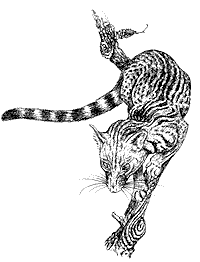 flashes
away far to the north. Soon rest will come to many players in our
magic mystery forest theatre. In the quiet of the evening, away
from the busy dust of the day, it is easier to weave oneself into
a song that celebrates this place, these plants, the soil, the
animals and smaller things, nurturing our own culture and myth,
those dimensions that help us understand our role in the
ecosystem. flashes
away far to the north. Soon rest will come to many players in our
magic mystery forest theatre. In the quiet of the evening, away
from the busy dust of the day, it is easier to weave oneself into
a song that celebrates this place, these plants, the soil, the
animals and smaller things, nurturing our own culture and myth,
those dimensions that help us understand our role in the
ecosystem.
The little scops owl
calls gently, civet cats scramble in the palmyra leaves, all sorts
of wonder waits, poised. Jackals sing in the open field as the
moon rises over Pitchandikulam.
|