|
September 2002
Negotiating Newcomerhood: Highs & Lows
- by Abha
Does one choose
or is one chosen to be in Auroville? What is it like to be a
newcomer? How do Aurovilians respond to newcomers? Do factors of
nationality or cultural perception count at all? These issues are
examined through the experiences of three recent newcomers to
Auroville, one of them being myself, writes Abha
Before joining
Auroville formally, I decided to sound some Aurovilian friends and
acquaintances about it. In a brief visit to Auroville last
October, I went about spreading my message of cheer in the midst
of pre-monsoon showers. Most people smiled indulgently at my
enthusiasm, urging me on. Others, more sober, congratulated me on
my resolve, which had taken eight years to shape. A few, with a
wry twist of their mouths, asked me why, Auroville being amongst
the most difficult of places to live in, did I want to be here?
I remember that
question throwing me off. It seemed unfair that one could be asked
to explain the most important decision of one's life, beside an
assortment of motorcycles parked outside Pour Tous. What does one
say? That I am here because of an unspoken, wordless beckoning
that has been getting stronger over the years? That sometimes,
when I walk here at night, gentle shadows stalk ahead, stepping
carefully over the trees, against the luminous sky? That the
breeze here actually lifts up my spirit like on no other place on
earth? That I believe this is the only place where my inner being
can be manifest? That I feel connected to the Mother and Sri
Aurobindo? That I'm willing to join hands, however different and
tenous that they may be? That I am here for maybe the same reasons
that you are and which cannot be explained?
I had first heard of
Auroville in 1992 while completing my higher studies in Canada.
Surprisingly, even today, not many middle-class people,
particularly in North India know of the place. When I came to
Auroville briefly in 1993, I experienced a strong state of déjà
vu twice in the space of one week. Feeling came in exhilarated
rushes -- I felt in touch with my child self. The sense of
belonging deepened when I came to settle in November 1994, but
within a few months contrary forces were at play within my
personal life. I moved to Pondicherry soon after, with still some
measure of love for Auroville in my heart.
Joining Auroville in
May this year was a turning point in my life, yet it seemed the
most natural thing in the world. I ended my last day of work as a
lecturer in English at St. Stephen's College, Delhi, and bought a
one-way ticket to Madras. While most of my extended family in
Delhi thought of the move as nothing short of "crazy,"
my parents, with their selfless love, wished me luck as I boarded
the train. With my old laptop nestled precariously under my tennis
racquet in the suitcase, and a lot of goodwill, I finally arrived.
Everything that needed to be done happened quickly and quietly in
the space of two weeks. I found work, a place to live, filled the
forms, and got the go-ahead from the Entry Group. Even in the
unrelenting heat of the summer, life seemed wonderful. I happily
cycled my way up and down between Certitude, where I was staying,
and Aspiration for my essentials, and to Surrender for the AV
Today meetings. A colleague and friend offered rides to Bharat
Nivas where I worked three mornings a week. When I received my
newcomer status, I gladly made the rounds, like last year. To
become a newcomer was a badge of courage and faith, a symbol of my
entry into an infinite, boundless journey that I had struggled
hard to reach.
The magic of Auroville
was still palpable but had it really become a more
"difficult" place to live in? Had things changed from
1995 when at the age of twenty-nine, I had left Auroville due to
my broken marriage and had chosen to live near the ashram for the
next three years? Some things were indeed different. Auroville had
a greater international diversity than before - there were
newcomers from Israel, and Kazakhstan, for example, -- but also a
degree of possessiveness about people's personal space had crept
in. Owing to the economic crisis, housing and land had become
contested, problematic issues. There was a better organization and
communication network in the community, but more rigid rules had
come into effect. Many things had become more commercialized, and
more expensive.
How were these changes
affecting other newcomers? I decided to ask some people about
their experiences here, both positive and negative. One of the
first persons I approached did not want his views aired at all.
"It will change nothing, so why bother?" he said.
Another wanted only her positive views on Auroville to be
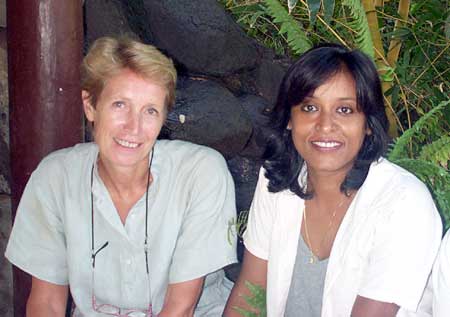
included, not the rest. Finally, I met Valeria and Doris who were
both willing to share their experience of arriving in Auroville,
along with the ups and downs of newcomerhood. It would be fair to
keep in mind that their views are necessarily rooted in the
personal and coloured by their specific cultural and social
backgrounds. Also that they are related to the present moment, and
therefore, not unchangeable or absolute.
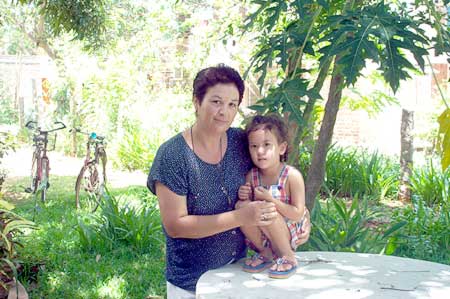
Valeria, an Italian
woman in her mid-forties, had an interesting life before she
joined Auroville. After completing her major in Psychology in
Italy, she travelled around the world on a yacht, visiting 25
countries in the space of 8 years. A trained Ikebana teacher,
Valeria has lived with her husband Kenji for the last fourteen
years in Japan. Last November, they and their little daughter
Monica joined Auroville. Presently, they live in Franca's house in
Auromodele.
Valeria has a strong
sense of belonging to Auroville in an individual, spiritual way.
She realizes that most Aurovilians have intense characters because
they choose to be here and because "it takes courage to be
here." She feels part of the community, but sees little
meaningful interaction and supportive networking between
Aurovilians and newcomers. Aware that her responses to Auroville
are filtered through her experiences as a person with hybrid
cultural traditions with their roots in Italy and Japan, she makes
the strong claim that living in Auroville as "an Italian
woman" is fine but as a Japanese, life is "very
difficult in Auroville. A Japanese person finds it hard to adjust
in Auroville given the high level of respect people give one
another in Japanese society. Many people are friendly in
Auroville, but some are not very polite. One expects educated
people to have a more civil manner of speech especially if they
are working in a service unit in Auroville. Basic terms like
"please," "excuse me," or "thank
you" are rarely used by some individuals here."
Having studied the
Mothers's experiences in Japan before she began her work of
spiritual collaboration with Sri Aurobindo, Valeria believes that
people in Auroville have a lot to learn from Japanese customs and
culture as these had a special place in the Mother's heart.
"Many people in Auroville ask me about Japan. When I tell
them I miss the level of the respect people give to each other in
Japan, they ask me why we have come here!"
Valeria wanted to live
in India since her first visit at the age of 21 in 1978. Still
that did not prevent the wave of culture shock she encountered
after moving to Auroville last year. "Newcomers from outside
India have to deal with many new things on different levels. A new
country, a new culture, a new community, a new orientation . . .
one needs a buffer, a support system which can help newcomers
participate and feel integrated in the community life. Newcomers
should not be made to feel stupid. We may not know too much about
Auroville, but most of us are coming with some life experience
that is as important. Including newcomers in responsible work
activities will boost their self-confidence and feeling of oneness
with the community."
In addition to her
future plans of doing Ikebana workshops in Savitri Bhavan, and the
ARKA residential centre, Valeria hopes to be a contact person for
newcomers one day. "It takes courage to live in Auroville. I
want to be a support for those who come here," she smiles.
Doris, a German layout
designer in publishing, heard about Auroville thirty years ago
when she was working as a flight attendant with Lufthansa
Airlines. Through the "flying network" of international
tourists, and airline staff, one could know about the most
interesting places in the world. "At that time, around 1969,
only two places in India were the most talked about - Pune and
Auroville." When Doris heard about the Auroville Charter she
was interested but thought at the same time that, "it was an
outrageous dream, which seemed difficult to manifest." Her
marriage to a pilot and their hectic work lives kept Doris busy
for the next couple of decades. Auroville receded into the
background, becoming nothing more than a distant, unlikely dream.
Last year, however, when Doris and her yoga teacher were deciding
on a place to visit together, Auroville suddenly came to mind. It
seemed the one place that Doris had not been to. Having traveled
virtually the whole world, and having ended her marriage, Doris
felt ready for a new experience that would offer her the freedom
to "start from scratch." Before visiting Auroville in
December 2001 for a period of three months, Doris went through all
the information on the Auroville website. After a wonderful time
in Auroville during which Doris made the decision to come back for
good, she went back to Germany to arrange the final move. Before
returning to Auroville in April this year in order to begin the
newcomer process, Doris went through a detailed study of all the
website information available on the Auroville housing situation.
Excited by the prospect of being able to secure accommodation
within a few weeks of her arrival, Doris was surprised at the
discrepancy between what was on the net in the year 2001 and the
actual situation in Auroville. "The housing policy had
changed completely! Also, there are still no clear-cut guidelines
as to exactly how much a newcomer needs to pay for the total cost
of a house. There are various percentages that are added on to the
basic costs, and then there are the other costs that are not
listed at all and that come as a nasty surprise for the person who
is expected to pay."
As a response to her
own somewhat difficult experience of getting a house, Doris, with
the help of Charles, a long-term guest, and Volker, who works with
the Housing Service, is compiling information on the basic steps
to putting a house together in Auroville. In addition she is also
researching all the experimental housing which have been
constructed in Auroville. These results will be posted on a web
page. Doris is also working as a layout designer for AVToday, in
addition to teaching quilt-making to young Tamil children in New
Creation school. "Organising an improvised hand-sewing class
with incomplete materials to a group of enthusiastic children has
been really rewarding," she says. "It is like making the
best out of nothing."
For newcomers and
Aurovilians alike, that is one of the joys of living in Auroville,
despite it being a difficult place. There are limitations of all
kinds and yet new dreams continue to manifest themselves,
sometimes, virtually out of nothing.
|