|
September 2002
The Sacred Tie
by Sunaura
Within the complexities of Auroville's cultures, the traditions of
the Tamil people predominate. Their lives, whether Aurovilian or
not, intertwine with all who live in this township.
Amongst the many
ceremonies and rituals of the Tamil culture, marriage overrides
all others in the development and growth of each village. It is
through marriage that family and community structure is built, a
support system that eludes many western societies.
 Although
"love" marriage is a concept more commonly accepted
today, arranged marriages are still practiced to the larger degree
in this area. Unlike in the Western tradition, marriage is not
something that waits years to be discussed. When a Tamil child is
born, her marital destiny begins to be carved out for her. Within
the large extended families of Tamil Nadu (and they can be very
large), a child's birth is discussed and possible marriage
proposals are taken seriously. It is not yet a time for papers or
astrologers, yet spoken words between family members can hold a
strong commitment. Although
"love" marriage is a concept more commonly accepted
today, arranged marriages are still practiced to the larger degree
in this area. Unlike in the Western tradition, marriage is not
something that waits years to be discussed. When a Tamil child is
born, her marital destiny begins to be carved out for her. Within
the large extended families of Tamil Nadu (and they can be very
large), a child's birth is discussed and possible marriage
proposals are taken seriously. It is not yet a time for papers or
astrologers, yet spoken words between family members can hold a
strong commitment.
Over compliments on
the beauty of a daughter or strength of a son, mothers and fathers
will match their newborns to suitable future spouses. Many look
for matches within their own lineage. Typically, the boy will be
two to three years older than the girl. If marrying a cousin, he
must be either her father's sister's child or her mother's
brother's child.
Consequently, as she
grows up, the young bride often knows about her husband to be. Her
girlfriends, who may envy her position, might tease her. Or she
and her friends might find this boy entirely disagreeable.
Sometimes, the girl romanticizes about her marriage only to have
the outcome change when the time has come. Many factors are
reconsidered when the girl reaches puberty. Did the boy's family
lose or gain status in the community? Is there a better match for
their daughter? What dowry will be expected? "You don't know
what is in the mind of the girl when she comes and sits on the
dais for marriage. She will have gone through so many stages in
her life before accepting the hand of this boy," says
Meenakshi, a long-time Aurovilian who works extensively with the
Tamil community.
When the boy's family
is interested and the girl has come of age, a relative, friend or,
on rare occasions, a broker, will approach the girl's family and
ask for her horoscope. The Tamil people follow the lunar calendar
and the horoscope plays no small role in marital matches. Through
a special horoscope reader, (today it is not unheard of to use the
computer to interpret the information), the boy's family will
determine if this girl will have a healthy life, be obedient,
bring good luck to their family, bring Lakshmi (prosperity) with
her, have healthy children…etc. "For the boy," says
Meenakshi, "the horoscope is secondary."
Once the boy's family
approves of a girl's horoscope they (the family with elders) will
visit the girl's family to talk about property, family relations
and will then agree upon an engagement. "There is a demand
from the girl's family for around Rs.10,000 for the girl's sari
(marital dress). Both families go to the shop and examine
everything. One of the elders may say 'Oh! I am not happy about
the color.' So they step out into the street to examine the colour
more closely. Each family may have a certain color preference. The
girl's family may say, 'in our family blue is good' and the boy's
family will say, 'no, in our family we prefer to have red.' So
they make a compromise and end up in purple." The elders must
be happy with the choice of sari even if the girl will only wear
it once in her life and then keep it as a memorial. Typically, the
boy's family will purchase three saris for the girl. The marital
sari is made from silk and is the most expensive, but the other
two also hold great importance. One is for the engagement and the
other is a simple red and white cotton sari for the morning
marriage ceremony. This simple sari will later be used for her
baby's cradle or be given to a female relative from her husband's
family.
Engagement ceremonies vary in size. Today, they often take place
in a rented hall with a large audience. But smaller ceremonies at
home are still practiced. The most important aspect of the
engagement ceremony is choosing the date of marriage. The Brahmin
who plays an important role in both the engagement and the
marriage does this. "There are two months in the year that
should exclude marriage ceremonies," says Meenakshi.
"December 13 to January 13 is devoted only for prayer and
Lord Shiva. During this time any ceremony to do with material life
will be postponed." The other month, a time known as
Adimasham, falls between mid July and mid August. The most
auspicious time to marry are the months after Adimasham and the
month devoted to Lord Shiva. "When the Brahmin sets the
marriage date," explains Lakshmi, a Tamil Aurovilian who
married at the age of fifteen, "it will either be in the same
month as the engagement, or the third month, fifth month or
seventh month. Never will it fall on an even number. Also, the
marriage is always during the growth of the moon. And never when
there is no moon." The hour of marriage is another important
aspect. Though always in the morning, the hour for the actual
marriage commitment depends on which day the marriage is conducted
on. To illustrate this, Lakshmi showed me her calendar, which not
only has days, months, and lunar settings, but also the time for
marriage on each day marriage is possible.
The days preceding the
marriage will include prayer, pujas and trips to the temple. On
the morning itself, the size and luxury of their marital hall
symbolizes a family's status. The cost of hiring a marital hall
can range from Rs.2,000 to Rs.20,000 or more. "In the olden
days or in remote villages," explains Meenakshi,
"everybody participates. In some areas the bridegroom is
brought in procession - in some it is the bride. Every house owner
will come and greet them in their chariot or open car. The
welcoming ceremony introduces the boy or girl to the village. But
now, they often marry in a hall in town and make a procession
through the streets, jamming the traffic with everybody
scolding."
As a Westerner
attending a marriage, I have been amazed by the organized chaos.
Unlike the silent rows of collected onlookers in the West, an
Indian marriage is full of action, laughing, talking and
celebration right through the ceremony. Both families will be
involved in different preparations and certain rituals. Loud drums
often drown out the happy cries of children, while jasmine and
local flowers fill the air with a thick aroma. "The most
symbolic thing in a Hindu marriage," explains Meenakshi,
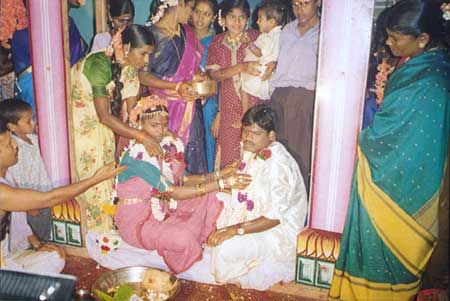
"is the tying of the Thali, also known as 'Mangalyum'. The
Thali is traditionally made of a particular yellow rope though
many Thalis today are made out of gold. The entire marriage
ceremony revolves around this auspicious moment (which the Brahmin
will indicate), when the boy ties the Thali around the girl's
neck. This gesture implies that she is now tied to his community
and now takes responsibility to uphold the ethnic, cultural
position and status of his family.
An anthropological
study states that the Thali represents a tiger's nail or claw.
"When there were still jungle people, the women preferred
only the strong men. Those who spirited the tiger and brought the
nail to a maiden were considered a good choice and it was an
honour for the girl to choose such a courageous man." Today,
the Thali is a symbolic representation of the history of its
caste. So, when one sees a Thali, they know what caste or religion
the family is."
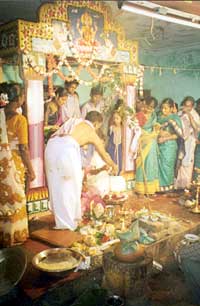
During the marriage
ceremony there are four clay pots. Two are painted while two
remain plain. While the boy ties the Thali, water is poured from
the two plain pots into the two decorated ones. After the
marriage, the bride and groom go to the river or pond. There the
woman will fill each pot with water, representing the eternal flow
of life. The man will plant seeds and the bride will feed her new
husband rice and beetle leaves. This is symbolic of the work ahead
(once, commonly, fieldwork) and the woman's commitment to support
and nurture.
The boy then takes his
bride to his family where they receive blessings and gifts. Then
they will go together to the girl's home where they may stay for a
day or a week. They then return to the boy's home. After some time
a family member from the girl's side (usually an uncle or brother)
will come and take the girl back to her parents' home. And
finally, the young groom will go to retrieve his wife and together
they will walk into the life ahead of them.
|