 |
|
|
|
Home > Journals & Media > Books & CD's > Shikra > A tree for the Gods |
A Tree for the Gods |
|
|
"This tree," the first man said,
"its wood won't burn, it can't be used to make a fire." Then the wisest of the wise men pondered over the
question. "Ah ah! Ama! True wisdom! No problem!"
they all agreed.
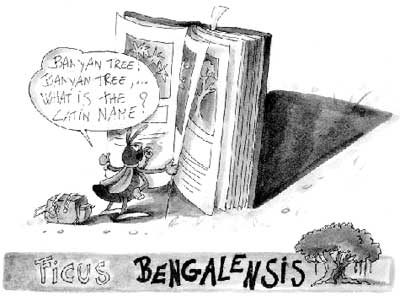
Most of us know the Banyan Tree… Do you remember if the flowers were yellow? Red? Purple with green spots? Pink? We do know the tree has fruit; little balls that
look like ripe cherries. They grow in pairs along the leaf axils. During
fruiting season the tree is filled with hundreds of birds. We know that all fruit must have a blossom - or do they? Sometimes the Banyan fig is called a fruit without a flower. This is nonsense of course. But- where are the blossoms? You will need better eyes than even our Shikra hawk to find a Banyan flower. That's because they are hidden inside the fig. The blossoms are very small and hundreds of them spend their entire lives inside the fig. The flowers have a unique friend called a fig wasp. Each kind of Ficus (fig tree) has its own special species of wasp attached to it. The wasp's job is to pollinate the fig flowers. The wasp enters the fig through a natural hole in
the top and lays its eggs. When the insects hatch and leave their home
they become covered with pollen. Then they make their way into another
fig and fertilize its blossoms, making sure it will produce seeds.
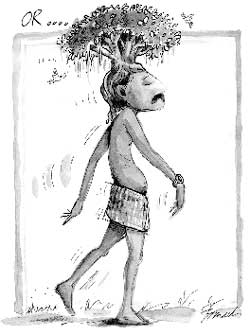
Most of the Banyan trees in Auroville started their lives high up on the trunk of a Palmyra. Why? And how did it get up there? It was planted by a bird. A bird ate a fig and made a dropping on the Palmyra. Of course it could have landed on a temple roof or a rock or… The dropping cemented the seed to the wall of the tree. If you observe carefully you might find a seed just starting to send out tiny hair-like roots. These minute aerial roots will become stronger and
thicker and cling to the trunk of the tree. Eventually the roots will
completely envelope the Palmyra and can even strangle the host tree. But
in the embrace of the Banyan the two can co-exist for many years, or
until the Palmyra grows old and dies. The Banyan grows wide spreading branches that send down aerial roots, like clumps of rope, until they enter the ground and become trunks. So the tree widens and covers a larger and larger area. One famous Banyan was said to be 600 m. around. It was so big that 20,000 people could all shelter at once in its shade. The Great Banyan of Calcutta has one thousand trunks and a walk around the tree is almost a quarter mile long. It is one of the biggest trees in the world. The Banyan is indigenous (native) to south India,
but it can now be found all over the country.
A bird ate the fig and made a dropping on a tree.
Of course it could have also landed on a temple roof, or on a rock or…
This very special tree, The Banyan, was chosen by the Mother to be at the heart or center of the Auroville Township, and she called the center 'Peace'.
|
|
|
Journals & Media > Books & CD's > Shikra > A tree for the Gods |
| Auroville Universal Township | webmaster@auroville.org.in |   |
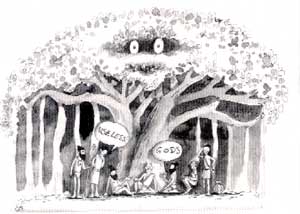 Many years ago, in fact so many years that no one
remembers if it was hundreds or thousands of years or even longer, a
group of village wise men had a debate on the merits of the Banyan Tree.
Many years ago, in fact so many years that no one
remembers if it was hundreds or thousands of years or even longer, a
group of village wise men had a debate on the merits of the Banyan Tree.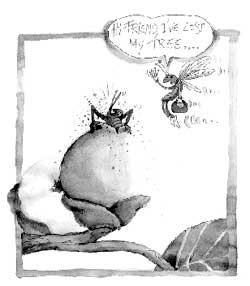
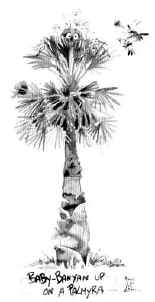 Now that we have found the flower let's try and
find a baby Banyan seedling.
Now that we have found the flower let's try and
find a baby Banyan seedling.