 |
|
|
|
Home > Research > Appropriate building technology > Building with earth |
Building with earth |
||||||||||||||||||||||||||||||||||||||||||||||||||||||||||||||||||||||||||||||||||||||||||||||||||||||||||||||||||||||||||||||||||||||||||||||||||||||||||||||||||||||||||||||||||||||||||||||||||||||||||||||
|
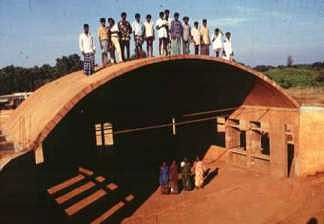
1. The Auroville experienceDifferent trials in earth building have been attempted in Auroville with varying success. In 1989, with the creation of the Auroville Building Centre / Earth Unit and the construction of the Visitors' Centre, a new era in earthen architecture started. This Visitors' Centre, of 1200 m², used Compressed Earth Blocks (CEB) and demonstrated the possibilities of earth as a quality building material. After that, many more projects blossomed: individual houses, clusters of houses, apartments, schools, and the Solar Community Kitchen designed for 1,000 people. The earthen buildings presently amount to 20 to 40% of the total number of buildings constructed in Auroville. The diversity and quality of techniques and know-how has increased; and thus the demand for and general recognition of the value of this natural building material has risen. Its economic advantage, comfort quality and flexibility is now well established. The Auroville red soil makes for aesthetically pleasing buildings. It gets its colour from iron oxides, the properties of which enhance the already rich composition of this remarkable building material. Some may say, "Using soils for building will lead to the destruction of nature..." True, if it is done unconsciously, without knowledge; but wrong if one is alert to proper management of resources and the natural balance thereof. The Auroville Building Centre / Earth Unit lays emphasis on the management of resources, where the quarry is planned first, so as to be integrated in the processing of every development. First of all, one should scrape away and put aside the topsoil, which can be re-used later for agriculture or gardens. Two types of quarries may be developed: deep ones which can be used later on for water harvesting, pools, percolation systems, or shallow ones which can be used for landscape design, work or play areas, gardens and also percolation features, etc. 2. Compressed Earth Block (CEB)Today, Compressed Earth Block technology is the widest one used worldwide, as well as in Auroville, because it represents a synthesis of traditional practice and modern technology. It is also benefitting from scientific input. In Auroville, the average results obtained with CEB at 5% cement are (±) 50 kg/cm2 (5 Mpa) for the dry compressive strength, and (±) 9% for the water absorption. Local fired country bricks are at (±) 35kg/cm² and (±) 12%). The Auroville Building Centre has designed a press for CEBs, which is manufactured by Aureka, and sold in India, Africa and even Europe. 3. Rammed earth (PISE)This technology was used traditionally in countries like France, Morocco, northern India and Tibet, and is today used with stabilisers in USA and Australia. Pisé is rammed in forms either manually or pneumatically. Until 1995, Auroville had only one house in raw rammed earth. AV-BC / Earth Unit designed slipping forms adapted to Indian conditions for building the 600m² of Mirramukhi School with stabilised rammed earth. Since then, the demand has risen for houses, workshops and other developments using this technique. 4. RoadsAV-BC / Earth Unit is conducting research on soil stabilisation adapted to tropical climate. The aim is to implement roads, where the sub-grade courses and the wearing course are done in a single course, so as to reduce the construction process and cost. The challenge for Auroville is how to implement a quality road with little means and without the usual, incredibly heavy machinery. 5. Buildings, from foundation to roof
|
||||||||||||||||||||||||||||||||||||||||||||||||||||||||||||||||||||||||||||||||||||||||||||||||||||||||||||||||||||||||||||||||||||||||||||||||||||||||||||||||||||||||||||||||||||||||||||||||||||||||||||||
|
The
moisture measured with an electronic hygrometer gave these
results. |
MOISTURE |
After
402mm rainfall in 5 days |
2
weeks after rainfall, under sun |
||
|
Outside |
Inside |
Outside |
Inside |
||
|
Vault |
100
% |
31.
6 % |
19.
4% |
22
% |
|
|
Window
sill |
59.
8 % |
27.
8 % |
20
% |
21. 8% |
|
It's sometimes said that building with earth is more expensive than building with conventional fired bricks. Probably people are confusing the cost of masonry with the final cost of building, which implies so many variations in design and finish, and which includes the quality of the site management as well as the skill of the builders.
The following tables give interesting information on this issue.
|
|
Wire
Cut Bricks |
Country
Fired Bricks |
Compressed
Earth Block (CEB) |
Rammed
Earth |
|
Size
of brick (cm) + Volume |
23x11x7.3
= 1.95 lt. |
20.5x
10x 6.3 = 1.29 lt. |
24
x 24 x 9 = 5.18 lt. |
(Cast
in situ) |
|
Weight
of brick |
3.4
kg = 1750 kg/m³ |
2.2
kg = 1700 kg/m³ |
9.6
kg = 1850 kg/m³ |
1850
kg/m³ |
|
Stabilisation |
Fire |
Fire |
5%
Cement |
5%
Cement |
|
Cost
per unit on site |
Rs.
1.50 |
Rs.
1.25 |
Rs.
4.00 |
- |
|
Wastage |
4% |
15% |
5% |
4% |
|
Units
per m³ (raw material) |
541 |
774 |
193 |
- |
|
|
||||
|
Mortar
used |
1
Cement 6 Sand |
1
Cement 6 Sand |
1
Cement 6 Sand 6 Soil |
- |
|
Qty.
of Mortar / m² of Wall |
61
lt./ m² |
72
lt./ m² |
36
lt./ m² |
- |
|
Units
per m² of wall |
87
(1.5 cm mortar) |
112
(1.5 cm mortar) |
40
(1 cm mortar) |
- |
|
Daily
output per team |
350
B = 3.65 m² |
500
B = 4.46 m² |
170
B = 4.25 m² |
8
m² |
|
Pointing
output (m² / day) |
4
m² |
4
m² |
5
m² |
- |
|
|
||||
|
Cost
of 1 m³ of raw material (Including
the waste ) |
Rs.
845 / m³ |
Rs.
1115 / m³ |
Rs.
810 / m³ |
Rs.
810/ m³ |
|
Cost
of mortar per m³ |
Rs.
1135 / m³ |
Rs.
1135/ m³ |
Rs.
610/ m³ |
- |
|
Cost
of wall per m³ |
Rs.
1520/ m³ |
Rs.
1700 / m³ |
Rs.
1215 / m³ |
Rs.
810 / m³ |
|
Cost
of wall per m² |
Rs.
345 / m² (23
cm. thick) |
Rs.
348 / m² (20.5
cm. thick) |
Rs.
295/ m² (24
cm. thick) |
Rs.
195 / m² (24
cm. Thick) |
|
|
||||
|
Pollution
emission (CO²)* |
39
Kg / m² |
126
Kg / m² |
16
kg / m² |
16
Kg / m² |
|
Energy
consumption (wall)* |
539
MJ / m² |
1657
MJ / m² |
110
MJ / m² |
110
MJ / m² |
|
Dry
Crushing Strength |
(±)
90-120 kg/cm² |
(±)
30-40 kg/cm² |
(±)
40-60 kg/cm² |
(±)
40-60 kg/cm² |
|
Water
absorption |
9
– 11% |
10
– 14% |
9
- 11% |
8
– 10% |
|
*
Source: Development alternatives, New Delhi – 1998 |
Value October 2000: 1 US $ = ± 42.5
Rs. |
|
Country fired brick is also called
village brick |
Wire cut brick is also called kiln-fired brick. |
|
The material cost includes the delivery
on site. The
CEB price is the production cost on site. All costs are cost
price. |
|
DATA
|
||||||
|
Sand = 700 Rs./ 4.5m3 lorry
Þ 200 Rs./ m³ sieved |
Mason |
= 120 Rs./ day |
Team for bricklaying |
= 1 mason, 2 helpers (M +F) |
||
|
Male helper |
= 65
Rs./ day |
Team for
rammed earth |
= 5 labourers |
|||
|
Soil = 50 m³ dug &
sieved |
Female helper |
= 40
Rs./ day |
Team for CEB making |
= 9 block makers |
||
|
Cement = 155 Rs./ bag (L & T – 53 grades) |
Labourer |
= 67
Rs./ day |
Team for pointing |
= 1 male helper |
||
|
RE labourer Block
maker |
= 75
Rs./ day = 75
Rs./ day |
|
|
|||
|
|
||||||
|
|
||||||
SUMMARY
|
||||||
|
MONETARY
COST |
STRENGTH |
ENVIRONMENTAL
COSTS |
||||
|
Per m3, a finished CEB wall is 28.5 % cheaper than country fired bricks. 20 % cheaper than wire cut bricks. Per m3, a rammed earth wall is 33.3 % cheaper than a CEB wall. 52.3 % cheaper than country fired bricks. 46.7
% cheaper than wire cut bricks. |
CEB and rammed earth are: 42 % stronger than country bricks. 52
% weaker than wire cut bricks. |
CEB
and rammed earth present: Pollution
emission 2.4
times less than wire cut bricks. 7.8
times less than country fired bricks. Energy
consumption 5
times less than wire cut bricks. 15
times less than country fired bricks. |
||||
Building with earth is definitely an appropriate and cost & energy efficient technology that has a great future. However, one has to master the disadvantages of the material. These are usually caused by variations in the soil quality, and hence the block quality may suffer. Bad quality soil can give relatively poor characteristics (when compared to concrete) and shrinkage cracks may occur.
Among the advantages of earth as a building material, one observes:
Earth is a local material, contributing to sustainable development.
Production of the building components utilises a lot of semi-skilled manpower.
The technology is easily adaptable and transferable.
The energy & monetary costs are much lower than with most other materials.
The thermal comfort and 'vibratory' atmosphere are very positive.
Obviously, one has to master the materials and techniques so as to obtain the optimum possibilities with a harmonious, durable, agreeable and efficient architecture!
Nevertheless, the following drawbacks have to be considered:
Mechanical qualities less regular.
Sensible building details.
Constraint to organise and manage the production of one's own building material on the site.
Building with earth has a great past, but also a promising future, especially in Auroville. It is a true challenge to realise an architecture full of light, suppleness, simplicity, imagination and beauty with a dark, heavy and formless mud. In Auroville we're working on it.
|
Research > Appropriate building technology > Building with earth |
| Auroville Universal Township | webmaster@auroville.org.in |   |