 |
|
|
AuroAnnam -
|
|||||
|
See also AuroAnnam organic food
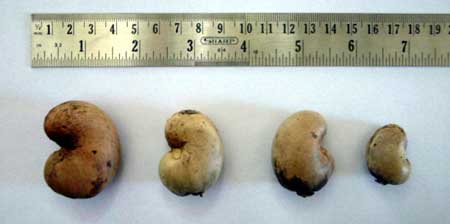
Cashew nuts.. how to get to them
|
Organic Cashew Nut Cultivation
They tell us the following:
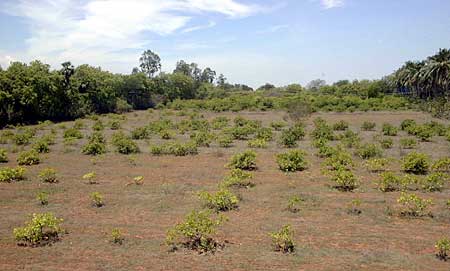
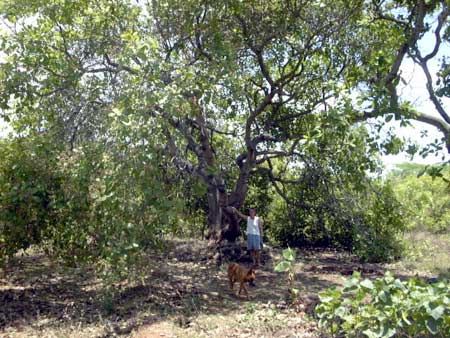
Parameters as per June 2001The total area of the farm is 14.5 acres, of sandy
loam soil texture, of which 4 acres have been under cashew for the past
30 years. There are also 72 coconut palms. Previously some of the land
had been used for irrigated cultivation of soya, peanuts, gram and cow
fodder, but this had become economically unsustainable. Later, an
additional six acres were put under cashew (total today 639 cashew
trees). Flood irrigation has been drastically reduced.
Effective Micro-organism (EM) TechnologyMany people, mainly from Europe and India, visit Auroville throughout the year. Auroville is a kind of laboratory for different workshops: architecture, organic farming, sustainable agriculture, city planning, seed bank, renewable energy, etc. These visitors who visit AuroAnnam farm all come into contact with EM Technology and other farm practices. Students from different universities in the USA, France, Holland and Germany have had internships in AuroAnnam farm, and there they learn about EM Technology. Lucas is in contact with Indian NGOs working in the field of sustainable agriculture, and Margarita maintains links with Auroville farmers practicing different farming systems.
Definition of Organic Farming (OF)We here present the farming practices which have been developed and used over the last two years at AuroAnnam, practices which are under continuous scrutiny and will undergo further changes so as to achieve optimal ecological and economical benefit. The authors welcome feedback based on experience and on-farm research. The objective of OF as we understand it is the production of optimally nutritious food, free from contaminants and toxins as far as possible, and grown under conditions which ensure long-term soil fertility and bio-diversity and benefit the wider environment. BD, EM, vermicompost, homeodynamic, agnihotra,
rock dust Management of soil fertilityIn OF, where the use of chemical fertiliser is out
of the question, soil fertility depends on an input of farm yard manure
and/or compost. Other OF practices are mulching and green manuring. Horn manureWithout having ourselves experience in assuring long-term fertility, we rely on an OF experiment which is ongoing in Switzerland and which has demonstrated that bio-dynamic (BD) practices have the best results (in comparison with conventional chemical and general organic practices). We practice the sprinkling of the biodynamic preparation 'horn manure' (so-called BD 500). Bio-dynamic teaching recommends at least two applications in the first year, and in later years at least once a year. We are completing the second year of BD practices, and administer BD 500 at least thrice per year in the area defined as BD. EM BokashiThe microbial inoculant EM is available as extended stock solution, which is the most potent, but has a limited shelf life as regards its optimal impact. EM extended stock solution is ready for use by the farmer and gardener. Bokashi is the Japanese word for fermented mulch, and EM bokashi uses EM as its ingredient for controlling the fermentation. EM bokashi can be used together with EM-soaked charcoal and applied in pits under the canopy of the cashew trees. EM can also be used together with Fermented Plant Extract (EM-FPE). As regards EM bokashi, we aim at providing about two or three bullock carts per acre i.e. about two tons of well-fermented mulch. EM needs moisture. This means that all EM preparations should be kept moist or should be brought out on the land if there is rain; preferably mild rain, which helps distribute the microbes without washing them away. VermicompostVermicompost has been described as a compost of
ideal nutritional balance. If vermicompost is available or can be made
in large quantities, there seem to be no limits to its use. Weed controlConventional cashew farmers use bullock-drawn or tractor-mounted ploughs to control weeds in between trees and under their canopies. As ploughing destroys the superficial hair-roots which are important for the uptake of nutrients from compost and the intake of surface moisture, and as each ploughing causes a loss of 1 mm of topsoil i.e. of 6.4 tons of mineral per acre, ploughing cannot be regarded as the ideal technique for weed control. Mulching and growing a leguminous green cover are obviously the better choice, dependent on whether mulching material is available in sufficient quantity. Management of plant health / pest controlIf there is good topsoil with balanced nutrients and good microbial activity, the health of a plant is expected to be generally good, to some extent also fit for fighting off diseases and pests. Beyond this, injuries to the trees are to be avoided. If they occur, bark paste should be applied over the wound surface. This bark paste may be made of dry cow dung, bentonite, CPP or BD 500, EM-FPE, EM5 and BD liquid fertiliser or rainwater. This prevents infestation by the root and stem borers which are attracted by the smell of the fresh cut wound and seem to prefer to settle in injured trees. Some of the ingredients used:BD 501, BD liquid fertiliser of casuarina, Management of plant and of yieldWell-matured compost, vermicompost, BD 500, CPP and EM, are expected to ensure good general health of the plants without nutritional depletion or one-sidedness. Foliar sprays:BD 501, Cashew nuts should ideally be harvested when they fall from the trees; only then the kernel can be expected to be fully matured, with a smooth surface. Traditional organic agriculture in India and BD farming take astrological data into account for the timing of cultivation practices such as sowing, ploughing, weeding, harvesting, and the administering of inputs. Management of water resourcesIn general we cultivate under rain-fed conditions so as to keep our practice comparable with the practices of the surrounding cashew farmers. However, in some trees, we have started experimenting with the following technique: during the dry season (on the Coromandel Coast normally between December and July) we dig two pits per tree of about one cubic foot and fill them with EM-drenched charcoal and EM bokashi; every two months we replenish the EM load with two litres of extended EM solution. 'Diking' and mulching'Diking' around the tree - along the drip line of
the canopy - is said to be capable of increasing the yield by up to 45%.
We have started experimenting with this water catchment technique.
Appendix, literature:
|
||||
|
Research > AuroAnnam R&D farm | Cashew nuts.. how to get to them |
| Auroville Universal Township | webmaster@auroville.org.in |   |