|
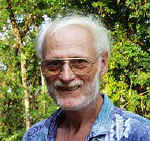
Manfred Lehnert, who hails from Germany, joined
Auroville in 1993 and is working on a variety of research and
development projects. Manfred has a Physical Engineering Diploma from
Germany topped with decades of practical experience in the design of
engine components and other engineering projects, cryogenics (working
with liquid helium), vacuum technology, silencers for cars and
motorbikes, reactors/catalysers for cars, water heating systems, welding
and soldering techniques and anti-corrosion systems.
In Auroville, Manfred is presently working on the
following four projects:
(1) Solar sea water desalination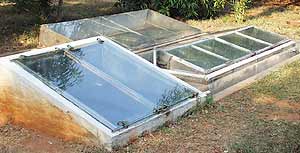
Today Auroville's potable water sources are
becoming increasingly polluted by industrial waste and untreated sewage,
and in the coastal zones by intrusion of sea water. Manfred's research
aims at obtaining drinking water from polluted or saline water by solar
distillation. The use of two inexhaustible sources of water and energy -
the sea and the sun - is well known, and has been applied since 150
years in, for instance, Chile. The design is simple: a glass house
covering a basin with sea water. The sun heats up the water, which then
evaporates and condenses against the inside of the cooler glass roof,
finally trickling into a distiller catchment
As of today, three prototypes have been installed
in the Petite Ferme settlement, occupying altogether 6 sqm. The first
results are encouraging. Every square metre can give 3-5 litres
distilled water daily, which can be used for batteries and his soap
production (see below). The beach area would be ideal for installing a
bigger solar sea water desalination plant, involving an area of 100sqm,
200sqm or even 500sqm. For example, 100 sqm could yield 150,000 litres
distilled water annually. But before building such a big plant further
research is necessary.
(2) Biodegradable soaps & cleaners
Manfred's biodegradable liquid and solid soaps and
cleaners are made from plant oils such as palm, coconut or pongam oil
and natural essences, and can replace the harmful chemical washing
powders generally available on the market. These natural soaps have the
same cleaning result, and keep our environment healthy. They contain no
synthetic detergents, bleaching powder, enzymes or other chemicals. The
living organisms existing in our waste water treatment plants will not
be disturbed by their use.
Manfred now produces natural liquid soap and a multi-purpose cleaner for
floors, toilets, wash basins, etc. These are available to the
Aurovilians through Pour Tous. Other soaps are still in development.
(3) Plant oil as a substitute for harmful diesel oil
Manfred has been experimenting with cultivation of
the Kurinjee tree, whose pods give kuringee oil, which on filtration and
viscosity reduction can directly substitute for diesel in diesel
engines. Some of these experiments have been conducted in Dual Fuel
engines run on biogas/producer gas by Dr.U.Srinivasa of SUTRA project at
the Indian Institute of Science in Bangalore, with whom Manfred is in
regular contact. Experiments in such
substitutes and blending have been going on throughout the world since
the 1940s, but are only now finally drawing serious attention.
His project aims at promoting the production and
application of a renewable bio-degradable plant oil from the indigenous
'Pongamia pinnata' tree to replace the harmful, non-renewable fossil
diesel oil at a reasonable cost. Use of this alternative could reduce
CO2-emission (responsible for global warming) and air pollution (it
contains no sulfur and creates no particles such as soot). This plant
oil is bio-degradable, and therefore presents no danger to soil or water
through leakages during transport, storage, etc. It can also become a
substitute for chemical fertilisers when using the oil-cake as an
organic fertiliser. The sale of these oil cakes can help to reduce the
oil price.
It is a renewable source of energy which can be
used without sophisticated technical preparation, and can be locally
grown on wasteland, along roads and as fencing. It needs little
financial input, makes use of the local oil processing capacities, and
finally can generate employment for the rural population. Moreover, it
could provide an eventual solution for the expected exhaustion of
mineral oil at some point in the future.
The project would include the planting and
cultivating of the oil bearing trees in Auroville, as well as the oil
processing and distribution of the bio-fuel within the township and its
environs. Additionally, the monitoring of the concerned engines and
possibly the measuring of the exhaust gases would be undertaken.
4) Low cost light roofing components
The aim is to develop lightweight, low cost 'fibre
reinforced concrete' (FRC) roofing tiles as an alternative to asbestos
products. Manfred, who works on this with his partner Dorothee, gives
the following advantages for this material:
-
There is no need for sophisticated technology,
therefore initial investment is low.
-
Low energy consumption for production.
-
Because of the light weight of the roofing
material, its supporting structure can be cheaper.
-
Use of environmentally friendly, locally
available material.
-
Small scale fabrication for local use can
generate employment for unskilled labourers.
-
Climatically advantageous, because the very
thin tiles do not store the heat: therefore the rooms will cool down
fast in the evenings.
-
Use of colour pigments to create greater
variety of materials (lighter shades will reflect the heat better).
The first samples, 45 x 45 cm roofing tiles, are
encouraging.
|