|
|
|
Auroville Language Laboratory |
|||||
|
|
|||||
The Language Lab moved to Last School Campus
The ALL team has set the space up with a lovely and inviting classroom, a mediatheque with computers giving access to a range of audio-visual material in different languages, a library area for self-study, and outside teaching spaces.
Opening hours are
are 9 am-12.30 and 3 - 6pm and all are welcome. |
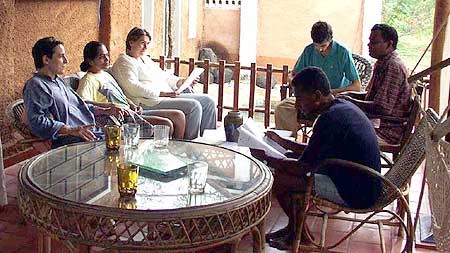
Since October 1999, several Aurovilians who teach languages to adults have joined together to create a proper Language Laboratory here in Auroville. Not to be put down by the struggle of teaching in this singularly under-funded sector of Auroville education, a base group of teachers united their efforts to conceive 'ALL', the Auroville Language Laboratory. ALL is an attempt to realise a common dream and to address a real need to provide proper language education for adults. It bring teachers together in a free and non-institutionalised atmosphere to work together across languages, in the here and now, as well as to realise the goal of creating a building which will become the hub of language education in Auroville. The base group has since expanded and is continually expanding with everyone free to contribute their energies in any way they can…
Those who are interested to see the shape it is taking, please feel free to view the ALL proposal. You can do this by clicking on the links given on this page, choosing the language preferred. The proposal will soon be available in Italian, Spanish, Russian and German.
Auroville Language Laboratory,
Tapas Desrousseaux, Mita Radhakrishnan, Coordinators
Centre Field, Auroville
Tamil Nadu - 605101
Email : mita@auroville.org.in
The present activities in each language are given here.
The languages most widely studied in Auroville are Tamil, Sanskrit, French, English. Teaching is conducted regularly by professional teachers in these four languages for beginners, intermediate and advanced levels, for individuals and groups.
The exact number of students, unlike in the case of schools, is difficult to estimate in the case of adults. The nature of life and work in Auroville causes the number of students in any particular class to change quite often. Adults fit language classes into already busy schedules; they sometimes cannot continue regular study due to other pressing reasons, and often stop only to continue later when they can.
Classes take place all over Auroville - at ad-hoc spaces offered or at teacher's and students' houses. (This is one of the reasons that a Language Laboratory is needed - to provide a suitable atmosphere of study, discipline and concentration.)
Courses oriented towards special needs are also undertaken. Beneficiaries include Aurovilians of all ages, Newcomers, long-term guests, local youth, employees of Auroville units and services.
A preliminary calculation has revealed 250 students of languages per year. This includes around 50 who learn other languages such as Hindi, Italian, German, Spanish, Russian, Tibetan, Latin, etc. from about 20 other teachers. (A proper survey will identify the real situation.)
An informal survey conducted over one week through the e-mail system of Auroville revealed 120 responses of those expressing a wish to learn another language.
There are several classes and different groups of adults. Beginners' classes of Spoken Tamil are based on using the English phonetic to communicate basic grammar with the aim of getting the students to utilise the language in their daily life. There is a lot of emphasis on practice and speaking in class, along with exercises in grammar. Classes are conducted in small groups as well as larger ones; mostly 3 times a week for a period of 2 months. Often the students come back after a period of practice to continue their studies; many do so individually.
Classes are also held on reading and writing Tamil, with varied materials for different levels. Young Tamil students taking public examinations in Tamil have also gone through year-long preparatory courses.
Taking into account the needs expressed by students of introductions to the cultural heritage of the Tamil language, this past year, trips to specific places in Tamil Nadu were organised. These turned out to be really successful in raising awareness and appreciation of Tamil culture. It is hoped that this can be developed into an ongoing program.
In order to meet the needs of a largely international population intimidated by the perceived 'complicated' nature of the Tamil language, the experience of years of teaching has been encapsulated in the form of a book to help students pick up the language without difficulty and to use it with ease in their daily life. Work on this book is being finalised. Audio-cassettes have also been created.
Efforts are also being made to identify different Tamil teaching methods, and contacts have been established with the Centre for the Study of Indian Languages in Mysore. Audio-cassettes of a Tamil method developed in France have also been identified and will be widely distributed shortly.
Sanskrit classes have been going on in Auroville for 15 years. These were initially limited to a small number of students.
The declaration of the year 2000-2001 as 'Year of Sanskrit' by the Indian Ministry of Human Resources Development led to a great expansion of the Sanskrit programme in Auroville. Specifically, a collaboration with an organisation dedicated to the revival of Sanskrit, 'Samskrita Bharati' in Chennai, has been developed.
The programme is based on a unique "Learn Sanskrit through Sanskrit" approach with absolutely no translations. These 'Speak Sanskrit' camps have reached 150 people in the four times they have been conducted, leading to a dramatic increase in the number of students. 9 of these students have also participated in a teacher-training course in the Speak Sanskrit method.
In addition, regular classes take place catering to different levels, including courses in Vedic chanting, Sanskrit grammar, singing in Sanskrit, Vedic literature, with Sanskrit experts invited as guest lecturers, etc. Lectures on the Sanskrit texts such as Kalidasa's poetry have been recorded and cassettes disseminated.
A correspondence course leading to a diploma will soon be widely followed, backed up by a 'Day of Sanskrit' once a month.
To meet the needs of beginners in Sanskrit as well as students of Hindi, special classes have been conducted on the 'Deva Naagari Script'.
Research is also going on to create a full package (with primer, audio-cassette, workbook and index cards) to enable students to learn the script easily. These will be widely widely with different nationalities in order to perfect the contents.
French has been taught at many different places in Auroville, in the last year, essentially to Tamil people. These include young high school students going abroad for a special cross-cultural educational programme to complete their schooling; employees of various offices in one of the main administrative areas of Auroville and young high-level computer engineers at an Auroville-based international computer company. Initial contacts were made to follow up a request from the Youth Council of a village within Auroville for French classes, which will be developed this year. A special method, 'Lecture des Sons' along with a cassette, has been developed to get beginning students used to the sounds of French words.
French has also been offered to classes of mixed nationalities at the French Laboratory. Classes use a video based on the "immersion method", supplemented by audiocassettes, exercises, extensive reading out loud and grammar. The classes, each one and half-hour long, take place twice a week, during a period of 3 months. After six months of assimilation and practice, the students may return to the Lab or continue their studies with the aid of CD-ROMs. Intermediate level classes also use other audio-based methods on both audiocassettes and CD-ROMs, texts by different authors, and articles from French newspapers and magazines. They also view tapes of French TV programmes and French films.
For specific needs, the Lab also offers individual courses:
Reading, writing and grammar(for students who speak French, but who have never had access to reading and writing);
Discussions(for advanced students who want to improve their French); and
Films and Reflection: for students who prepare for a course of study in France.
Research is also being conducted on audio-visual, computer, distance education, and internet-based French language teaching material and methods.
Internet research is leading to the development of an 'infothèque' through contacts with organisations such as Framonde/AUPELF, Montreal, Canada - FIPF, Fédération Internationale de Professeurs de Français - Bibliopolis/Lili (Paris) - and the French Department, University of Liège, (Belgium).
The language methods assembled at the infothèque have been disseminated to individual (adult) students and to schools through photocopies, through lending of audiocassettes, videocassettes and CD-ROMs (such as f.i. the didacticiel - software programme, received from the University of Liège).
There is an enormous demand for English from both the international and local population. Two teachers teach it full-time to adults in a space that has been offered for the purpose. Classes are of 12 students each, twice a week, for a period of 3 months. The emphasis is on speaking, articulation and correct grammar. A lot of research has been done in identifying books and textual study materials which would be of use to students of English as a second-language (ESL). Research on textual study material for various levels has gone on for several years. Research has just started into audio-visual methods to supplement classroom teaching.
In addition to the regular teaching and concomitant research work in each of the languages, we are now preparing the future Language Lab in full swing by:-
Building of base team of teachers, consultants, technicians, librarian, designer, accountants and management executives;
Researching to keep in touch with developments in the world of language teaching;
Establishment of contacts with other Language Laboratories around the world;
Membership of International Association of Language Learning Technologies; research with IALL Language Lab Planning Kit and Management Manual; adaptation of these to Aurovilian and Indian context;
Resource mapping of existing resources;
Identification of didactic material;
Sitography creation;
Discussions and collaboration with architect for plans;
Informal needs assessment survey;
Development of laboratory management tools such as cards to keep track of students and teachers;
Creation of website;
Communication with a variety of individuals and organisations within Auroville such as Centre of Indian Culture (for Sanskrit and other Indian languages), etc.;
Creation of a group of 'language ambassadors'/liaison persons for international languages;
Project proposal creation.
|
Auroville Language Laboratory | Avlish | French Language Lab | Sanskrit | Tamil |
| Auroville Universal Township | webmaster@auroville.org.in |   |