|
Communities in alphabetic order
|
| |
|
|
|
Acceptance
|
Housing & Communities
|
| Name of the
community : |
Acceptance |
| Number of
houses : |
5 houses |
| Number
of people : |
9
adults, 7 children, 3 dogs and a few snakes |
| Date of
creation : |
Early
seventies |
| Guesthouse : |
A small
capsule |
| E-mail
contact : |
No |
More details :
There is no community kitchen, video
room or any other common gathering place here and community
meetings are irregular.
We have five families in Acceptance who live together and are
doing so relatively well. Mawite and I (and Mawi's brother
Suanbawi and cousin Khum) are happy here. It's a good place to live,
a nice mixture of Western and Tamilian Aurovilians, and
generally people with very different backgrounds.
And surely Acceptance is the most centrally located community
in Auroville! Everything is close by: PourTous, Aurelec, Solar
Kitchen, Bharat Nivas, etc.
Our house also includes the office
for Avitra, the Auroville International Translators unit that
started in October 2000 by Lloyd and myself (Michael).
There is small guest-capsule in Acceptance, but it is more or
less permanently occupied by Aurovilians waiting for another
place to stay because of the housing shortage.
|
|
|
|
|
|
|
|
Adventure
|
Housing & Communities
|
| Community
name : |
Adventure |
| Number of
houses : |
10 capsules |
| Number of
people : |
10 adults and
2 children |
| Date the
community started : |
July 1997 |
| Guesthouse
: |
Yes, 3 keet
capsules |
| E-mail
contact : |
N/A |
More details :
As a GreenBelt community, we are
focussed on developing the land in various ways. We
occasionally raise seedlings in the nursery for planting in
our forest, we maintain an orchard and grow vegetables
organically for consumption in the community. We try to live
simply and lightly on the land with houses made from natural
materials such as keet and casuarinas, and we use renewable
forms of energy like solar and wind power.
We have a community kitchen, and bathroom facilities are
shared. For the three guest spaces, we charge100 rupees per
night for one person and 150 rupees per night for a couple.
|
|
|
|
|
|
|
|
Agni Jata
|
Housing & Communities
|
| Name of the
community : |
Agni Jata |
| Number of
houses : |
6 houses |
| Number of
people : |
6 adults and
2 children |
| Date of
creation : |
1982 |
| Guesthouse : |
N/A |
| E-mail
contact : |
N/A |
More details :
We love gardening, painting, music
and Sanskrit. We have a community kitchen but lead more or
less individualistic lives with most of us working outside of
the community.
|
|
|
|
|
|
|
|
Ami
|
Housing & Communities
|
| Community
name : |
Ami |
| Number of
houses : |
6 capsules |
| Number of
people : |
7 adults and 2
children |
| Date the
community started : |
1976 |
| Guesthouse
: |
Yes, 3 keet
capsules |
| E-mail
contact : |
giri@auroville.org.in |
More details :
Ami has been a youth community for a
long time, some of our greatest dancing parties were done
there, but these last years things have cooled down.. The
community kitchen is not used by the members anymore but it's
used only for the guesthouse which is one of the cheapest
around.
|
|
|
|
|
|
|
|
Annapurna
|
Housing & Communities
|
| Community
name : |
Annapurna |
| Number of
houses : |
4 houses |
| Number of
people : |
5 adults and a
child |
| Date the
community started : |
1987 |
| Guesthouse
: |
Yes, a
student guesthouse |
| E-mail
contact : |
brooks@auroville.org.in |
More details :
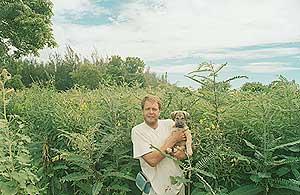 The largest but least developed farm
is Annapurna. It is located approximately 10 km. from the
Auroville city centre, near Vanur, and has heavy black cotton
soil. The farm was started in 1987 and grows mostly dry land
crops such as millet, oilseeds, rice paddy and pulses. In the
monsoon time some wetland rice is being grown. They utilise a
combination of solar, wind and diesel powered pumps and are
creating a series of water catchments ponds from which they
can irrigate more area without tapping into groundwater
reserves. They also maintain a biogas converter from dairy
manure, for their cooking fuel needs. The total area consists
of 135 acres. The largest but least developed farm
is Annapurna. It is located approximately 10 km. from the
Auroville city centre, near Vanur, and has heavy black cotton
soil. The farm was started in 1987 and grows mostly dry land
crops such as millet, oilseeds, rice paddy and pulses. In the
monsoon time some wetland rice is being grown. They utilise a
combination of solar, wind and diesel powered pumps and are
creating a series of water catchments ponds from which they
can irrigate more area without tapping into groundwater
reserves. They also maintain a biogas converter from dairy
manure, for their cooking fuel needs. The total area consists
of 135 acres.
Annapurna is the only existing Auroville farm where field
crops can be grown on a large scale. It still needs large
investments for the farm to reach its potential. Besides
growing food for Auroville, Annapurna is an active research
centre for ecological and biodynamic farming, as well as
maintaining a collection of non-hybridised local seed stock.
They keep 8 cows, and a small poultry. At present they can
provide basic accommodation for 1 farm volunteer worker.
|
|
|
|
|
|
|
|
Antakarana
|
Housing & Communities
|
| Name of the
community : |
Antakarana |
| Number of
houses : |
2 houses |
| Number of
people : |
2 adults |
| Date of
creation : |
1986 |
| Guesthouse : |
N/A |
| E-mail
contact : |
petra@auroville.org.in |
More details:
ANTAKARANA is located in the
Auromodele area.
It is a two-house settlement, no guesthouse, but two cats and
two dogs and a nice painting of Lord Ganesha at the
front-gate. Come and visit !
|
|
|
|
|
|
|
|
Anusuya
|
Housing & Communities
|
| Name of the
community : |
Anusuya |
| Number of
houses : |
5 |
| Number of
people : |
7 adults and
3 children |
| Date of
creation : |
1974 |
| Guesthouse : |
N/A |
| E-mail
contact : |
N/A |
More details :
Anusuya is in the Green Belt of
Auroville and is primarily dedicated to look after the forest
that surrounds us. We use one main windmill for water supply,
we all live on solar energy and each one of us has his/her own
little kitchen garden. We are
living individually.
|
|
|
|
|
|
|
|
Aspiration
|
Housing & Communities
|
| Name of the
community : |
Aspiration |
| Number of
houses : |
29
Aurovilian huts and 5 'pucca' houses |
| Number of
people : |
50
adults and 10 children |
| Date of
creation : |
1967 (before
the official date of Auroville's inauguration) |
| Guesthouse
: |
Yes,
7 rooms/huts, & 1 larger /family hut |
| E-mail
contact : |
No |
More details :
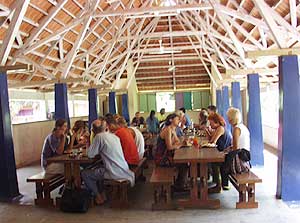 Aspiration
was built for the first settlers in Auroville in
the late 60s… another part of the community was
specifically built to accommodate the second caravan
that arrived from Europe. The community was built
on dry, red, unrelentingly barren land. Today, there
is a canopy of vegetation covering most of the community. Aspiration
was built for the first settlers in Auroville in
the late 60s… another part of the community was
specifically built to accommodate the second caravan
that arrived from Europe. The community was built
on dry, red, unrelentingly barren land. Today, there
is a canopy of vegetation covering most of the community.
Community life survives with basic accommodation,
in Auroville, known as "huts". They generally
have a keet (thatched) roof covering a wooden structure.
Aspiration is still the largest community in Auroville
with a head count of 60 persons, including 10 kids.
For its residents, the community aims at the diversity
needed to work on the ideals of Auroville, consciously
striking a healthy balance between Indians and non-Indians.
Breakfast, lunch and dinner are prepared by community
members who cook at least once a week. While a part
of the income generated by the guest-houses is used
for the running expenses of the community, another
part helps keep the resident's contribution realistic.
In the guest contribution of Rs.250/-, all meals
are included. Typically, two guest rooms/huts share
a common bath/toilet. We will give you a bicycle,
if available, …and not broken down! Laundry is free,
but please provide the soap. ;-)
Come check out the place, you are always welcome!
|
|
|
|
|
|
|
|
AuroAnnam
|
Housing & Communities
|
| Community
name : |
AuroAnnam |
| Number of
houses : |
1 residence |
| Number of
people : |
1 adult |
| Date the
farm started : |
1999 |
| Guesthouse
: |
No |
| E-mail
contact : |
margarita@auroville.org.in |
More details :
Auroannam is not a cumminuty: since
1997 Lucas had been searching for a consolidated plot of land
to develop into a demonstration site for organic cashew nut
cultivation. In October 1998 the Auroville Farm Group offered
the northern corner of AuroOrchard. The total area is 14
acres, of which 4 ½ were already under cashew. As for the
rest there are about 70 coconut palms, and some land had been
used for irrigated cultivation of soya, peanuts, gram and cow
fodder, though this had become economically unsustainable.
This farm is one element of an
overall strategy for the promotion of organic and sustainable
farming, with a focus on cashew cultivation and cashew farmers
regionally. Lucas (German) is the overall manager, while Muthu
and Shanmugam (Tamil Indians) assist him on the farm and the
overall program.
There is a bore well and an
electrical pump and booster pump. Existing sprinkler
irrigation is being phased out, and replaced by a micro
sprinkler / drip system. Flooding (for the coconuts) will be
replaced by heavy mulching, ground cover crops and,
eventually, micro sprinklers. That area, already under
irrigation, will be more intensively cultivated with various
fruits and vegetables.
There is a bullock cart for plough
work. A few cows are being included, to achieve an optimum
ratio between acreage and cattle and to decrease the need for
outside purchase of organic manure. In the open fields, mainly
fodder crops will be grown.
|
|
|
|
|
|
|
|
Aurodam
|
Housing & Communities
|
| Name of the
community : |
Aurodam |
| Number of
houses : |
10 |
| Number of
people : |
16 adults and
3 children |
| Date of
creation : |
1976-1977 |
| Guesthouse
: |
yes |
| E-mail
contact : |
radiance@auroville.org.in
c/o Guy |
More details :
If you wonder why the community was
called Aurodam, here's the simple answer: a dam was built just
nearby to prevent erosion from a small canyon. We take care of
a small nursery for afforestation around Aurodam (David does
most of it).
Since many years Goupi is giving massages here, and a
commercial unit called 'Radiance' (interior decoration) has
emerged adjacent to Guy's house.
A community kitchen is used for
dinners (most of the residents eat there but not all of them);
we go to the Solar Kitchen for lunch.
Aurodam is one of the few
settlements in Auroville that still have a real community
spirit. It's also a central spot for the Japanese GO game.
|
|
|
|
|
|
|
|
AuroGreen
|
Housing & Communities
|
| Name of the
community : |
AuroGreen |
| Number of
houses : |
4 houses |
| Number of
people : |
6 adults |
| Date of
creation : |
1975 |
| Guesthouse : |
Yes |
| E-mail
contact : |
charlie@Auroville.org.in |
More details :
Aurogreen is one of the oldest farms
in Auroville. It is situated on the north-east side of the
city in the GreenBelt. The farm covers about 35 acres (of
which 13 acres are irrigated), to grow citrus fruits, papaya,
coconuts and cow fodder. Six and a half acres of mango and
cashew plantation are grown under dry land conditions. We also
grow some vegetables. It has a dairy with fourteen cattle and
a poultry of 450 chickens which combine to provide Auroville
with milk, cheese and eggs. The farm primarily supplies to
GreenBelt residents in their immediate area, Pour Tous, and
the Solar Kitchen.
We have a community kitchen that we share and we rely on
biogas for cooking. The community lives mainly on solar power.
Only two of the members work fulltime in agriculture, the
others have different works, but help out if needed.
For any guesthouses information see Tine - for all the other
matters (farm), see Charlie.
|
|
|
|
|
|
|
|
Auromodele
|
Housing & Communities
|
| Name of the
community : |
Auromodele |
| Number of
houses : |
12 houses |
| Number of
people : |
16 adults and
3 children |
| Date of
creation : |
1971 |
| Guesthouse
: |
Yes |
| E-mail
contact : |
pala@auroville.org.in |
More details :
Auromodele has about twelve houses in
the same style, all built under Mr. Roger Anger's guidance.
From the beginning onwards, the plan was to have a communal kitchen but this
was never achieved. We don't have an official guesthouse
either, but we do enjoy a restaurant in our settlement, and
that is 'Roma's Kitchen'.
If you need more information, please contact me (Andre Hababou)
via
auromode@auroville.org.in
|
|
|
|
|
|
|
|
Auro-Orchard
|
Housing & Communities
|
| Community
name : |
Auro-Orchard |
| Number of
houses : |
1 houses and
a storeroom |
| Number of
people : |
1 adult |
| Date the
community started : |
1965 |
| Guesthouse
: |
No |
| E-mail
contact : |
gerardorchard@auroville.org.in |
More details :
Auro-Orchard, combined with the
neighbouring community of Hope, some roads and buildings, and
a temple to the god Ganesha, comprises 60 acres of land. It
was one of the first pieces purchased, around 1965, by Mother
for Auroville, though real development started in 1969 with
the connection of electricity, enabling the instalment of two
extra bore wells with submersible pumps. At present, about 50
acres are cultivated : Approximately 14 acres under
irrigation, growing coconuts, fruits, vegetables, fodder,
peanuts, millets and pulses, while on the remaining 36 acres
grow cashew and mango, as well as regenerative forest. There
is a dairy of 12 cows, heifers and calves, and a poultry of
250 birds. Recently solar powered pumps have been introduced,
along with drip irrigation, to reduce the cost of state
electricity and cut down on overall irrigation needs.
The initial financial investment in
1969 was paid by the Auroville administration, as it operated
in those days, though (with Mother's full support) from the
middle of 1969 onwards Auro-Orchard began a new experiment as
a "Self-Supporting Unit", developing the farm
"acre by acre" by reinvesting all farm profits over
the next 12 years. "Lately", says Gerard, the
original and ongoing caretaker (Swiss) of this highly
productive farm "for different and complex reasons, the
profits are declining seriously! In a few years it may, in
fact, be difficult to be fully self-supporting."
|
|
|
|
|
|