|
- by Abha Prakash
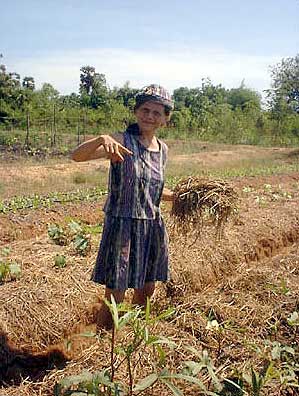
Search for a holistic life
When Priya Vincent was doing her doctorate in sociology
at the University of Surrey in the mid-seventies, she probably hadn't
imagined she would one day enjoy making compost for her organic vegetable
farm in a remote corner of South India. Such occupational makeovers
are, however, quite common in Auroville. A British policeman turned
into a village school principal, a task he carried out admirably for
years. A chemical analyst from Russia shifted to energy massage and
teaching yoga. A former airline attendant still runs a successful knitwear
venture. Evidently, people who join the Auroville adventure somehow
leave their old selves behind. For many, Auroville is the site of their
transformation into the individuals they were meant to be but hadn't
been able to become. For some the process of transformation began dramatically
as with a change of name, for others it was a deeper and much more gradual
process. Part of becoming Aurovilian involves an openness to experimenting
with areas of work that are generally poles apart from what one has
been accustomed to doing in the society one consciously left behind.
Or using the skills one has but in a different way.
Having moved to various places and with various
people in order that she could express "something that needed to
be expressed at that time," Priya joined Auroville with the recognition
that "this was the place for [her] to be." Having worked for
fifteen years in market research companies subsequent to finishing her
doctorate, she had since the late eighties become more and more interested
in balancing her work with the needs of her inner self. While the name
change happened as a consequence of her association with the Rajneesh
Commune in England, deeper changes began taking place as she started
experimenting with more sustainable practices of living. This experimentation
was facilitated when she and her former partner, along with Emma, their
eldest daughter (then eleven months old), moved from Europe to Malaysia
where they lived in traditional communities. During this fruitful period
of her life, Priya authored Birth without Doctors (Earthscan,
1991) and Birth Traditions and Modern Pregnancy Care (Element,
1992). Her interest in alternative healing and health intensified her
need for a more holistic living experience where she could engage with
the land in a meaningful way. Living close to the earth, Priya felt,
would also enhance her other interests such as painting and writing
poetry.
Call of the Earth
When in 1996 Priya, now a single parent with two
growing daughters, joined Auroville she turned her attention to setting
up a farm, having already accrued some experience and personal joy in
this area when she lived in Kodaikanal, also in Tamil Nadu. It took
her several years, however, before she could find a place to farm in
Auroville. Not daunted by the degraded one-acre plot of land that was
eventually offered to her, Priya named it 'Buddha Garden', a place she
believed would balance her inner healing with the healing of the earth.
Thus in 2000 began another one of Priya's journeys this time towards
satisfying the practical needs of the community through involvement
of the self with earth. Buddha Garden, situated in the western part
of Auroville, became the canvas for Priya's literal and poetic exploration
of the earth and her own inner sky.
Earth
Inviting my hands
To sense its essence.
Empower her fruitfulness.
("Earth's Asking")
Setting up the farm infrastructure was not easy,
however, as Priya documents in her book How
My Garden Grew (Auroville Press, 2002). Her confrontations with
a Tamil villager over the laying of her telephone cable, the frequent
petty thefts, broken fences that had to be mended daily, the feeling
of overwhelming tiredness that left her "feeling under siege"
(p.96) make Priya's journal a human record of endurance and endeavour.
Growing pest-free vegetables almost out of red dust and gravel was challenging,
nerve-racking business which, sometimes, came with its set of unpredictable
blessings - help from unexpected quarters; a rainbow after a thunderstorm;
a poem:
My sky is the sky of flatlands
A massive dome of soaring infinity
Canvas for naked forces writ large and loud . . .
("Inner Sky")
Sustaining the self and the community
Despite her initial misgivings and feelings of frustration
in the first year, Priya's farm began supplying vegetables and fruits
to the Solar Kitchen, Visitor's Center cafeteria, and Pour Tous. This
was due to the back-breaking efforts not only of Priya but also of Arjunan,
her Aurovilian assistant, and the various volunteer workers who gave
their cheerful energies for weeks or a couple of months at a time. We
get to meet some of these volunteers in the video "Welcome to Buddha
Garden" that was made recently.
The "vegetable growing" as Priya says
in the video, is "only half the story" of Buddha's garden.
The story of a single, western woman managing a farm in traditional
Tamil Nadu in the face of resistance from some of her village neighbours,
and her determination to create a different farming experience is perhaps
the other half. Buddha Garden is different from other Auroville farms
in that it does not rely on a steady pool of village farmhands. Priya's
vision is not just to grow vegetables for the community but to have
the community participate with the land. For Aurovilians to be together
on a material basis means for her primarily "to grow food together,
and build houses together." The commitment to community living,
according to Priya, has to be somehow inbuilt within the Aurovilian
organization, so that the rugged pioneer spirit of the old days is kept
alive especially in relation to the earth.
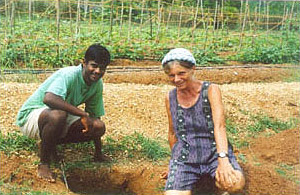
To expand Buddha Garden, now a seven-acre plot,
into a community farm that is sustainable for the earth and for Auroville
is what Priya is working towards. Her future plans for the farm include
growing cereal crops, to further develop her "mixed bags"
(a variety of vegetables totaling a certain weight) scheme for which
there is a growing demand in Auroville and to have additional accommodation
built for the young volunteer workers, either Aurovilian or long term
guests who want "to come and share in [her] life and work."
http://www.buddhagarden.org
|