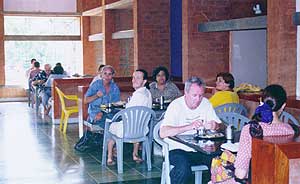
Seating patterns
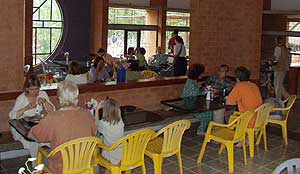
The seating layout of the Kitchen over the years
has developed a pattern based more on intermixing discreet sub-sets of
all diners (on any given day) occupying clearly definable areas or
habit-zones. Medium table-groups fluctuate in content but come from
larger identifiable separate pool-sets and are focused around small
relatively fixed-in-content groups or units (say 2-3, sometimes
family-based around a parent with young children, or groups of 2-3 young
men mostly) who move freely only within a definable area, rarely
straying beyond invisible habitual boundaries.
Long-time diners find they tend towards one part
of the dining area more than another, dining on rare occasions in other
areas when asked by a member from that area to meet for some reason.
To queue or not to queue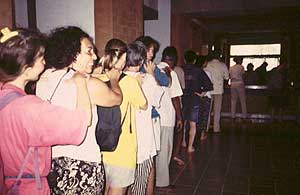
Webster's Ninth New Collegiate Dictionary defines
'Queue' as 'a waiting line, esp of persons or vehicles'. Based on this
definition the following analysis can be made of the Solar Kitchen lunch
queue:
Participants divide into X categories:
Conventional queuers
Those who upon arrival stand at the end of the
queue at that time, allowing all previous arrivals precedence.
Unconventional queuers
Upon arrival at the queue this category of diner
tends to wander normally about one third of the queue's length towards
the front, and then either strike up a trivial conversation with someone
they would otherwise not normally converse with, for purposes of
convincing themselves they have successfully reduced their waiting time
by a third (assuming the queue travels at a constant speed) but without
incurring the wrath of the conventional queuers they have come in front
of.
Reactions
In the eyes of the unconventional queuer, their
strategy is a win-win situation: they have reduced waiting time without
repercussion from those in front of whom they stand. This, of course, is
delusion. Many focus-group based studies of community kitchen social
dynamics, including Schlumberg & Moonaswami's Evolved Social
Protocols in Condensed Intentional Communities Solar Kitchen case study1
show despite the absence of perceivable reaction, the majority of diners
react negatively to "cutting-in"2
. Consequences for the "cutter-in"3
are usually negligible in the short term, says Geneva's 4th Dimensional
Research head, John Pertwee , but long-term repercussions, while
difficult to gauge, have been shown to exist5
. Long-term reactions range from diminished inclusion of the offending
individual in social activities to actual vocal confrontation and in
some rare cases expulsion from the larger community6
.
1. SCHLUMBERG
& MOONASWAMI, Evolved Social Protocols in Condensed Intentional
Communities; A Solar Kitchen case study, 2000, Chennai E-City Press,
p.965-1599
2.
LALVANI, J.K., Interviews With Disgruntled People, 1998, Majorcan
Community Press, p. 13
3. Ibid
4.
PERTWEE, J., I'll Get You Later; Studies in Silent Rage, 1987, Mumbai
Elite Academic Special Fancy Press.
5.
Ibid, p. 1003
6. PHIERRY,
Z., Quit Notice For Cutting-in,
|