 Towards a Pavilion Towards a Pavilion
for the African Culture
Looking at the
population of Auroville as of 2002, one sees that the African
population is as yet sorely missing. The community is
therefore happy that a longtime friend of Auroville and
resident of Ethiopia has now come to live in Auroville and is
actively working towards a more African presence in the
township.
Tekeste Kidan has been in contact with the Ashram and
Auroville for many years, and is now putting his energy into
the creation of an 'Africa house' which will be a modest
beginning of a future African Pavilion in the International
Zone.
We present you
here with a few glimpses of what he has in mind.
Relation of Auroville and Africa
The relation of Auroville and Africa started at an early
stage, when the Indian Government presented the plan and
concept of Auroville to the governments of the world at a
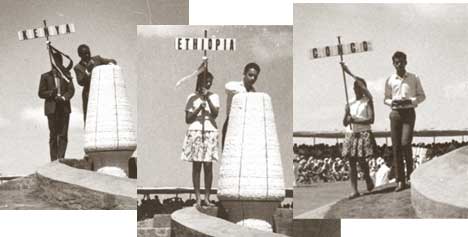
UNESCO Conference in 1966. Subsequently, out of 124 countries
participating in the Auroville inauguration ceremony, 37 were
from Africa. As in Africa the concept of Auroville is hardly
known, participation of Africans has been very limited. It is
therefore important to create awareness among the African
people of the need for a place like Auroville, dedicated to
brotherhood, human unity and international understanding.
Connection with
Auroville's founders
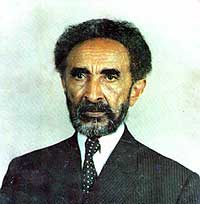 From Sri Aurobindo's writings, and particularly his poem
entitled 'Hail to the Fallen' dedicated to Haile Selassie
(Collected Poems, p 596), we see that Sri Aurobindo had great admiration
and sympathy for Africa. It is also interesting to note here
that the Mother was of Egyptian/African origin through her
mother. From Sri Aurobindo's writings, and particularly his poem
entitled 'Hail to the Fallen' dedicated to Haile Selassie
(Collected Poems, p 596), we see that Sri Aurobindo had great admiration
and sympathy for Africa. It is also interesting to note here
that the Mother was of Egyptian/African origin through her
mother.
It is significant that, at the beginning of preparations for
Auroville's foundation ceremony in 1968, Africa's leadership
consisted of a world-level statesman and a world-level
spiritual leader both of whom were the first Africans to
express in writing to the Mother their support to the ideals
of Auroville, - and the Mother has blessed them.
Creating awareness ..
Today the world is increasingly faced with the challenges of a
rapidly changing multi-cultural society, with all its
attendant problems and potentials. Certainly the African
continent copes with very basic problems that mainly arise
from ignorance, poverty and lack of basic education, and in
order to change this situation the ideals of Auroville and the
wide vision of its founders may prove to be of timely help to
the African people. It appears that creating awareness of the
ideal of Auroville is more necessary in Africa than in any
part of the world.
Tekeste
Tekeste Kidan came as a young African Diplomat to India in the
beginning of 1966, attached to the Ethiopian Embassy in New
Delhi. Through his friends and through the invitation received
by his Embassy to participate in the Auroville foundation
ceremony in 1968, he became aware of Auroville and came to its
first Anniversary celebration. Tekeste has served as an
Ethiopian Diplomat from November 1959 up to August 1993. After
his retirement in that year, he served for five years in
Ethiopia as a social worker and is living in Auroville since
1999, where his strong will and push to get his continent more
integrated in the city is widely appreciated.
An 'Africa House' in
Auroville's International Zone
In order to create awareness of the ideals of Auroville among
the new generation of young Africans, it was proposed that an
'Africa House' should be built in the International Zone in
the area allotted to the African continent. The Africa House
could accommodate African students and guests and allow them
to directly experience Auroville. At the same time, the House
will present Africa to the international audience of
Aurovilians and visitors to Auroville's International Zone.
The main features
of the Africa House would be:
-
a hostel intended to provide at least 35 rooms for students
visiting or interning in Auroville, as well as for guests and
teachers from Africa
-
a multi-purpose hall to be used for exhibitions,
audio-visual presentations, and get-togethers
-
classrooms, offices and utilities,
-
a kitchen and dining area
-
a garden with tennis courts
Other objectives
-
to increase awareness in Africa about the dream and
practical accomplishments of Auroville by exposing Africans
studying in India to Auroville
-
to organise camps for African students in which they are
introduced to Auroville's sustainable development practices,
which are applicable to Africa's developmental problems
-
to arrange for internships and study programmes for
Africans in Auroville
-
to have the research done by the students act as a basis
for presentations on Africa, both in Auroville and in Indian
and African universities
-
to conduct programmes to acquaint Indian and Aurovilian
audiences with the glories and potential of Africa. This could
be done by, for instance, conducting a sports programme in
Auroville, involving African sports heroes as coaches and
trainers; and by encouraging cultural exchange between Africa
and Auroville in the fields of music, dance & arts through
bringing exhibitions, performances, training courses, etc.
|