        |
|
|
|
Home > The City > Architecture > Agni jata |
|
||
Economic earth construction designed by Ray Meeker
The structure was built with mud blocks and
mortar, stuffed with ceramic products, and fired. The house itself
would get fired as a consequence. The fuel required for firing would
be largely accountable to the products inside. Mud mortar joints would
be made possible as they strengthen after firing. And further economy
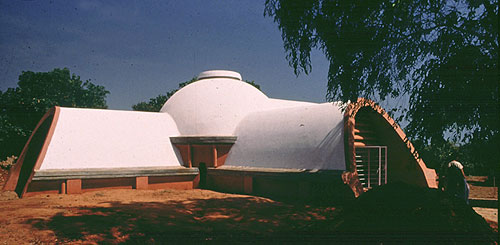
would result. The planThe simple requirements were accommodated in an equally simple plan - a central dome surrounded by four vaults covering a 700 sq.ft area. There were only two main additions after firing - the entrance canopy as a fifth vault in fired brick and lime mortar, and a partial loft within the highest of the four vaults. Nubian vault construction was followed for all five vaults. The constructionThe entire structure was sunken 75cm below the surrounding ground level to reduce the buttressing necessary for vault walls. The foundation walls were made of fired brick and lime mortar with a damp-proof course administered in cement mortar. The walls were constructed as composite walls - of fired brick on the outside surface, and sunbaked earth bricks on the inside - but the vaults and dome were made entirely with unfired bricks.
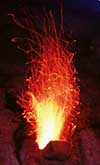
The firingThe form, so simple from the architectural
point-of-view, was fairly complex from the point of view of firing as
a kiln. Domes and vaults in combination, and specially as the dome was
surrounded by four vaults, were a new experiment in firing, but
successfully fired in one operation. The stacking of products within is of prime importance, as it determines the path of heat flow and therefore how evenly the products and the building will be fired. The stacking arrangement took about 4 weeks in this case. Some 60,000 table-moulded bricks, 2,000 tiles, several gargoyles and terracotta toilet pans were stacked inside the structure and fired for 4-1/2 consecutive days with 23.5t for casuarina wood and 2,400 bundles of malaar. The firing begun at the four vaults first involved the evaporation of water from the vaults and walls and the products inside, for 2 days. The smoke was allowed to escape from holes high above on the vault. Then the holes were closed and the heat
directed towards the dome, which was finished as a down-draft system,
the down-draft chimney placed in the centre and rising 2m above the
dome. After firing the temperature reached 900-900c at the
thermocouple points, but varied much more throughout the entire system
- probably 800 degrees in the cold spots and 1,100 where the bricks
began to melt. Finishing materialsThe burnt tiles were used for flooring and part of the brick in the external paving. Although the structure would not slake in the rain waterproofing was essential as it was porous. The water absorbed would significantly increase the load and result in leakage. The limitationsIt is necessary to have good brick clay on or very near the site for cost-efficiency. Other architectural limitations also exist, as the house must be primarily designed as a kiln. Other than ensuring adequate draft, the interior spaces must be simple; the roof vaulted or domed. The structural design is also limited by the strength of unbaked earth; whether it will continue to stand till fired. Above all the technique requires the expertise and supervision of a specialist at every stage for scientific thermal applications, demanding high precision. The ideal economic situationIf good brick clay is available at the site, materials and transportation costs are eliminated and transportation costs are eliminated and labour is the only expense for the mud brick construction. Further fuel efficiency can be realised by increasing the length of the heat flow path as much as possible. If all fuel and firing costs are justifiably borne by the products fired within, the house will cost as much as one in unbaked mud and mud mortar. With all the complex technological applications involved, the overall appearance is one of simplicity. Agni-jata is set sufficient with solar panels and a biogas plant. Ray Meeker has been working on this technique since 1985, achieving more efficiency with each successive experiment. He is presently engaged in a two-vault structure at the Auroville Information Centre that promises to get very close to the ideal economic situation.
|
||
|
The City > Architecture > Agni jata |
| Auroville Universal Township webmaster@auroville.org.in |
|

 The four arches supporting the Nubian vaults
are constructed with the help of a frame developed along a catenary
curve. The vaults are built without any centering - beginning with an
inclined course leaning on the base of the arch, and increasing the
inclination with each successive course until the desired gradient is
reached. For a vault 2m high with a 3m span, 10 courses were required
to reach the desired angle of 75 degrees, which was then carried
through the rest of the vault length. The frame for arch construction
at this stage served as a handy grid guide to maintain the catenary
shape.
The four arches supporting the Nubian vaults
are constructed with the help of a frame developed along a catenary
curve. The vaults are built without any centering - beginning with an
inclined course leaning on the base of the arch, and increasing the
inclination with each successive course until the desired gradient is
reached. For a vault 2m high with a 3m span, 10 courses were required
to reach the desired angle of 75 degrees, which was then carried
through the rest of the vault length. The frame for arch construction
at this stage served as a handy grid guide to maintain the catenary
shape.
