        |
|
|
|
Home > The City > Architecture > Visitors Centre |
|
The Auroville ExperimentUsing compressed earth blocksAs the main purpose of the Auroville Information and Reception Centre is to introduce the international township to visitors, the Auroville Building Centre (AVBC) has taken the opportunity to demonstrate and promote the rich potential of alternative technologies in its construction, with particular emphasis on the use of mud as a building material. An information office, conference room, exhibition space, video room, restaurant, handicrafts shop and toilets were accommodated in a structure specifically designed for visitors from all over the world, with the local climate materials and building skills influencing the design. Special emphasis was placed on natural lighting and ventilation in the building, as renewable energy sources were to be used. The AVBC wanted to limit the use of concrete and steel, but this was easier said than done, for in a compression structure the construction of arches, vaults and domes is necessitated. Prefabricated ferrocement elements were used for all doors and overhangs, thereby doing away with the use of wood. A 4m grid using load-bearing pillars and arched or corbelled openings was made with stabilised compressed earth blocks to reduce costs. Solar, wind and biomass energy, water management and recycling techniques, mud and ferrocement technology, and reclamation and afforestation were all integrated in the process. Stabilised soil blocks for domes and prefabricated ferrocement channels were considered as the best solution to roofing. It was felt the resulting sequence of arcaded and semi-covered spaces would give a clear sense of direction to people.
Granite block foundations and earth block structuresA composite type of foundation in stabilised mud
mortar was used because of its advantages. The material to be used had
to essentially have a greater load bearing capacity than the
stabilised blocks. Thus the use of fired bricks was eliminated and
locally mined rough granite blocks were used instead. This foundation
was cheaper and less time consuming than the conventional fired brick
foundation, and most of it could be done using unskilled labour. The
excavations for pillar foundations were always made up to the clay and
gravel strata, which varied between 75cm and 120cm below ground level. At the start of the project, the Auroville soil
laboratory was not yet available, and no lab analyses were done, only
a number of tests were conducted with various soil-sand-cement mixes
with the two different soils available on the site - a gravelly soil
and a yellow sandy soil. The two parameters of need -the cost factor
quality and the type- as well as the two parameters of specific
project requirements -including quality and cost factors- plus the
actual product behaviour in terms of dry and wet compressive strength,
water absorption, quality of surface and edges, led to the choice of
the optimum mixes. INTERVIEWArchitect Suhasini Ayer (S.A.) in conversation with Anupama Kundoo (A.K.)
S.A. I was introduced to earth as a
building material in urban areas by HUDCO's conference in Trivandrum.
I had seen pictures of earth buildings in Rajasthan, Yemen and Morocco
which were very beautiful, but it had never been introduced as a
relevant possibility in most architectural colleges. Today, after
trying to understand and use the material, after experiencing the
usual drawbacks and frustrations, I can say that mud is the most
responsive of building materials, and even its limitations are
exploitable for a more human and relevant architecture and urban
environment. A.K. Having built your own house with adobe, why did you choose soil blocks for the Information Centre? S.A. I personally believe that adobe is the most economical material, and is suitable to the available labour resource, but one has to go through the stages of transfer of technology so that it is not rejected by the prevalent prejudice against adobe or kuccha bricks. The compressed stabilised block has the right impact of technology to interest the layman, as it enhances the strength (making large openings possible), aesthetics, precision and facility for building. Psychologically, the public feels secure with this technique as the structure will not erode during a chance rain. A.K. What were the formative principles of design? S.A. When one uses minimum steel and concrete and stabilised compressed blocks, one goes back to the age old solutions of arches, vault and domes. We have tried using these features to give a more contemporary interpretation, with an eye to achieve maximum floor space. The building follows the same principles as a beam and column structure, except that the beams are arches and the columns are brick pillars. This way, we could have flexibility in the floor plan, large openings and maximum usable floor space. |
|
|
The City > Architecture > Visitors Centre |
| Auroville Universal Township webmaster@auroville.org.in |
|

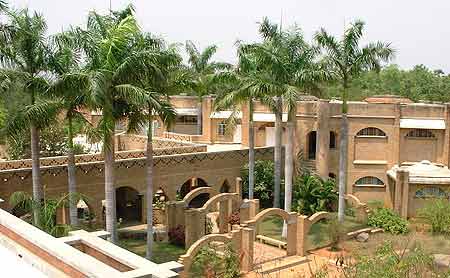 The
Auroville Visitors and Reception Centre is a popular and pleasant
place for the use of visitors and Aurovilians alike. It was
constructed in 1988 with grants from HUDCO and the Foundation for
World Education, and has become well-known for its architecture and
energy-saving construction materials. In the Society section of our
site you will find a descriptive page on the daily comings and goings
of this buzzing place, while the following article by its architect
and builder concentrates on the more technical details of this
remarkable building.
The
Auroville Visitors and Reception Centre is a popular and pleasant
place for the use of visitors and Aurovilians alike. It was
constructed in 1988 with grants from HUDCO and the Foundation for
World Education, and has become well-known for its architecture and
energy-saving construction materials. In the Society section of our
site you will find a descriptive page on the daily comings and goings
of this buzzing place, while the following article by its architect
and builder concentrates on the more technical details of this
remarkable building.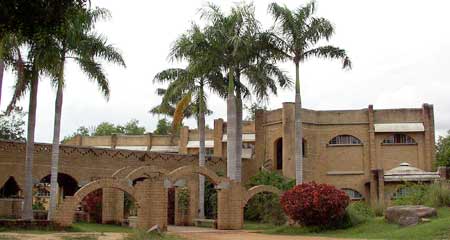 As
1.6 lakhs blocks were to be made for this and future projects, AVBC
employed a number of special tools for their specific needs - standard
wheelbarrows to transport soil, flat wheelbarrows to transport the
blocks, metal sieves of various mesh sizes, steel centring for arches,
compasses for constructing domes, and a new improved Auram 3000 press
to compress the earth blocks. This press was specially designed for
higher output, with many unique features, as the Astrams acquired only
manufactured 30.5x14.5x10cm blocks when ¾-and ½-sized blocks were
needed for bonding and thinner blocks of the same size, 30.5x14.5x5cm,
for the domes.
As
1.6 lakhs blocks were to be made for this and future projects, AVBC
employed a number of special tools for their specific needs - standard
wheelbarrows to transport soil, flat wheelbarrows to transport the
blocks, metal sieves of various mesh sizes, steel centring for arches,
compasses for constructing domes, and a new improved Auram 3000 press
to compress the earth blocks. This press was specially designed for
higher output, with many unique features, as the Astrams acquired only
manufactured 30.5x14.5x10cm blocks when ¾-and ½-sized blocks were
needed for bonding and thinner blocks of the same size, 30.5x14.5x5cm,
for the domes.
