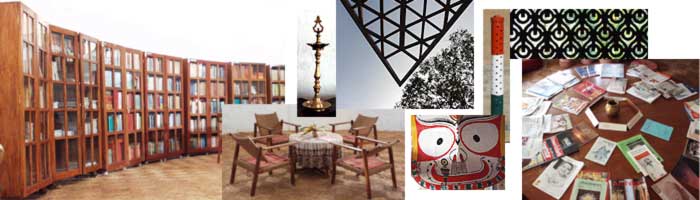
Bharat Nivas, House of India
update 2002
The campus of Bharat Nivas in Auroville's
International Zone has been a dynamic and generous centre in the
community's life since it was given to the Aurovilians in 1982 - to
utilise and bring to completion. While presently one of Auroville's
post offices is located there, as well as the main Auroville
Library, office of the township's Working Committee, Entry Group and
Residents Service, administration of SAIIER, the SAWCHU office and
main platform for communal meetings, as well as quite a number of
other Auroville services, this is a temporary arrangement only. In
the not too far future, when the new 'Town Hall annexe' will be
ready for use, a number of services and units that are now working
from the Bharat Nivas campus will move to their more permanent and
appropriate places future.
Bharat Nivas, the House of India, Pavilion of
the Indian Culture, can then fully grow into its own..
History
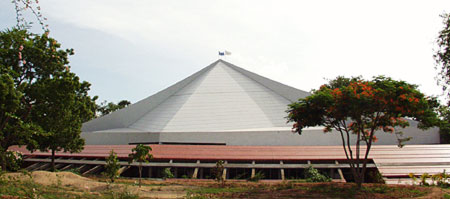
Bharat Nivas, the Pavilion of India in
Auroville's International Zone was, naturally, the first one to be
started. The Mother initiated the work and highlighted the purpose
it was meant to serve in the experiment of Auroville:
With the first pavilion it was intended to
create a process which other pavilions-to-be could follow in the
future. With this in mind, the Mother announced, in 1970, a national
competition to design 'Bharat Nivas', House of India. The 'Indian
Institute of Architects' sponsored the competition, and a jury
consisting of Auroville architects and other personalities was
constituted with the Mother as its president.
Competition brief
The brief given to the
architects was to design the buildings of Bharat Nivas as a symbolic
representation of the soul of India, seeking inspiration from
India's spiritual past, her thought, her character and perception.
The common zones as well as the sectors presenting the various
states were to be designed in such a way that they would bring out
the essential unity of India, in the midst of her rich diversity.
The buildings and open spaces should reflect the interaction that is
natural to Indian life. And, above all, the architecture of Bharat
Nivas should not be imitative of the past, but seek to renew itself
in dynamic forms.
Press release on competition, 1970
 A widely
distributed press release in August, 1970, carried three main
guidelines for the contestant architects: A widely
distributed press release in August, 1970, carried three main
guidelines for the contestant architects:
1. The first step is to contact such persons
who have an understanding of their culture, live it themselves, see
its future growth and potential and can advise and give the true
perspective. In this manner a group may form spontaneously to arrive
at a complete and total understanding of a culture in its different
aspect.
2. The second aspect of the work will then be a choosing or
selecting the most typical or distinctive aspect of the culture.
These should not of course overlap with those of other cultures or
merely repeat them, but the underlying unity should be well and
truly brought out.
3. The final step would be to represent this
culture in Auroville in a living and concrete manner. This
presentation should also bring out the ultimate aim towards which
that culture is striving. The pavilion, or better still the
structure for this, should be a reflection of the true spirit and an
integral part of this cultural manifestation.
The winner and first years
At the close of the
competition on 27.04.1971, the Mother chose a design prepared by Sri
R. Chakrapani of Chennai. The construction began in August 1971 with
funds received from the Government of India and from some of the
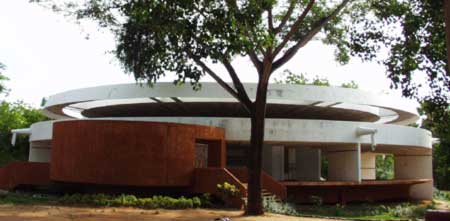
states. Two years later, with the Auditorium and the adjacent round
building of the restaurant partially completed, the work came to a
halt, in 1973. With differences regarding the nature of management,
the stalemate continued till 1982 when, under a special provision,
the Government of India handed over the unfinished complex of Bharat
Nivas buildings to Auroville to utilise it as it stood, and to work
for its completion.
First round of work after 1982
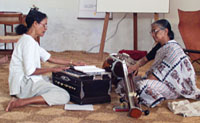 1. A Centre for Research in Indian Culture (CIC)
was set up in one of the partially complete buildings. Its purpose
was two-fold: 1. A Centre for Research in Indian Culture (CIC)
was set up in one of the partially complete buildings. Its purpose
was two-fold:
a) to re-discover the essential attitudes,
perceptions of Indian life and personality, which have been affected
by many extraneous influences
b) to have recovered them - to have
seized the 'soul' of India in its vibrancy of spiritual feeling and
effectivity, and to then, from that poise of being, try and deal
with contemporary issues
2. At the same time in 1982, about thirty
units and services of Auroville instrumental in various fields
needed to be housed as there was a shortage of buildings elsewhere
in the township. These came to find their space and moorings in the
buildings that had still to be completed and it is thus that for
instance Auroville's main Library, the Laboratory of Evolution,
SAIIER administrative offices, Auroville's Future planning offices,
the Entry Group office, Auroville International office, Residents
Service, SEWA employee office, the Auroville Post Office, the
Multipurpose Health Centre, Free Store and other such services are,
still, generously housed by Bharat Nivas. Also the offices of the
Secretary of the Auroville Foundation have Bharat Nivas as their
steady address.
However, with the increasing use and beautification
of the site, as well as other developments in the township where the
above mentioned general services would be more appropriately
located, a gradual siphoning off will take place, leaving the
premises for their original intent and function during the coming
years.
3. The process of fundraising to complete the
buildings was started and maintained and, by now, in 2002; some
buildings have been completed, new ones have been put up, but quite
some work still remains to be done
4. Considering the growth of centres and
activities specific to Bharat Nivas' functioning, the Pavilion of
India has grown in a full measure in spite of material limitations
and has become an important centre in the daily life of the township
Present development
Presently, in the year 2002, the Bharat Nivas
complex per se consists of:
Gnana Vijnana Kendra:
-
Centre for the Knowledge of Spirit and
Matter
-
School of Sanskrit and other languages
-
Centre of
Scientific Knowledge in India
Kala Kendra:
-
Centre for Research in Indian Culture
-
Studios for music, dance and painting
-
Centre of Perspective
Studies (the present SAWCHU building)
Sri Aurobindo Auditorium
Atithi Griha guesthouse
|