 |
|
|
|
Home > The City > Planning the Township > Traffic |
Towards a motor-free city |
|||
|
'Auroville Mobility
Concept' For the full concept paper, with detailed drawings, download 'Mobility Concept', pdf, 1.9 Mb. |
Search for new urban mobilityThe last 50 years have shown that the car cannot
remain the instrument of urban mobility without adversely affecting the
city. Cars and other motorised vehicles are the cause of serious
environmental, social and aesthetic problems. Among other things, they
kill street life, foster urban sprawl, contribute to noise and air
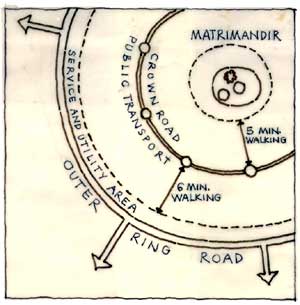
pollution, and are inefficient users of scarce energy resources. Car-free Galaxy plan..Recently Mr. Hans Billinger, a traffic planner who lives in Stuttgart, Germany, told some Aurovilians that he considers the structure and proportions of the Galaxy plan ideal for a car-free culture: all areas of the city are within 5 or 6 minutes walking distance from the Crown Road. The outer ring road could take motorised traffic and connect with centralised parking areas there. Onward travel would be BY bicycle or public transport via the radials and along the Crown, which could become the backbone of a public transport system (buses, tramway or monorail). The Crown Road is 4 kilometers long. Assuming an average speed for public transport of 16 kms/hour (including stops), the Crown Road can be circled within 15 minutes. If only one bus would be circling constantly, and one walks to and from the bus, it would still be possible to reach any point in town in less than 30 minutes. (See drawing) Pedal-power within the city properInside the outer ring road area, transport of people and goods would be by pedal-power (there will be a network of pleasant cycle and walking paths) and electric-powered vehicles: they would not overpower the streetscape because they are quiet and slow (in September, 1965, Mother noted that electrically-powered vehicles with a speed not exceeding 15 kms/hour would be used for transport in the city). Doctors, ambulances and other emergency transport could enter, of course, with any type of vehicle. Parking at outer ring-roadThis raises the question of what would happen to our cars and motorbikes. If we feel like keeping them, they would only be used for transportation outside the city area and could be kept in secure parking areas or garages along the outer ring road. Exceptions would be made for taxis carrying people with a lot of luggage or sick and elderly persons.
Also located on the outer ring road will be large
storage yards for accommodating supplies while awaiting dispatch into
the city. The pedestrian-based city would have a special atmosphere. The architecture would be different from that of auto-centred cities, providing a 'closeness' found in towns before the advent of the automobile. There will be visually-interesting passageways, as well as urban spaces based on a human scale. Is Auroville willing to show that another way is possible?This ideal plan cannot, of course, be established immediately. Major construction activities in the city will continue for a long time to come and, as yet, Auroville lacks the means to substitute non-polluting transport for the diesel-fuelled brick delivery lorries and various vans that deliver goods. But if we are agreed upon the aim of creating a pedestrian-based city, then we can begin outlining steps towards its implementation. At present there are about 500 million automobiles in the world (of which there are some 100 in Auroville..), and the numbers are increasing almost exponentially: for those who don't own one, particularly in the developing world, the car remains the badge of prosperity and modernity. Can we tolerate the noise, danger and global climate change which more and more cars will bring? Or is Auroville willing to show that another way is possible? Contact: helmut@auroville.org.in
|
||
|
The City > Planning the Township > Traffic
|
| Auroville Universal Township | webmaster@auroville.org.in |   |
 Car-free
cities will probably become the norm this century due to energy
constraints. It seems appropriate, therefore, that Auroville should be
willing to take a lead in this. But how can we design Auroville as a
city which could function without cars and motorbikes?
Car-free
cities will probably become the norm this century due to energy
constraints. It seems appropriate, therefore, that Auroville should be
willing to take a lead in this. But how can we design Auroville as a
city which could function without cars and motorbikes?