"A new spirit of oneness will take
hold of the human race..."

Towards unity?
Vasudhaiva kudumbakam, said the ancient
Indians: the world is one family.
The ideal of human unity, which was already present at the dawn of
civilisation, has never appeared so close to realisation, but
paradoxically the closer we come to it, the more it seems to elude us.
It is as if at the onset of the 21st century the need for human unity
has never been so great, and yet quite often this very unity, seen as
inevitable, is perceived as somewhat threatening.
World in crisis
We speak of mondialisation, of globalisation, and
in the same breath we deplore the dangers of uniformity.. We speak of
democracy as a universal ideal and of the progress of all nations
towards it as irreversible, and yet at the same time this democratic
model is perceived as a system imposed by some nations on others. We are
facing environmental problems which threaten the very survival of our
planet. We are aware of 'global warming' and a decrease in the finite
resources of the planet, and we know that in order to tackle these
common problems the individual nation-state is not an adequate
institution anymore. But the very concept of a supra-national body is
perceived as a possible infringement on the sovereignty of the
nation-state, won in numerous cases after many decades - or longer - of
struggle and pain.
Erasure of cultures
We claim that today's world is a global village,
because technological progress has made our earth very small, and news
can instantly reach every inhabitant of the earth through the highroad
of information. But there is the fear that this global village culture
may erase the diverse cultures of the earth; indeed it is argued that
there is already an immense drive towards uniformity of life habits and
uniformity of knowledge.
Economic front
On the economic front, the much-talked-about
liberalisation process is seen by many as an attempt to impose
everywhere a model only suited to some countries, and to spread
everywhere a culture of consumerism. A computer for everyone and bread
for only one quarter of the world population; is this the goal towards
which we are advancing?
Science
In the 19th century, intellectuals saw the
progress of science as the great factor which would lead to the
unification of mankind, since science was a thing common to all men in
its conclusions and was international in its very nature; but we know
now that science can be misused, and is being misused, to discover more
and more means of destruction. We have lost faith in science as a
panacea for all evils, but what is there to replace it?
Biggest obstacle
We know that egoism is the biggest obstacle to a
life of harmony and peace on earth, but after so many centuries of
civilisation no amount of religious preaching or moral teaching has been
able to convince the ego to forego its claims, as to speak to him of
fraternity is to speak to him of something fundamentally contrary to his
nature.
Need for real unity
Therefore it appears that although we are moving
somewhat reluctantly towards a kind of unification, this is not a
process likely to solve the many acute problems of the earth, nor will
the envisaged unity answer the deeper needs and aspirations of the human
being. In fact, we have begun to understand that if we want to preserve
the freedom for man to develop and grow in all liberty, this unity
cannot be built through mechanical means. It cannot be achieved as long
as man does not recognise a real unity between man and man; it cannot be
arrived at through social and mechanical devices; and we have even
started to realise that if its aim is not to bring about a fairer,
brighter and nobler life for all mankind, this unity is hardly
desirable.
Man will be surpassed
It becomes therefore urgent to understand what
this unity is towards which we feel pushed in spite of ourselves. Man is
a transitional being, said Sri Aurobindo shortly after the first World
War, evolution continues and man will be surpassed. Not only did Sri
Aurobindo foresee the next step in the evolution of man, but he told us
how to participate in it: instead of remaining a passive spectator in a
painful and incomprehensible process, we could consciously collaborate
in our own evolution and break free of our seemingly inextricable bonds.
Using inner means
But for this, we have to reverse the process, said
Sri Aurobindo, and instead of using external means, we have to turn
inward, because without a change in man's nature no real changes in the
external circumstances are likely to take place. The only way we can
move towards unity is to progressively realise that there is a secret
Spirit, a divine Reality in which we are all one - not only realise it
mentally but discover it in ourselves and live this knowledge. The
secret of unity is within, said Sri Aurobindo; the secret of brotherhood
is within. There is no unity except by the soul, there is no real
brotherhood except in the soul and by the soul. Only when we live from
the soul and not from the ego will a real unity reign on earth.
Connecting with the new consciousness
This 'spiritual age of humanity' then will
represent a transformation in the nature of man as momentous as the
appearance of the thinking mind on earth. In the same way as for
millennia the mind was the centre of our life, so, in the new age
opening for humanity, or 'supra-mental' age, the soul will become the
centre of all life and activities. A new stage in the evolution of man
has already begun; a new consciousness, higher than the mind, a
truth-consciousness, as Sri Aurobindo said, in which the dualities,
hesitations and limitations of the mind and the greed and blindness of
the ego will no longer exist, has already started to appear, and all the
upheavals and convulsions that are at present so painfully tearing our
earth are the outward signs of this evolutionary crisis. This new
consciousness is already at work in the atmosphere of the earth: we can
connect with it, we can call it in ourselves, we can use it to transform
our entire nature and consequently the world in which we live.
It is in this wide and far-reaching sense that
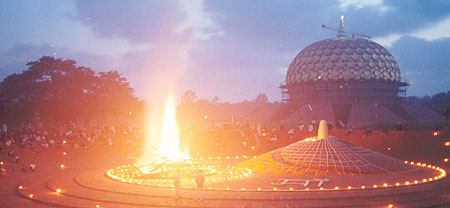
Auroville is dedicated to human unity. All are invited.
|