 |
|
|
|
Home > Art & Culture > Ceramics > Anamika & Chinayi |
|
Anamika's and Chinmayi's pottery - Published as
"The wonderful witches of Auroville" by Zareen R. Mistry in 'Inside Outside', July 2001 -
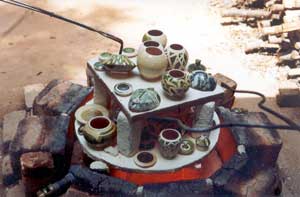
Enchanting, mystical and magical, their art leaves the viewer, spellbound, wondering which wood nymph or fire-sprite could have created these marvels. Their elegant bottles with long necks and sloping shoulders, and vases that flare upwards from narrow bases, have ethereal coloured surfaces transformed by the wizardry of smoke fire. Clay is a gift for humanity, dug out of the bowels of our ancestress Gaia, mediating between life's sacred elements - and ceramic art is the art of primeval elements. It is made from the earth with water and transformed by fire. Little wonder then that we potters feel like the witches in Macbeth or like the boy wizard Harry Potter! Is it just a coincidence that Chinmayi's son is called Merlin, you may wonder? Anamika is Dutch and Chinmayi German, but they have adopted an Indian monastic life. They met in Auroville, and their shared philosophy and mutual romance with pottery led them to set up Mandala Pottery, where they have been working in tandem since 1995. They have experimented extensively with local clays and glazes and numerous firing schedules and have held a number of workshops with visiting potters. Their meeting with Bernadette Baumgarten, a Swiss ceramist, and Jane Perryman from the UK, who are both specialists in smoke-firing, has greatly influenced their move into exploring this age-old pottery technique, and to adapt it to best suit their way of life.
When the form is leather-hard, it is burnished with the back of a spoon, a piece of wood or stone. This again is a slow, meditative process. This stage cannot be hurried through - the peace and patience of the potters are transferred to their pots. Burnishing seals in the pores of the clay leaves a lustrous tight skin, on which the fire and smoke can work their magic. After burnishing, the pot is bisque fired to 800° C, to mature the clay and leave the burnished gloss intact. Finally the bisqued pots are placed in saggars - containers made of heat and fire resistant material - and set aflame, embedded in combustible materials such as straw, sawdust, seeds, husks, newspapers and banana peels. Sometimes a cocktail of salt and oxides is poured into the sagar to give lustrous smoking effects. It is at this most exciting stage in a smoke-fire that one can imagine Anamika and Chinmayi gleefully dancing around the fire chanting, 'Round the burning
saggar go, After the combustibles have burnt down and the glowing embers are cold, and the pots are cool enough to handle, the loose carbon is scrubbed away to reveal the mystery and artistry of the smoke-fire. The rich and random smoke patterns, on the warm, burnished surface of the vessels have an immediate visual impact and energy. A range of colours from subtle pastels to intense reds, smoky hues, bright and dancing pigments are the hallmark of potters Anamika and Chinmayi. There's surprisingly a solitary lidded pot which is completely black. It is unique with subtle nuances of light and shade, illustrating the 'less is more' dictum. These enchanted vessels are metaphors for an ideal life, votive images, objects for use and for pure contemplation. Through them we seek a new modesty and learn to value spirituality. Raku Raku offers our culture an insight into new concepts of beauty. A bisqued clay form is covered in a glaze that fuses between 700 to 800° C. The pot is then put into a pre-heated kiln with the help of long-armed steel raku tongs. When shiny, the piece is pulled out with the raku tongs from the kiln, and thrust into a container of combustibles such as sawdust or dried leaves. The lid is clamped shut, to starve the air of oxygen and produce a reduction atmosphere in the container. After three minutes the piece is removed from the container and quenched in a bucket of water to arrest the effects of reduction. The messy, discouraging looking loose carbon is scrubbed away to reveal the crackled glaze and surprise flashings of metallic patina that are typical of raku.
For Anamika and Chinmayi it is the 'letting go' of the stranglehold
of expectations in raku, as in life, and discovering how things can live
alongside each other, that is fulfilling. For
Bilmat Zeramics, the Ceramic Art Gallery in Mumbai, Anamika and Chinmayi have specially
crafted lidded pots and bowls that have the typical raku fragmented crackle
glaze on the exterior with a metallic lining of copper and bronze on the inside.
Some lids are shaped like minaret-domes alluding to Mughal architecture.
Visitors to the gallery admire these potters' intense commitment to the superb
quality and finish of their work, and how they have used to advantage the smoked
and fire flashed surfaces for their expressive qualities, and in doing so have
recognised the strong emotions that the physical activity of living fire can
evoke in us all. |
|
Art & Culture > Ceramics - Anamika | Chinmayi |
||||
| Auroville Universal Township | webmaster@auroville.org.in |   |
||
 Far away from the
metropolis of Mumbai, deep in the awesome forests of Auroville, Mandala Pottery
is the den of Anamika and Chinmayi where they practise their special brand of
witchcraft using the ancient pottery techniques of smoke-fire and raku. Created
in tranquility, their work is imbued with a quiet energy. It stands apart in an
aura of contemplative stillness, distinctively unique from the other potters'
glazed and brightly coloured ware on display at the Bilmat Zeramics Gallery in
Mumbai.
Far away from the
metropolis of Mumbai, deep in the awesome forests of Auroville, Mandala Pottery
is the den of Anamika and Chinmayi where they practise their special brand of
witchcraft using the ancient pottery techniques of smoke-fire and raku. Created
in tranquility, their work is imbued with a quiet energy. It stands apart in an
aura of contemplative stillness, distinctively unique from the other potters'
glazed and brightly coloured ware on display at the Bilmat Zeramics Gallery in
Mumbai.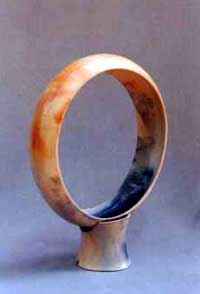 In their
smoke-fired ware, the elegantly simple forms are thrown egg-shell thin, from a
white stoneware clay body. Bottles, bowls and vases with variations on the nape
and shoulder, are refined with clean edges. The centring of the clay and its
taking shape on the wheel are also meditative and centring exercises for Anamika
and Chinmayi. Whilst working on the wheel, they find their own centre and inner
balance, and also a balance between inner-directed and outer-imposed influences.
In their
smoke-fired ware, the elegantly simple forms are thrown egg-shell thin, from a
white stoneware clay body. Bottles, bowls and vases with variations on the nape
and shoulder, are refined with clean edges. The centring of the clay and its
taking shape on the wheel are also meditative and centring exercises for Anamika
and Chinmayi. Whilst working on the wheel, they find their own centre and inner
balance, and also a balance between inner-directed and outer-imposed influences.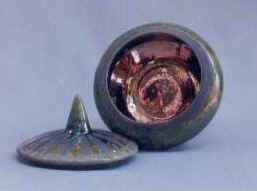 Besides being the
high priestesses of smoke-firing, Anamika and Chinmayi specialise in raku. Raku
is hard to define - it's not merely an exotic pottery technique originating in
Japan, but also a way of feeling - 'Happiness, pleasure, comfortable, best in
the world' are feelings attribute to raku.
Besides being the
high priestesses of smoke-firing, Anamika and Chinmayi specialise in raku. Raku
is hard to define - it's not merely an exotic pottery technique originating in
Japan, but also a way of feeling - 'Happiness, pleasure, comfortable, best in
the world' are feelings attribute to raku.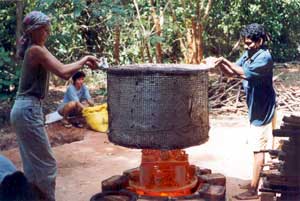 Anamika
and Chinmayi enjoy raku as an alternative to smoke-firing. The essence
of raku is that the use of a clay body strengthened to resist thermal
shock enables normal pot-making rules to be disregarded and a kiln opened
whilst hot in order to permit controlled and selective oxidation and
reduction. It is possible in raku to maintain both visual and actual
contact with the pot at all stages of making and firing. This creative
intimacy and the speed and drama of raku and its mottling effects are
what drew them to experiment with the technique. They were aided in
their efforts by Kristine Michael from New Delhi, a leading raku expert
who built with a ceramic fibre blanket. It has an ingenious 'top hat'
design, that simplifies the firing process. The lid comes on and off
like a top hat over the ware placed in the centre, facilitating its
removal with the tongs.
Anamika
and Chinmayi enjoy raku as an alternative to smoke-firing. The essence
of raku is that the use of a clay body strengthened to resist thermal
shock enables normal pot-making rules to be disregarded and a kiln opened
whilst hot in order to permit controlled and selective oxidation and
reduction. It is possible in raku to maintain both visual and actual
contact with the pot at all stages of making and firing. This creative
intimacy and the speed and drama of raku and its mottling effects are
what drew them to experiment with the technique. They were aided in
their efforts by Kristine Michael from New Delhi, a leading raku expert
who built with a ceramic fibre blanket. It has an ingenious 'top hat'
design, that simplifies the firing process. The lid comes on and off
like a top hat over the ware placed in the centre, facilitating its
removal with the tongs.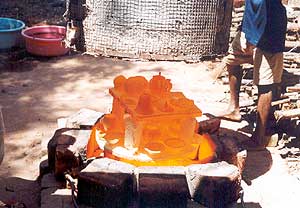 For their raku
ware, Anamika and Chinmayi use a brown stoneware body and the pots are thrown
strong and sturdy. Lidded pots or open bowls are thrown and finished, and then
bisqued to about 700° C. Certain areas of the bisqued pot are brushed with wax
in a webbed pattern. The wax acts as a resistant and forms a contrast between
the glazed areas and the raw unglazed parts of the vessel, showing off the
patterns of crackle and subtle pigmentation to the best advantage.
For their raku
ware, Anamika and Chinmayi use a brown stoneware body and the pots are thrown
strong and sturdy. Lidded pots or open bowls are thrown and finished, and then
bisqued to about 700° C. Certain areas of the bisqued pot are brushed with wax
in a webbed pattern. The wax acts as a resistant and forms a contrast between
the glazed areas and the raw unglazed parts of the vessel, showing off the
patterns of crackle and subtle pigmentation to the best advantage.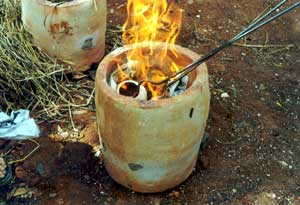 The wax-resisted
and glazed vessels are then put into the top hat kiln and the temperature taken
up to 900° C. When the ware is glowing hot and the glaze melted and shiny, the
top hat is removed and the ware transferred with tongs into a saggar with
combustible materials or on a pile of sawdust to 'reduce'. After three minutes
the ware is plunged into water to arrest the effect of reduction, and then
scrubbed clean. Unique colour effects emerge on the pots in their battle for
survival from the intense thermal shock, from heat to instant cool. In a raku
firing there is always expectation and tension mingled with an element of the
unexpected.
The wax-resisted
and glazed vessels are then put into the top hat kiln and the temperature taken
up to 900° C. When the ware is glowing hot and the glaze melted and shiny, the
top hat is removed and the ware transferred with tongs into a saggar with
combustible materials or on a pile of sawdust to 'reduce'. After three minutes
the ware is plunged into water to arrest the effect of reduction, and then
scrubbed clean. Unique colour effects emerge on the pots in their battle for
survival from the intense thermal shock, from heat to instant cool. In a raku
firing there is always expectation and tension mingled with an element of the
unexpected.