|
|
|
|
Home > Education > Schools for Auroville > Transition School |
Transition School |
|||
|
See also:
|
Transition School is a primary and middle school that serves the Auroville community since 1984. Inspired by the teachings of Sri Aurobindo and the Mother, the school aims to promote human unity, and to help our children to develop integrally so that they may reach their full potential. Our programme initiates what will hopefully be a life-long process of individual development towards a balance of body, mind, and spirit. Here, children from different cultural and ethnic backgrounds grow together in an atmosphere of protected freedom and harmony, developing an understanding that we are citizens of one world. Our deepest aspiration is to prepare our children and ourselves to live in a higher consciousness to manifest a truer and higher life on earth.
Who attends Transition School?Transition School, founded in 1984, provides a
learning environment for children from 6 to 14 years of age (grades 1
through 8). The school has a total capacity of 160 students. As we aim
to offer a holistic and integrated education, class sizes do not exceed
20 students. This creates an environment in which teachers are able to
know and follow each child individually.
What are Transition School's educational objectives?Our programme is child and process oriented.
Attention is given to our students' academic progress, motivation,
attitude, and the ability to work in a group. We value practices that
heighten observation, concentration, self-awareness and creativity.
Themes such as truth, fraternity, freedom, and progress are introduced
so that our children can develop a sense of values. We impart to our
students the idea that they are learning for their own pleasure and
growth, and their progress is the goal. Each subject is viewed as a tool
for self-discovery, as well as an aid to help the children express
themselves and gain knowledge.
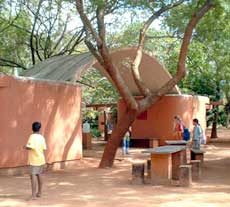
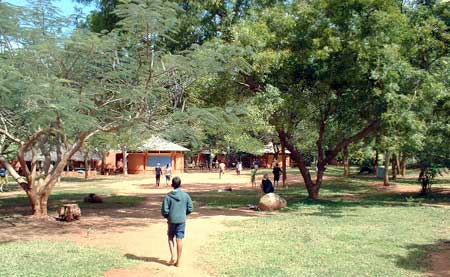
How are classes taught?Each class has a teacher who is responsible for the overall progress of the class. Our teachers use an eclectic approach, including cooperative learning, individual work, and class and school projects to address different learning styles. We create an atmosphere where our students feel good about themselves as learners and are willing to take risks, knowing that each individual has strengths and weaknesses, and that we learn from our mistakes. Grades one through four are conducted in the Mitra Building. Grades five through eight take place in the Shant Building. In Sanskrit, Mitra means friend, and Shant peace. Classes have a ratio of one educator to ten students. Schoolwork is often structured around projects, which integrate several subjects such as science, language arts, and social studies. Class meetings are a very important part of our programme. They offer a safe space for discussions on many different topics that are important to the children's lives, and provide a forum where successes are shared and problems are discussed and solved by the entire class. During one of the first class meetings, children entering Transition choose their class name. How is Transition School administered?Transition is a non-profit school that receives public and private donations. We maintain a horizontal hierarchy. There is no principal or administrator that determines programmes or policies. Instead, decision-making occurs through a participatory process at weekly teachers' meetings. Special programmesLanguagesLanguage is the path to communication, cultural
understanding, and ultimately human unity. As a community aspiring
toward human unity, Transition School endeavors to develop our
children's capacities to learn languages and understand different
cultures. Our children learn English, French, and Tamil. Language Arts,
in English, is taught for a minimum of four hours per week. French and
Tamil speakers take an additional four hours of their mother tongue
weekly. Second languages are taught for two to three hours per week. As
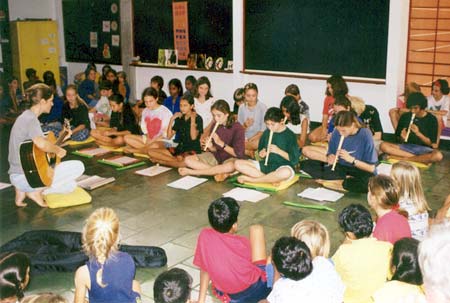
mentioned, Sanskrit is learned through songs. MusicStudents take one hour of music per week. The programme includes playing recorders, singing, rhythm and coordination exercises, dances, musical games, and music appreciation. Often, different composers' works are presented, and their lives and their contributions to music are discussed. Music classes offer children an opportunity to explore an important aspect of various cultures. The children learn songs from different countries, in different languages. A variety of styles of music are introduced, including classical, jazz, Indian, folk and pop. Musicians are invited regularly to the classes. Small school performances for other students, teachers, and parents help our children gain self-confidence and trust. When our students leave Transition, they have acquired basic music skills, and their interest in music is awakened. Awareness through the Body'Awareness through the
Body' aims to provide our
children with tools to expand their consciousness and discover their
inner self so that they learn how to steer their lives. Through games
and exercises, the children come into contact with the different parts
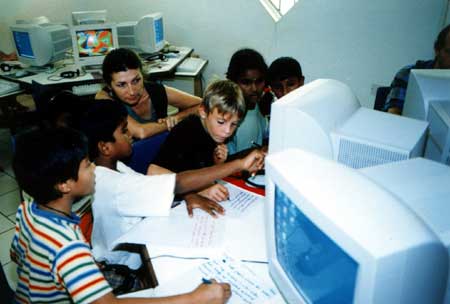
of their being. Arts and CraftsThe aim of the Arts and Crafts programme is to develop in our children an aesthetic sense, an awareness of the quality of their work, and the skills to improve it. The children learn to concentrate, to persevere and to trust their own judgment. Students are given individual and collective responsibility for tools and materials so that they can develop respect and a sense of responsibility for their learning environment. The Arts and Crafts programme is often based around activities relating to class projects. Our teachers primarily use two approaches with the primary school children. Either they are given a task or a problem to solve, and given time to find their own solution. Or the teachers provide step-by-step instructions, requiring good listening skills and concentration as well as manual dexterity. Middle school children explore various activities including painting, sculpture, woodwork, stained glass work, and building musical instruments. In addition to exploratory work, each child selects an activity and develops and completes an in-depth project. Sand BoxThe Sand Box has two 50 cm x 70 cm boxes filled with sand - one wet, the other dry. Nearby are hundreds of figurines, elements such as rocks, shells, feathers, and ribbons, and cardboard to create figures. With these materials, a child, working alone, can create a picture that is a reflection of his/her inner world at that moment. As a child works, the teacher observes, listening to what the child may say, and noting it. The teacher does not interpret these pictures. It takes one hour to complete and discuss a sand picture. The teacher spends the following hour sketching and photographing the box to keep a record of the child's work. This activity helps our children relax, enables them to express themselves freely, and gives them the unique opportunity of a creative self-encounter. We have noted that this activity provides teachers with insight into our children, and also calms children who may be having difficulty that day. The Sand Box is a relatively unexplored field in education and is still a subject of research. Other FacilitiesLibraryThe library has a selection of children's books and reference material. Every class visits the library once a week to select and borrow books, which are read at home. The library is also used for quiet study. ComputerWe have twelve computers available for our students and teachers. Email and Internet are available to all. All of the children practice typing. The younger children work on spelling and mathematical skills, while the older children develop their word processing, web design, and research skills.
Transition School functions within a community
of volunteer workers who are dedicated to the Charter of Auroville. One
of the points of the Charter is for Auroville to be "a place of an
unending education, of constant progress, and a youth that never
ages." We are constantly striving to improve our curriculum, our
methodology, and our approach to education, so that children have the
possibility to reach their full potential. Address:
Transition School, Auroville, 605101 Tamil Nadu, India. |
||
|
Education > Schools for Auroville > Transition School |
|
|
Transition poems | Transition | website | Photo gallery | Awareness through the Body |
| Auroville Universal Township | webmaster@auroville.org.in |   |