 |
|
|
|
Home > Environment & Bioregion > Environmental work > Harvest > Blue pages > February 2002 |
|
|
|||||||||||||||||||||||
Blue pages - No.2
|
|||||||||||||||||||||||
|
|
Artificial recharge of ground water – an attempt to recharge the confined aquifer in the Vanur watershed (western part of Auroville bio-region) Artificial recharge‘Artificial Recharge’ is the process by which the ground water reservoir is augmented at a faster rate than under the natural conditions of replenishment. An Artificial Recharge System is a man-made scheme or facility that adds water to an aquifer. Man-made irrigation tanks, village ponds, check dams, percolation ponds, sub-surface dykes and injection wells are some examples of an artificial recharge system. Artificial recharge through Injection wells by Gravity flow – [a trial basis]Significance of the system in relation to the Auroville Bioregion The Vanur watershed area consists of sedimentary formations. Laterite and Sandstone of Cretaceous and Mio-Pliocene periods are exposed. Sedimentary formation (clay) of upper cretaceous age is exposed in the southeastern part of the project area. The following table shows the detailed major geological succession of formations: |
||||||||||||||||||||||
|
|||||||||||||||||||||||
|
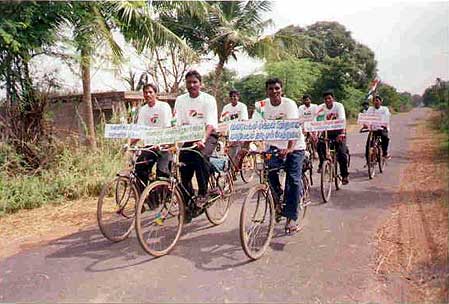
It could be seen from the above table that the Vanur and Ramanathapuram sandstone, which are the major source of groundwater to this region, are confined. Therefore, the best method for recharge to this semi-confined aquifer is by artificial recharge. A threat of saltwater intrusion in the above-mentioned aquifer, in the north and northeastern part Auroville invoked Harvest to take immediate steps to recharge the declining aquifer through artificial method. \ System ExplanationAs the land cannot retain all the rainwater, the aquifers are considered as storage tanks in which water with potable standards can be stored while it is available and could be utilised at the time of scarcity. A part of the surplus water that flows into the sea during monsoon, and the excess water stored in the tank will be injected into the ground through injection wells. An injection well will be installed 100m away from the tank in the downstream area. Water will be injected all 24 hours per day during surplus seasons. The observatory wells will be installed in the upstream and the downstream of each tank to monitor the raise and fall of ground water level before and after the injection. The wells would be opened only for monitoring. The observations thus made out would be noted down regularly. An automatic water level recorder will be fixed in the observatory wells to monitor the level of water continuously. The quality of water that injected into the well will be regularly analysed at a laboratory. A sand filter will prevent the suspended solids from entering into the injection well. ConclusionConsidering the significance of the system, the Central Ground Water Board has granted an amount of Rs. 1.2 crores to set up the artificial recharge system in the Vanur watershed. The project is under implementation and the functioning of the recharge system will commence in the coming year. People’s participation in village developmentA cycle rally programme for creating awareness among the masses The themeThe population of India has crossed one billion and is likely to reach 1.5 billion by the middle of this century. Every additional breath on the earth needs additional resources like water, food, power and land. We try to solve this major problem by exhausting the present resources or finding alternatives, which in turn deplete the supply for the next generation. Water is the base for other resources such as food energy etc. In most of the places in India, surface water resources like tanks, ponds etc have started to disappear. This coupled with over-extraction of ground water has resulted in the decline of the ground water reserves. The diminishing reserves of ground water can jeopardise the very future of our civilisation. It is the same with the other resources that have been taken for granted, like earth and air. Heavy use of fertilisers and pesticides pollute the land resources leading to eco-system poisoning which in turn poisons the food chain. Use of plastics and petroleum products pollutes the very air we breathe. As they do not, or very slowly, disintegrate we opt to get rid of plastics by burning it and the fumes lead to air pollution. Our ancestors have built a nation and the next generation, is responsible to develop it and provide a better land for the coming generations. Development at the local level will subsequently lead to national development. For this we need to develop our local resources and infrastructure like roads, energy, water, land, air etc. In the past, our ancestors used traditional technologies to maintain the natural resources, which should be revived, adapted and executed with government and the participation of the common person. The Government policy of supporting low interest financing for cottage industries for women group is a good example for this participatory approach. We need to re-group ourselves to establish sustainable development of our villages bearing in mind that this alone will bring about prosperity and growth. Are we ready? – It is high time that we should be ready! The reportBased on the above, Harvest and Volunteers of the
‘Pudhu Vasantham Theatre Group’ organised a two-day ‘Awareness
Cycle Rally’ in the bioregion of Auroville (Auroville, Kiliyanur,
Olagapuram, Tindivanam, Chingee) on the 26 and 27th of January ‘02. The following topics were covered using awareness techniques like distributing notices and pamphlets, group discussion, charts exhibition and shouting slogans.
The rally was a big success. The message was conveyed to about 3,000 people in the area. This was a wonderful experience to all the participants. We received great support from travelers, villagers etc. Almost everyone whom we met appreciated our efforts and wished us success. We crossed 5 towns and 60 to 70 villages wherein we were able to meet about 20 to 30 people from each village. ConclusionThe message was taken to the mass; the seeds were sown with hope that it will grow. With the urgency of the situation, we need to gather beneficiaries’ support so as to fight the foreseen environmental catastrophe.
Contact: Murugaian at harvest@auroville.org.in |
|||||||||||||||||||||||
|
Environment & Bioregion > Environmental work > Harvest > Blue pages > February 2002 |
| Auroville Universal Township | webmaster@auroville.org.in |   |