|
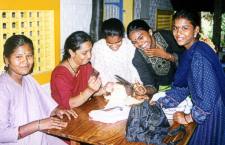
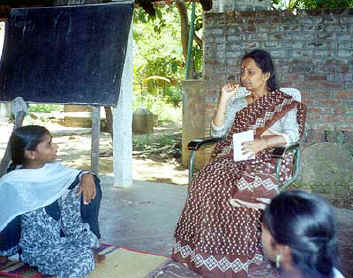
The Life Education Centre was founded in 1991
as part of Village Action Group. It is a place where young school drop-outs
from neighbouring villages, aged 15 to 22, can receive life-oriented
education. The main aim of the centre is to train young women in skills
and develop their social behaviour and self-confidence in women's issues,
health care and community awareness. As the students grow in self confidence
and become psychologically stronger, the teamwork of the group improves,
trust builds up, and thus they can influence the village communities.
For this a certain adjustment is necessary, and we need to spend time
with the youngsters as they all have different situations and abilities.
The Life Education Centre has been lovingly
nurtured and sustained by Zerina, a friend and dedicated social worker
from Pondicherry. She is presently assisted by Karin, a German Aurovilian,
who is fundraising and running the Lively boutique and production unit
for the support of the Centre.
High drop-out rate
The number of these drop-outs in India is incredibly
high: 30% of all the children who start school never complete primary
school. And nearly 80% never complete their education.
Why is this so?
On one hand the very poor parents aren't able to
support their children. Being illiterate themselves they are hardly
able to help them with their homework. And furthermore, being dependent
on each rupee, they don't appreciate education in general and aren't
ready to support and encourage their children to get any skills; rather
they are forced to send them out to work to earn a salary.
Besides that, there's the existing rigid educational
system. Many teachers are totally unmotivated, using blind repetition
as a teaching method. There is also a lot of pressure on children of
non-caste families. There is no encouragement to develop their self-esteem
or love of others and nature, so they create children who become so-called
failures
Still this is not all. Even if a poor rural child
is lucky enough to pass entirely through the normal course of schooling,
it will not have provided him with skills necessary for surviving in
a rural community, thus youngsters prefer to leave their village for
urban employment - adding to the urban overcrowding, the disappearance
of rural artisans and the impoverishment of the rural economy.
New chance
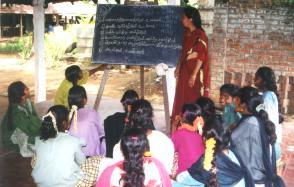
In Auroville's Life Education Centre they get a
new chance. They are trained for about two years in basic skills like
writing and reading Tamil, in mathematics, English, typewriting and
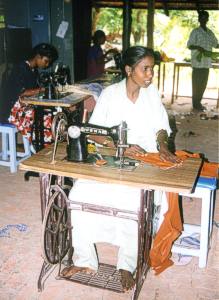
some basic computer-skills. They also learn tailoring and needlework
in order to become independent and able to earn money on their own in
their villages. On occasions there are also workshops on theatre, art,
child psychology and so on.
New family
The coordinator accompanies the girls during their
whole process, and assists them like a mother. Carefully and with love
she encourages them and teaches them to be aware of their rights and
how to defend their position. Once a week they talk about the situation
of women in India and also about their own family situations. The girls
support each other like within a family, and obviously they have in
L.E.C. a second home where they can grow and develop according to their
own nature.
It is not only a professionally given education
that makes a human grow and face bravely the world, but life itself,
all the surroundings and relationships. There is an aphorism of Mother
which fits here quite well:
"Let all circumstances, all happenings
in life be occasions, constantly renewed,
for learning more and ever more."
Mediating between generations
On the other hand there is the traditional Indian
society with its generally positive and supportive structure, but also
with negative restrictions and limitations. It happens quite often that
parents don't want their daughter to go to L.E.C. They fear that she
could become too independent-minded and free, and afterwards break the
traditional rules and roles.
In these cases the coordinator has to be a mediator
between the old and the young generation, between tradition and the
seeking of a new life. She visits the parents and very sensitively and
carefully gains the confidence of the families and convinces them of
the advantages of obtaining education and professional skills. Once
again we can see how far the seeds of one little project may spread.
Grown in consciousness
After their two years training, some of the girls
get a job or buy their own sewing-machine to take tailoring orders from
their neighbours. But even when they return back to their traditional
life, they have learned so much. They have become conscious of their
situation, they have reflected on gender issues, and they know much
more about the power of a women's group. They will share their attitudes
and perceptions with their relatives, and will pass them on to their
daughters and sons. In fact, after these discussions they are able to
handle all their problems in a better way.
Presently we have 38 students. A policy has been
introduced whereby the students get a monthly stipend. Offering this
was a success, both for solving tensions at home and giving the students
an extra motivation for finishing their studies.
We're happy to be instrumental in helping these
girls, enabling them to know self-esteem and happiness, and to contribute
to their families and to their wider society in a constructive manner.
Contact: Zerina_lec@yahoo.co.in
as well as karin@auroville.org.in
|