|
|
Download:
AVAG annual report '02
AVAG's Concept
AVAG's new training centre
Life Education
method
Life Education Centre
Training of social
development workers
AVAA (Auroville Village Action
Arts Programme)
Mohanam
AVAG Project list
Contemplation
Some projects
Woman
Power programme
Life Education Centre
Sappadu project
|
|
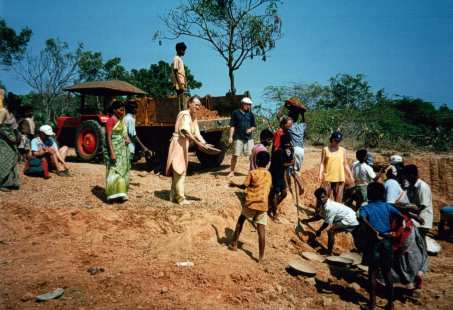
In about 1983, the community of Auroville became
aware that more directed steps needed to be taken to build up a truer
relationship with the surrounding villages. It was decided to
interrelate with them as complete neighbouring entities, and not just
with the individuals who came for work or education. The Auroville
Village Action Group began with this intention, and continues to
maintain this important network among the communities of the Kaluvelli
Tank bioregion.
Chaos caused by urbanisation
On going out to meet the villages, the presenting
situation was found to be nearly as chaotic as the Aurovilian 'divine
anarchy'. It took a while to understand what had happened, not only in
our local villages, but in villages all over India. We discovered this
as we worked to help the villagers with their clearly stated lacks: they
asked for our help because they lacked money, lacked water, lacked
health care, lacked education… In trying to secure the funds to
assuage these lacks, we began to work with youth and women, helping them
to organise themselves into Village Development Clubs. And as we worked,
we learned how, since the onset of urbanisation and modernisation, the
coherent social fabric of the villages (a society which had four
distinct levels: teachers/advisors; leaders; tradesmen/artisans/farmers;
and labourers) had been eroded by migration to the cities. The top three
layers were missing, gone to the city for good jobs, better schooling
for the kids, a new life, and left behind were a population bred and
conditioned to take orders - not to take responsibility for the village
commons. The seeds of grassroots democracy could find fertile soil here,
as the people were driven by poverty to seek new ways of managing, and
were already of a fairly horizontal social profile.
Auroville as 'catalysing agent'
The Auroville Village Action Group is based on the
idea of Auroville acting as a "catalysing agent" - sparking in
the people the wish to improve themselves, and encouraging their own
dreams. Auroville, as a new city, can be seen as a conscious and young
urban entity working to remain conscious and considerate of the land and
population on - and with - which it is growing. There is no attempt to
impose new values on the people; simply Auroville is growing, and
demonstrating to the people new technologies, new methods, new ways.
These are not always 'good' - but the awareness and acceptance of
necessary change in the old traditional culture, which had become
stagnant and ossified, is definitely good.
The outreach style of Village Action Group is
based on work with village young men and women. A batch of six to
fifteen young people are recruited each year as "Development
Work Trainees". They remain "trainees", while earning
a reasonable salary, for two years. During this time they not only gain
a lot of new information (about environment, the ecological crisis,
local power structure, personal and public health, etc.) but they are
also engaged daily in group processes, learning how to communicate,
think analytically, listen deeply, speak clearly and bravely. In the
learning group, castes and outcastes are mixed and treated equally, and
women and men are also treated as equals. It is through group exercises
that the reasons to change from the prejudices with which they were
raised become apparent to them. They are also learning participatory
ways of teaching for their work as supplementary teachers in the village
schools.
Sharing the enthusiasm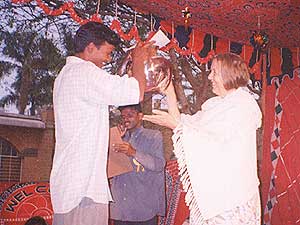
As their minds begin to awaken, their faces begin
to shine. They are themselves developing. Then their work in the
villages - helping youth clubs and women's clubs to meet, helping them
organise village improvement projects, meeting local officials, teaching
in the local schools - is not just explaining "development
programmes" and meeting targets. They are sharing with their fellow
villagers, relatives and friends, their own experience and enthusiasm
for learning and developing. At one time we tried getting better
educated young people from nearby Pondicherry to act as supervisory
staff, but experience has shown that the local young people, although
needing a longer break-in time to become responsible and show
initiative, are much more stable and committed to their work. They have
their roots in the place; they earn respect in the village; and they
gain as much as they give. It is not just "a job" for them, it
is a way of individual progress and community participation.
The work of Village Action falls into three categories:
-
The first is what was explained above, the
intensive training of local youth as change agents, development
workers, educational animators in their own villages.
-
The second is community organisation.
-
The third is supplementary education for the
village children.
Development worker training
This training began in l993 and has been developed
over the years under the guidance of a pair of dedicated Tamilian social
workers, Moris and Anbu. They have personally trained and supported the
growth of the youth, and worked out a detailed curriculum. The curriculum includes training with the
other Auroville units involved in bioregional outreach: Health Centre,
Pitchandikulam Bio-Resource Centre (particularly use of local plants as
medicines), Water Harvest (water conservation, restoration of the ground
water), Isai Ambalam (innovative teaching materials) and Vérité
Integral Learning Centre (cultural expression). There are presently 35
development workers and trainees who work in teams of about 4-7 persons
including trainees, each team looking after a "cluster" of 4-8
villages and hamlets. They work on Sundays and in the evenings, when the
people are available for meetings, and take Wednesday as their day of
rest.
Community organisation
Through the Development Workers the villagers are
encouraged to form village "clubs" which will look at the
problems in each village and take action to remedy them. Youth Clubs and
Women's Clubs provide a venue for people to come together; to learn how
to organise themselves; and to discuss needs (starting first with the
most basic material ones, such as leveling the streets which are muddy
and rutted, deepening the common well, whitewashing the school, getting
the street lights fixed, etc.). They go to the government offices when
they can help, and where they cannot, they draw up their own plan of
action with an estimate and submit it to Village Action. The very act of
planning and making an estimate is often an awakening experience.
One third of cost
The estimate has to show that the group will cover
one third of the cost of the project themselves, either by raising money
or by contributing labour or goods. And it has to say how it will be
maintained afterwards. The whole process is an educative one for the
village group - they learn how to bring a project through, and when it's
finished, not only is the new facility there, but the group has
increased self-confidence and is ready for the next one. Little by
little the sense of community is growing.
The traditional clan leaders, and the elected leaders, are included in
the process as "consultants", thereby gaining their support
and leading to strengthening of a whole community feeling.
Women's empowerment
As a means of women's empowerment, this method is
particularly effective. Without ever protesting, by repeatedly
demonstrating that their club can do effective things for the community,
many women's clubs have been recognised by the village leaders and
invited to participate in meetings even over the protest of the other
men, because of their effectiveness. For family issues, where the
women's clubs have developed the confidence of the community, they are
often asked to settle the matters which formerly the "headmen"
did.
Dalit colonies
In regard to the dalit (untouchable) communities,
which are located beside almost every village and are legally considered
a part of the main village, Village Action treats them as independent
entities. They form their own youth club, own women's club, and develop
leadership skills among themselves. They attend cluster meetings on an
equal par with the caste village representatives. In this way they
develop their own self-confidence and self-identity.
Sometimes it is possible for the youth clubs and
the women's clubs to cooperate on a project. And sometimes it becomes
possible to form a "Village Council" in which the youth club
and women's club are represented along with the traditional and elected
leaders. Such a council meets every three months to make quarterly plans
for the village. They are able to list all the needs, prioritise them,
and look at sources of materials and funding, including the budget
allocated to elected leaders by the government. Then they decide what to
do, and where to get the funds. These decisions used to be made by the
leaders, un-witnessed by the people; now it is a public decision. The
clubs also keep a watch on contractors who have taken up public works,
such as repairing the schools or roads, and make sure they do it
properly.
Auroville also has made international contacts
which are a source of funds for village development, and village assets
such as overhead water tanks, borewells and handpumps, etc. have been
installed in the villages, with Village Action organising the
participation of the people.
Supplementary education
for village children
Besides each child's development being important
as part of the future of humanity, their education is of utmost
importance to the future of Auroville, as the children of the villages
are the future neighbours of the township. There are several schools for
village children operated by Auroville within Auroville. These are New
Creation, Ilaignarkal, Arul Vazhi,
Isai Ambalam and Life Education
Centre.
Dismal situation
Despite the above mentioned Auroville-based
schools, Village Action is also concerned with the education of a large
number of children who are attending government schools in their own
villages. The situation is dismal: dirty dilapidated school buildings,
utter absence of educational games or materials, and teachers
uninterested in teaching or children, who if they bother to come to the
school at all, teach only by rote, repetition and liberal use of stick.
It is possible to find in these schools children in 5th standard who
cannot read and write, or multiply.
In the early days, educated youth from the
villages wanted to set up "night schools" where they could
coach the kids on their homework. AVAG took up the support and training
of these volunteers. There are presently 35 night school operating in as
many villages. But this did not seem to tackle the root of the problem -
and it seemed unfair and unhealthy to ask the children who had been in
school all day to come again in the evening.
Primary Education Project
That's how the idea of PEP (Primary Education
Project) came up, which involves getting into the schools to improve the
quality of education there. And who better to do that than the
development workers who had become aware of themselves as learners, and
also of the inadequacies of their own education. Intensive educational
training for the development workers has created a team of eager
teachers, and a much larger number of avid learners among the village
children, who look forward to the two days in the week when the PEP
animators come with playway methods of teaching, songs and dance, trips
to the city and Auroville, smiles and love for the children.
There has been recently also an improvement in the
cooperation of the government teachers. At first somewhat resistant to
helping with any of the after-hours programmes of PEP, like trips or
school plays, they have been inspired first of all by the consistent
diplomacy of the development workers and secondly by visits to some
excellent schools where new materials (being developed also in
Auroville) are in use and working. They are seeing that they might
actually be able to improve the educational standard using these
materials, and have agreed to try them out in their schools.
Lacking fund for pre-schooling
Although the importance of pre-school education,
especially for the children of working mothers, is well understood by
AVAG, to date we have only three pre-schools. While the parents
contribute a fee per child to the pre-school budget, the amount is
negligible compared to the cost of running the schools. We consider that
nutrition is an important aspect of the day-care, and that teachers and
helpers (local women whom we train) should be reasonably paid. So far,
we have had to put off requests coming from women's clubs to set up
pre-schools in their villages, for lack of secure funding. We trust,
however, that this situation will be remedied in future.
|