 |
|
Pongal
Pongal usually takes place in January
every year
|
Aurovilians know
by now that India is a land of many festivals and religious
celebrations, a fact regularly brought home to us by the often
overly loud music and sounds from the villages celebrating. The
first festival of every new year is 'Pongal', a celebration
which is wholeheartedly enjoyed by young and old in Auroville's
bioregion and beyond.
Pongal is not a festival celebrated only in the south. It is
also celebrated in the north of India, by the name of 'Makkar
Sankrati'. The word 'Pongal' basically means 'boiling over' and
it marks the beginning of the harvest festival.
Legend
Traditionally there
are four days of Pongal. In the villages around Auroville, basically
each family has its own god and goddesses and therefore the celebrations
vary in each household. However, everyone happily partakes in
the celebrations of all the four days.
Here are two legends attached to the festivals:
-
The most popular
legend is the one connected to the first day when the rain
god 'Indra' is worshipped. According to this legend it was
on this day that lord Krishna lifted the Govardhan Mountain
to shelter his people to save them from being washed away
by the rains and the floods.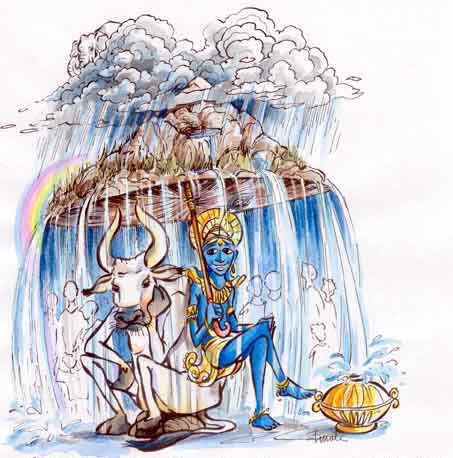
-
Another well known
legend is associated with the third day of Pongal (Mattu Pongal,
or Cow Pongal) says that lord Shiva once asked his faithful
bull 'Nandi' to go to earth and tell the people that they
should have an oil bath every day and eat food only once in
a month. But I guess Nandi turned out to be a confused fellow
as he told the people that they should eat food daily and
take oil bath once a month! This definitely displeased Shiva
and he decreed that, since the people would now need to grow
more grains, Nandi would have to remain on earth and help
them plough the fields. And so the poor bull has roamed the
earth forever. Gee.., all that for getting a message wrong?
Rituals
Day 1
Like any other Indian
festival, the rituals of the Pongal festival are quite elaborate.
The day begins with the purification process of the soul and the
mind by people taking an oil bath in sesame ('til') seed oil.
This is followed by huge bonfires where all the unwanted rubbish
of the house, like old mats, clothes etc., is thrown into the
fire. (The day before, the women have already cleaned their houses,
and preparations were made for the big puja, the religious offering
ceremony, which is performed on first day of Pongal itself.) Very
early in the morning kolams (patterns in rice flour) are drawn
to decorate the front of the houses, doors are sprayed with vermilion
and sandalwood paste, and garlands of leaves and flowers adorn
each and every home.
On this first day, Bhogi Pongal, the rain god is worshipped.
Apart from a collective ceremony in the temple of the village,
there is lots of merrymaking and feasting on freshly harvested
crops; old earthenware pots and other utensils are broken and
potters are asked to supply new stock. It's the time of the year
when the new replaces the old..
Day 2
The second day, Surya
Pongal, is dedicated to the sun god. On this day, sweet rice known
as 'Pongal', is cooked in a new earthenware pot which is placed
where the puja is to be performed. Fresh turmeric and ginger are
tied around this pot. Then a delicious concoction of rice, moong
dal, jaggery and milk is boiled in the pot on an open fire. According
to the ritual, this Pongal rice is allowed to boil and spill over.
Once the rice is cooked, it is tempered with cashew nuts and raisins
fried in ghee. When the Pongal dish is ready, it is offered to
the sun god on a new banana leaf along with other traditional
delicacies, like vadas, payasam, etc. Some people go to their
plots of land to spray some of the Pongal water on their fields.
Day 3
The third day of Pongal
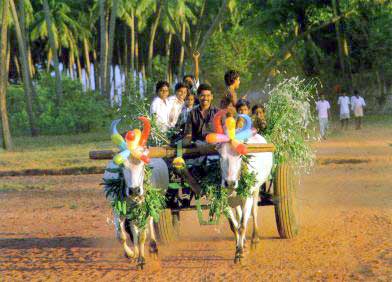
is known as 'Mattu Pongal' or the 'Pongal of the cattle'. On this
day the bullocks from all the houses are gaily caparisoned with
beads, bells and flowers. Their horns are painted and capped with
gleaming metals and colourful plastic balloons. Throughout the
day the cattle is paraded on the streets and in some areas the
famous southern bull fights take place: a vicious bull is chosen
and a handsome amount is tied around their horns and anyone who
can tame the bull gets to keep the prize.
In the villages around Auroville bullock cart races are held,
with families or groups of youth stacked onto the carts that go
racing throughout the area, shouting: Pongal, Pongaloo..! There
is happiness and excitement in the air..
Day 4
On the fourth day of
Pongal sisters visit their brothers. On this day the youngsters
of Chennai, for instance, take a holy dip in the sea. Those who
don't want to get into the rituals of a festival also hang around
the beach, just for fun with their family or friends. In the villages
around Auroville, shopkeepers give gifts or a bonus to their employees
to show their gratitude for the hard work they have done through
out the year.
Throughout the four days of Pongal there is exchange of sweets
and presents between family, friends, neighbours, employers and
employees, as a symbol of unity and tradition that is passed down
to new generations.
These festivals not
only bind us together but also bring us together in the joy of
reaping the fruits of our hard work and labour, together as a
family … the way India has always been. And the future township
of Auroville, some of whose residents have pretty much "gone
native", plays along..
Pongal recipe
If you feel like getting
traditional and making your own Pongal, here is how to:
Ingredients
-
2 liters milk
-
10 almonds
-
1 1/2 cups newly harvested
rice
-
1/4-cup moong dal
-
15 cashew nuts
-
1 1/2 cup jaggery (raw palm
sugar) grated
-
30 kishmis
-
1/4 level teaspoon nutmeg
powder
-
1/4 teaspoon saffron crushed
-
1 teaspoon cardamom powder
-
2 tablespoons ghee
(clarified butter)
Method
-
Chop almonds and cashew nuts
-
Clean kishmis
-
Pour milk in the earthen pot
(called `Pongapani') and place it on fire.
-
When the milk starts boiling
add rice and dal, after washing
-
As soon as the rice and dal
are cooked to softness, add jaggery and ghee
-
Let it cook on medium fire
for some time and then put in almond and cashew nut
bits, saffron, nutmeg and cardamom powder
-
Lastly put in the kishmis
-
Bring to one or two good
boils
Enjoy it!
|
|