The following article is
part of a book on 'Kolams' being prepared for the Tamil Heritage Centre
book collection, to be published by the Auroville Press. A team of
Aurovilians is working on this collection in order to give a glimpse of
the richness and diversity of the Tamil culture that so gracefully
accepts Auroville in its midst.
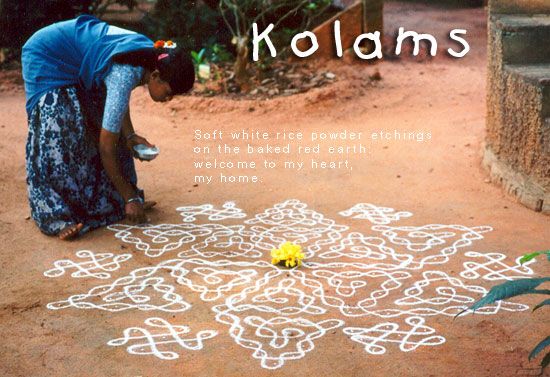
The 'kolam' is a symbol of an open heart and an auspicious welcoming.
Its colourful, devotional presence in the villages in the Auroville area
is a well appreciated and respected feature, and we're happy to share
some of its touch with you through this page..
From heart to hearth
Each day before the sun
rises, millions of women in south India say silent prayers as they
sprinkle their hearths with rice powder or chalk to make kolams and
invite the divine to grace their homes. The kolam -an ancient Dravidian
geometrical motif - combines form, movement and colour to announce each
new day. In Tamil, the word kolam implies beauty, form and play; it is a
quiet ritual full of grace to make the home a sacred space.
Women have drawn kolams before the entrances to their homes for
centuries. Kolams may be linked to the earth, the stars or special
festivities, but they are first and foremost a conscious offering to
Mother Earth. They are prayers for prosperity, joy, wisdom, good health,
and friendship. Their pretty patterns make villages and towns more
festive, joyful, and devotional.
Daily ritual
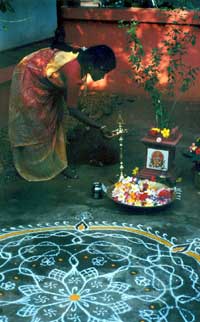 Just before daylight, a village woman prepares the ground before the
entrance of her house. After the day's initial tasks are done, she
sweeps the front porch area with a broomstick made of coconut fronds.
The sound of her broomstick striking the earth resonates with those of
other women who are also sweeping their thresholds. Soon there is an
orchestra of brooms signaling to those still in bed that morning is
coming and that it is nearly time to rise.
Just before daylight, a village woman prepares the ground before the
entrance of her house. After the day's initial tasks are done, she
sweeps the front porch area with a broomstick made of coconut fronds.
The sound of her broomstick striking the earth resonates with those of
other women who are also sweeping their thresholds. Soon there is an
orchestra of brooms signaling to those still in bed that morning is
coming and that it is nearly time to rise.
After sweeping, she prepares her earth canvas by first coating the
ground with a mixture of water and cow dung, which has been chosen for
its purification value. Then, with deft and nimble fingers, she first
lays out a regular pattern of dots with white powder. By letting the
powder run smoothly between thumb and forefingers as if she were pouring
dry water, she composes a continuous line, which turns and twists around
the initial dots. Some women can draw up to four lines at once, as the
powder slips through poised fingers. Sometimes a woman knows a pattern
by heart, and sometimes she will create a pattern that is entirely new
and unique. Each type of design has a name and a symbolic meaning. On
festival days, kolams are particularly large and magnificent.
Painted prayers
Crossing a threshold, or vayipati in Tamil, is a conscious event. Kolams
link the private realm to communal life, hospitality to guests and
passersby, the personal and familial to the divine. In this way, more
than a transient art, they are a conscious science. They are a subtle
bridge between the intimate home and the vast and challenging world
beyond. In ancient times, wandering sadhus would enter a village with
kolams gracing the thresholds of village homes and know something of the
lives of the inhabitants of each house. Abundance, hardship, aspirations
were written on the earth with a few lines and dots or the absence of
them.
Essential ingredients
Until recent times, kolams were most often drawn with coarse rice
flower, thus serving as a conscious offering to nature's creatures. Rice
flower is seen as an offering to Lakshmi, the goddess of rice. In south
India, where wealth is measured in terms of rice fields, Lakshmi plays
an essential caretaker role to assure the family's continued existence
and survival. The goddess has the power to attract wealth and prosperity
and to prevent poverty from entering the home.
Today, especially where rice is expensive, kolams are made of powered
limestone, red soil or chalk. In some regions salt, turmeric powder,
flowers, rocks, stones and sawdust are also used. Some women cannot
resist the more colourful store-bought artificial chalk power tints and
the technicolour world of magentas, emerald greens, turquoise and cobalt
blues. Plastic sticker kolams are also used and herald city life and a
different set of priorities for a woman's time..
Infinite patterns
Myriad kolam designs exist, - to mention just a few:
-
Nalvaravu, or welcoming
kolams, say that a home is open to visitors and friends. They are
especially used to welcome wedding guests for the most important event
of a woman's life.
-
Thottil Kolams, or cradle
kolams, are created for the naming ceremony of a newborn child. The
cradle kolam is drawn and paddy is spread in the middle of the kolam. A
song is then sung praying for the health and long life of the child.
-
Circle kolams originally
signified water and were often associated with the abode of gods. Today
they represent a recipient for the favourite goddess Lakshmi, goddess of
wealth, to manifest her abundance and bring health and prosperity to the
family.
-
Snake kolams originally
evoked the spiraling of life forces and the aspiration for an evolution
in consciousness. Today they are often used to protect the house from
thieves, evil spirits or unwanted visitors, as is the spiral in the
Sumerian and Egyptian cultures. These kolams are a kind of curse
catcher, or emotions screen to keep the household pure and serene.
Negative spirits are not necessarily wandering outside the house. They
may be seen as ill feelings in ourselves. Thus, there is a call to wake
up and be purified in mind and thought.
*Kolams are known by
different names in different parts of India. Hase in Karnataka, muggulu
in Andrapradesh, chowkpurna in Uttar Pradesh, alpana in Bengal and
Assam, and rangoli in Gujarat and Maharashtra.