 |
|
|
|
Home > Environment & Bioregion > The web of life > Birds in Auroville > More owls |
|
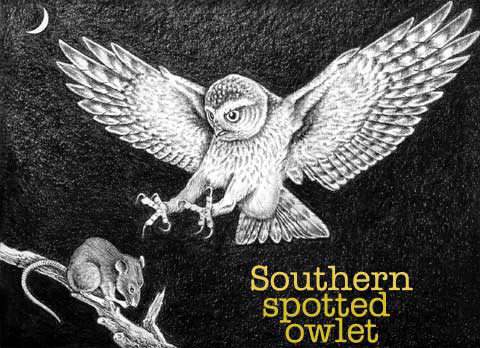
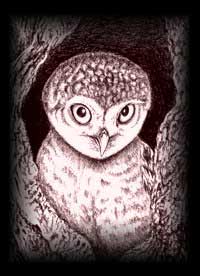
'Athene brama brama'
This is the most common owl not only in Auroville, but throughout India, and its harsh chattering, squabbling and chuckling calls are familiar nighttime voices. Not that it limits itself to making a racket at night - being rather diurnal, its call can be heard at any time of the day too, especially when it competes with mynas for nest holes. Eclectic by nature, it preys on anything its size will allow it to overpower, and at any time of the day or night. Able to survive in all types of habitat (even in the heart of the urban jungle), it adapts well to the changing environment quite admirably. One can often see it perched on a streetlight or hawking insects around it. Efficient predatorCute? Comical? So it may appear to be, but make no mistake - this little bird (the smallest of Auroville's owl, standing only 8 inches tall) is an efficient predator - a killer well equipped with sharp beak and claws to deal quickly and efficiently with rats and insects (its usual prey). In defense of its nest it has been known to kill cobras (Lei Whittaker in 'Snakeman') and knock down humans from Palmyra trees (ask this writer whose motive was to collect pellets, or innumerable toddy-tappers whose role in the inebriation of many Pondicherryans goes largely unnoticed). Reasonably sociable, it lives in small parties; individual pairs usually separating at the advent of the breeding season (March and April, the same as that of the Collared Scops in Auroville), though they may remain in close proximity of the main group. Often each Palmyra tree, just a few metres apart, harbours a breeding pair and their young intermingle. The owlet can survive in close proximity to humans on its own terms - indeed, such a species is blessed, in this case more than doubly so (just look at its scientific name).
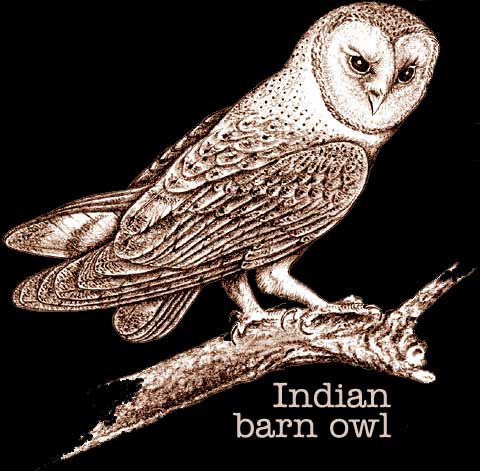
'Tylo alba stertens'
A pale disembodied ghostlike form floating silently in the still dark night around Matrimandir or Bharat Nivas is sure to startle the uninitiated or the impressionable. There are those who instantly recognise it to be a Barn owl - the same bird known in Tamil as 'Chãvu Kuruvi' (bird of death). As it is believed to be the harbinger of death to the house on which it perches, it is generally abhorred by the local population of Auroville's bioregion. This impression may be heightened by its startingly human face, dark staring eyes and discordant eerie shrieks, chuckles, snores and hisses. A veritable angel to AurovilleFables and superstitions aside, the Barn owl is a valuable member of Auroville community - a veritable 'angel' in disguise by combating the great havoc wrought by the great variety of rodents in the fields: a single Barn owl chick can get through 3 good sized mice every night and a family of 2 adults and their 5 chicks over 20 mice every 24 hours (Simon King in "BBC Wildlife", Jan. 1995). Around human habitationStanding little over a foot tall, the Barn owl
is not as imposing as the Eagle owl, but is equally, if not more
effective as a predator - it is definitely the most effective predator
of murine rodents in urban and rural environments. It hunts and breeds
in and around human habitations - even in the space between ceiling
and roof of a building, whether deserted or occupied. Outstanding acoustic abilitiesUnlike owls of the Strigdea Family (to which the 3 other owls of Auroville belong), the Barn owl relies entirely on its hearing to locate its prey. It's acoustic abilities and adaptations are outstanding - the conical heart shape facial disc acts to gather sound waves and its asymmetrically placed ears give it 'binocular hearing' - allowing it to pinpoint prey in pitch darkness without any visual aid whatsoever. Persecuted by frightened men..So much more can be said about this nocturnal raptor, but the sad fact is that this owl is so persistently persecuted by frightened men - all due to centuries of superstitious beliefs and imagined ferocity (this state of issues is not confined to 'backward' India alone, members of so-called 'progressive' societies indulge in even more barbarous acts of cruelty - one is always reminded of the tradition of nailing these birds to barn doors in 'cultural' Europe). But, as one needs be content with small mercies, the Barn owl finds a safe home in 'enlightened Auroville'.. Or does it ?
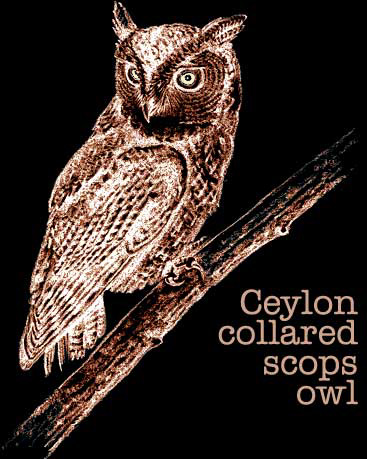
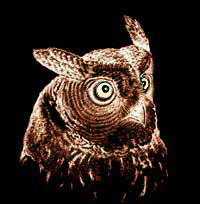
'Otus bakkamoena bakkamoena'
Eternal Salim Ali described it as "a pretty
little horned owlet". Standing no more than 10 inches tall, it is
the least known of Auroville's owls, though not at all uncommon in the
groves and forested tracts which are its preferred habitat. Highly territorialUnlike the closely related common Scops owl 'Otus scops', which lives a somewhat social life, this species is highly territorial. (We know of one Aurovilian who has a Collared Scops owl, 'Spenser', living in her toilet cupboard, who most pugnaciously defends his territory, i.e. the toilet and its environs, even preventing some visiting humans to enter the place..). What little is known about this owl in India can be ascertained from the fact that though it has been established that it lays 3 to 5 eggs in a tree hole in January and February (March and April in Auroville as in Sri Lanka), the period of incubation and the share of sexes in domestic duties has not been recorded. Feeding on insects and geckosContrary to popular literature which leads us to believe that the species feeds on mice and small birds in addition to insects and lizards, the owls in Auroville subsist on insects and geckos., The vast majority of insects predated upon by this small owl are members of the grasshopper group (Orthoptera) and termites - often over a hundred in one night - though cockroaches, beetles and spiders are also consumed among others. As such, this bird is of immense value as a biological control agent. Succumbing to pesticides..Alas, as is usually the case, all is not well
with this petite member of the Auroville community. Pesticides, which
most unfortunately are still widely used for cashew cultivation in the
villages around Auroville, have taken their toll: the number of
Collared Scops owls being found 'ill' in cashew topes has attained
alarming proportions.
Contact: aranya@auroville.org.in |
|||
|
|||
|
|||
|
Environment & Bioregion > The web of life > Birds in Auroville > More owls |
| Auroville Universal Township | webmaster@auroville.org.in |   |