|
|
|
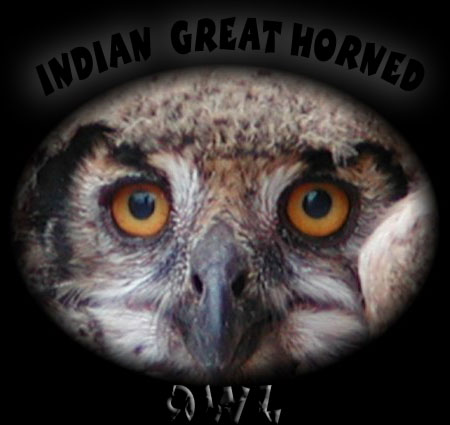
(- or Indian Eagle Owl, or Rock Horned Owl, or Bengal Eagle Owl, Bubo
bubo bengalensis, Franklin)
Rarest creature
Apparently the rarest avian creature in the Auroville bioregion is the
Bubo bubo bengalensis, the Indian sub-species of the Eurasian eagle
owl. Confined to peninsular India, Sind in Pakistan and Marakan in
Burma (where it may now be extinct), it faces a high risk of total
extinction in the near future (conservative estimates put the
country-wide population of breeding birds at less than 2,000 pairs).
Reasons for its endangered condition
An inhabitant of the deeply scored ravines and gullies, it clings to a
precarious existence as human pressure drives it out of its preferred
habitat (land development activities treat ravines and gullies as
sewage dumps, the rock faces are intensely mined for pebbles and 'blue
metal chips', and erosion leads to build-up of silt, which slowly but
steadily fills up the canyons). The indiscriminate use of pesticides
in the environment, which steadily build up in the tissues of this
bird, rendering it infertile (adding to its mortality), is another
apparently insurmountable problem. Add to this local mythical beliefs
(which consider owls as creatures of ill omen and harbingers of death)
and the general apathy towards the plight of this species by
environmentalists themselves, and their future looks very bleak
indeed.
Peculiar and distinctive 'who-whooo' call
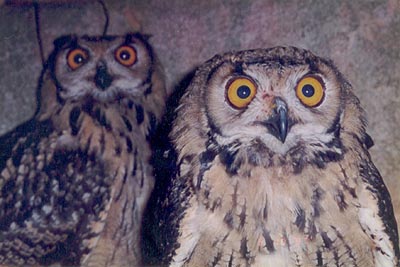
This impressive bird, with its arresting orange-yellow eyes, can be
seen in the Ravena, Forecomers, Success, Utility and Bommaiyapalayam
canyons. It spends the day sitting motionless in a cleft in a rock
face or under a bush, relying on its cryptically coloured plumage for
camouflage. At dusk it sets out from its hiding place, preceded and
accompanied by its peculiar and distinctive 'who-whooo' call, which
though not loud, has a curious far-carrying quality.
Predatory nature
The various species of rodents found in these parts (gerbils, mice,
mole rats and rats) constitute the prey base of 'Bubo bubo' (a single
owl has been known to consume nearly 300 rodents in a year), and the
predatory nature of the species keeps their numbers in check. At times
other birds, snakes, lizards, frogs and even other owls are consumed.
Breeding habits
The breeding period in these parts of its range is from December to
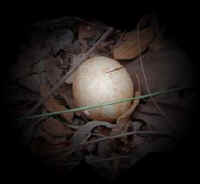
April. Sometimes three, but more commonly two, eggs are laid on the
ground in a sheltered spot among the rocky cliffs (no nest is made) at
staggered intervals. After an incubation period of approximately 45
days, the eggs hatch, again at irregular intervals, so much so that
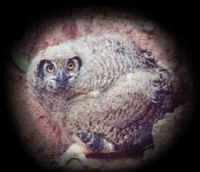
when the last chick emerges the eldest is 15 days old and capable of
feeding by itself. Usually only one chick survives (cannibalism and
Cainism is all too frequent - the larger chick killing and eating its
younger nest mates). The survivor matures rapidly, and is capable of
flying in less than 45 days.
Unfortunately, most details concerning the
natural history of this bird remain unknown and shrouded in myth.
Hopefully, at some stage, someone will make an effort to unravel the
fascinating secrets of its private life before it's too late; in fact,
the sooner the better..!
Photographs
by Dr. Claire Elouard.
|