|
Dec 2001
Greening the canyon
- by Kireet (Gerard Jak)
A flock of silver
coloured birds crosses a steel grey autumn sky. The egrets are back
again - a sign that the rains have started. Intently, I await what the
monsoon will bring this year.
The last two years the monsoons were mediocre at best. This year, so
far, some rains have showered their blessings on the thirsty land, but
hopefully they are just a prelude to an intense downpour to follow. By
mid-December we will know if the rains have brought abundance or, if
there will be scarcity again.
Three years ago I started
building check dams in Auroville. By now I am finishing check dam number
28. This year's dams were built in the Auroville communities of
Certitude and nearby Gratitude and in the surroundings of the coastal
village of Bommayarpalayam. The work received a big financial boost from
the Dutch group "De Nieuwe Gemeenschap" whose members now
visit Auroville yearly. Their financial support allows me to construct a
few more earthen check dams in the Success canyon, a work that will
start as soon as the monsoon is over, and then the money will have run
out.
Two large canyons have been
fully canalised and no longer transport rainwater to the sea. The water
flow is halted by the check dams, forming small lakes that, within a few
days, seep down into the underground. Doing so, the groundwater level
increases which, we hope, will bar seawater intrusion into the
groundwater.
The check dams have been
built in such a way that an overflow can reach the sea. This would only
happen when it would rain a few dozens of centimetres daily for at least
a week, - something, I admit, I am waiting for. I would love to see the
large check dams being tested and witness the waters cascading over
their tops. But so far, sadly, I have never been able to properly answer
those who wish to know if my dams 'hold' and how it is to swim in the
lakes.
The check dams change nature considerably. There is a definite greening
going on in the canyons where, three years ago, I built my first check
dams. Trees, bushes, creepers and other plants have spontaneously
emerged. Within a few years they will provide an impenetrable barrier,
provided that the villagers won't cut too many trees for firewood. The
explosive greening, however, is not to everyone's liking. Aurovilians
who love to go on nature discovery tours, complain that canyon walks
have become all but impossible. The flora ensures that rainwater seeps
quicker into the underground and it holds the red earth and the topsoil,
which otherwise would flow into the Bay of Bengal. The earth remains wet
for a longer period, and that in turn stimulates more plants to grow.
And without any need for human intervention, the canyon's biotopes
recover.
T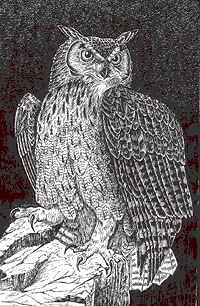 he
beginning of this process can be witnessed in the recently finished
Utility canyon. The white sand is being covered by red earth, the first
grasses come up and small plants mature. Its flowers attract insects and
large, colourful butterflies; they in turn provide food for small
mammals, reptiles and birds. So far I have seen wagtails, brahminy
kites, shikras (a small hawk), the hawk cuckoo also known as the
brainfever bird, green bee-eaters, metallic blue kingfishers,
redwhiskered bulbuls, hoopoes and, last but not least, the Indian great
horned owl. This is an impressive bird, who loves the canyon, sitting on
a perch watching for prey. As by grace, it sometimes descends on the
roof of my house, sounding its low-toned bu-bo, with the second syllable
much prolonged. Originally there was only one, but recently I have seen
three of them which is a convincing sign that nature is recovering. he
beginning of this process can be witnessed in the recently finished
Utility canyon. The white sand is being covered by red earth, the first
grasses come up and small plants mature. Its flowers attract insects and
large, colourful butterflies; they in turn provide food for small
mammals, reptiles and birds. So far I have seen wagtails, brahminy
kites, shikras (a small hawk), the hawk cuckoo also known as the
brainfever bird, green bee-eaters, metallic blue kingfishers,
redwhiskered bulbuls, hoopoes and, last but not least, the Indian great
horned owl. This is an impressive bird, who loves the canyon, sitting on
a perch watching for prey. As by grace, it sometimes descends on the
roof of my house, sounding its low-toned bu-bo, with the second syllable
much prolonged. Originally there was only one, but recently I have seen
three of them which is a convincing sign that nature is recovering.
See
also Indian great horned owl
|