Work update
End of April '02
Preparation for the twelve meditation rooms
The workshop at Matrimandir is filled with
the sounds of the grinding, welding and cutting of metal plates.
The air is full of activity – what is happening? The team involved
with fixation of the golden discs is busy preparing stainless
steel disc supports at one end of the workshop. Clamps for the
semicircular benches in the 12 meditation rooms are being given
final touches by a second team. A third group is welding and
polishing the stainless steel pipes that will carry water up
to the top of Matrimandir for cleaning the discs. And another
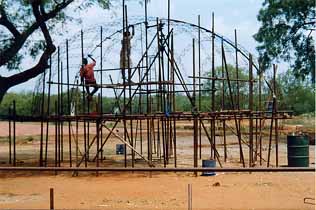
group has set up, on level ground outside the workshop, a to-scale
set of metal ribs forming the skeleton of an egg-shaped dome,
some 7 meters in diameter, that will be used to guide the team
of masons in the final inside plastering of the meditation rooms
inside the petals. This photo shows the dome being built.
Inner skin defined..
And then there
is one new project underway: the fabrication of a special table
for the application of colour to the round windows (a.k.a. portholes)
which are fitted into the middle of each of the ferro-cement
panels which make up the outer skin of Matrimandir. Why are
we going to colour these round windows? Let us take you back
a few steps in our process.
The biggest project
remaining to complete the interior of Matrimandir is the huge
work of making the “inner skin” – that translucent layer that
will cover the 3000 sq m of the inner face of the spherical
space-frame of Matrimandir. Over the last few years you will
have read in these news bulletins of our extended trials and
experiments to achieve the glowing salmon-pink colour - similar
to that of the hibiscus Mother named ‘Auroville’ - that She
indicated to be the colour inside the Matrimandir.
You may have
seen in our bulletins photographs of our attempts to make the
large triangles of the inner skin in coloured glass. (Each triangle
is 3 m. wide and 2.5 m. high!) For fusing the colour onto those
triangles, a huge gas-fired oven, capable of heating the glass
sheets evenly to a temperature of 800° C over a period of several
hours, was built. That last series of experiments allowed us
to develop the glass fusing technique to a high degree of accuracy,
but it also showed that it is extremely difficult to get an
evenly coloured panel using this process and, secondly, that
using Indian float glass, which has a greenish tinge, gives
any coloured panel a dull look. All these experiments have led
us to carry out a new series of trials over the last few months,
and to arrive at a conclusion that now seems sure to bring a
top class result.
The proposal to use large glass triangles
for the inner skin will be retained, but instead of using local
glass we will use European white glass. This glass will be sand-blasted
to give it a frosted effect and it will act as a translucent
white screen which will derive its salmon-pink colour from the
sunlight projected onto it through the round windows of the
outer skin of Matrimandir.
Orangish/pink/salmon colour..
It is to colour these round windows that
we are building a new table in the workshop. The coloured paste
is applied to the glass using a rubber squeegee which is drawn
very steadily and evenly over the silk-screen frame above the
glass. It is all but impossible to do this evenly every time
by hand. Hence the table has been designed to hold the squeegee
firmly and then to run it smoothly, on rails, over the glass,
avoiding any bumps or jerks. The glass is then put into the
large gas oven and the colour becomes fused to the glass. During
the month of March a very interesting and colourful experiment
was carried out inside the Matrimandir to assess this new proposal.
All 800 round windows of the outer skin
were covered with a plastic that had been painted to yield the
orangish-pink colour. Suddenly the atmosphere inside the building
was transformed! Bright pools of sunlight coming through the
windows of the lower hemisphere became subdued fields of colour.
The concrete structure itself seen from the first and second
levels took on a pinkish hue.
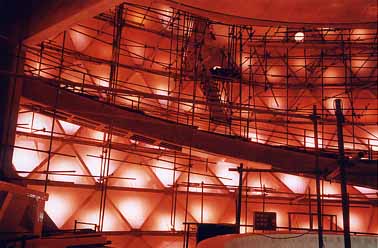
The entire inner surface of one of the four
quarters of the sphere was covered with a layer of translucent
tracing paper, to simulate the effect of frosted white glass
over an area of several hundred square meters (see photo below).
For the first time, one could get a realistic impression of
how the coloured skin will be – for the light from the round
windows was thrown onto the tracing paper, giving a sweeping
orangish glow to the entire surface.
It was necessary to make this large-scale
experiment as a tool and testing field to make final adjustments
in the colouring of the round windows, and to be sure that the
overall effect of the colour was pleasing and neither too bright
or nor too dim.
The experiment was viewed by one and all.
Tests were also made on artificially lighting of the inner skin
for the evening and night hours when there is no external light
from the sun.
Now the way forward seems clear –
in the workshops preparations have begun to set up the stages
of the manufacturing process that will engage a large part of
our attention and energy over the next three years.
To reach this point we have had to
go through many experiments, as was indeed the case for the
golden discs of the outer skin of Matrimandir as well as for
many other elements, which form part of the structure today.
And more tests will surely be called for as we go along.
Contact: matrimandir auroville.org.in auroville.org.in
|