Matrimandir work update
March / April 2003
Placement of discs
It is early February, and another row of discs
is being winched up into place on the lower hemisphere of Matrimandir.
This row, the third below the equator of the sphere (see drawing
below, location [1]) is well under the inward curve of the globe,
so that as we work to fix each disc we see the curve of the building
arching out overhead. When this row is finished we will start
the measurements for fixation of the discs at the very bottom
of the sphere and work upwards to meet the rows above. This will
allow us more time to finalize the intricate job of preparing
the base frame and details of the decorations that fit around
each of the four main entrances to Matrimandir. At the end of
February, a total of 1,108 discs out of 1,400 have been fixed
on the sphere.
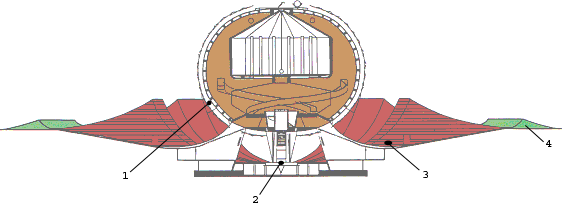
White marble slabs for pool under structure
Underneath the sphere, on top of the concealed
water tank below Matrimandir, beginnings are being made to plan
in detail for the construction of the 7m diameter pool that is
proposed to be created there in white marble slabs. (see drawing,
location [2]). This pool will receive the focused beam of the
sun's ray after it has passed through the Inner Chamber and down
through the center of the central staircase. In a very symbolic
representation, the light of the Sun, the Truth, is descending
visibly here to touch and illumine Matter at its most concrete
level in the shaded pool below Matrimandir.
It will be wonderful, in perhaps a year or
so, to be able to sit here on the cool stone cladding around the
pool and watch the sunlight play in the moving waters of this
"thousand-petalled" pond.
Meditation rooms inside the petals
From this point near the pool below Matrimandir,
the inner slopes of the twelve red sandstone petals sweep outward
and rise upwards towards their peaks overhead.
Inside each of these petals a meditation room is under construction
(see drawing, location [3]). This past year has seen a great burst
of activity in these rooms. The work done has been to perfect
their spheroid shapes by plastering the interiors of the domes
and then to begin to install the benches and marble flooring that
are common to each room. After the marble floors are laid, each
room will be painted in the distinctive colour representing each
of the qualities as given by Mother:
Sincerity: light blue,
Humility: deep green,
Gratitude: pale green,
Perseverance: pale yellow,
Aspiration: orange yellow,
Receptivity: orange,
Progress: orange-red,
Courage: red,
Goodness: reddish violet,
Generosity: pure violet,
Equality: blue violet,
Peace: deep blue.
Small 'Existence' petal
Outside the petals, and just in front of the
workshop, the solid red Auroville earth has been shaped to form
the wide low base of the small petal of Existence, the eleventh
of the set of twelve which surround the Matrimandir (see drawing,
location [4]). On February 20th, the day before Mother's birthday,
in a full-day of concreting, this shaped earth was covered with
a solid concrete foundation layer. After adding a second layer
of concrete, we will clad this small petal with slabs of red Agra
sandstone in the same way that the other small petals and the
Amphitheater have been clad.
Imminent departure of the workshops..
The twelfth and last small petal remaining
to be done poses a challenge for us; because in order to shape
and concrete it properly we have to remove our carpentry section,
marble storeroom, and generator rooms! The Matrimandir structure
is now coming right up to our workshop floor saying: "Get
ready! - it's soon time to move!"
The Matrimandir in its entirety is stretching
out and pushing to be fully manifest as soon as it can!
April 2003
In 1969 the Mother said in one conversation:
"It has been decided, and it will remain decided, that the
Matrimandir will be surrounded with water". She knew that
it would take time, that the question of how to get the water
to fill this lake was a part of the much larger question of how
to find enough water to supply the growing city-to-be that she
envisioned..
Experiments in pond sealing
The subject of this newsletter is not how
we are going to get that water (this we have touched in our letter
of December) but rather how we will hold it, how we will try to
keep it from soaking into the thirsty red soil, once we have got
it.
Here lies a major challenge, and one that
has touched off innumerable experiments in pond sealing since
the very beginning of Auroville. Besides the obvious approach
of simply creating a cement or concrete basin (which experience
has shown are much too prone to cracking to be useable in the
long run), we have been very much drawn to various approaches
which are more natural , using some sort of clay layer to accomplish
the task.
Existing water network
Auroville, remember, is surrounded by one
of the most well built and widespread networks of manmade lakes
in the world. These village tanks, the pride of Tamil Nadu have
been the mainstay of rural agriculture here since antiquity. Almost
every village is sustained by a large seasonally fed lake which
catches and stores the monsoon rain within the confines of a large
earthen dam, called a 'kolam'. During the hot summer months these
kolams slowly release life giving waters to the crops of rice
that are grown down slope from these reservoirs.
Need for all-time full lake
But these lakes, though inspiring in their
demonstration of the possibilities, are definitely seasonal…..they
are brimming full in December (if the monsoon has arrived and
delivered its wealth of rain!), but by May they may well be completely
dried up. They have provided enough water for the growth of the
crops, and their job for the season is thus fulfilled.
At Matrimandir, however, the need is to have
the lake full, or reasonably full, of water all the year round.
And thus we need a lakebed capable of holding the water, of not
letting it seep through. The village tanks are semi-sealed by
the effect of the accumulated silt and clay deposited by the inflowing
waters over decades, but that seal is not effective enough to
hold the water in for the full year.
Scientific studies
To study this problem of sealing scientifically,
help has been taken from a well known German institution, the
LGA, who have a considerable experience in various techniques
of lake sealing. To them we sent samples of the soils that are
found at different depths in the ground here (near the surface
one finds the famous red earth of Auroville, but deeper down,
say below two or three meters , there are more gravelly soils
and yellowish clays).
The results of their studies showed that the
red Auroville soil, when mixed with just two percent of a pure
clay called bentonite, could be formed into a top quality seal
for the future lakebed!
Implementation
In mid March two experts from that German
company arrived in Auroville to help the Matrimandir team conduct
a first trial using their proposed technique to seal a small lakebed
at the edge of the Inner Gardens.
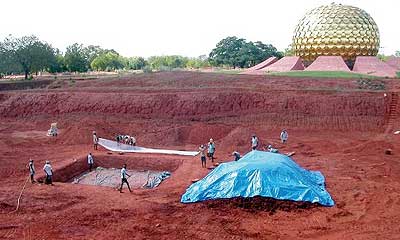
The test pond under preparation
(the large mound covered with plastic is the mixed red soil
and bentonite being protected from the sun).
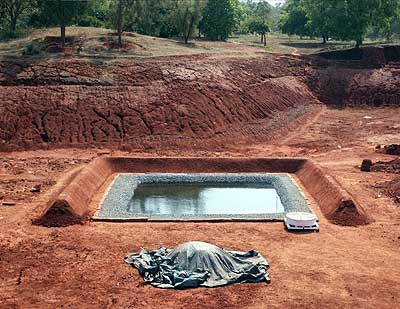
The completed test pond.
The circular basin at the lower right corner of the pond is
a water-filled device
used to monitor the rate of evaporation.
Last year, on the south eastern edge of the
gardens a large excavation had been made (50 meters wide and 4
meters deep) to begin in earnest the Lake project.
Now, in the center of this crater, we have dug out a second smaller
depression (8 meters x 8 meters x one meter deep) which was to
be the site of our trial.
Description of the process
The critical aspects of the new method of
sealing are to first create the proper mix of red soil and bentonite,
with just the right amount of water added , and then to compact
it in layers of twenty centimeters of so. First the flat layer
to cover the bottom is laid and compacted, and then the more time
consuming process of building up thick walls in the same material
is begun.
For the process of compaction, we used the
old heavy road rammer that we have on the site. In future, for
a larger job, a much more specific type of compactor, called a
'sheep's foot compactor' because of the specially shaped metal
protrusions on its base plate, would be required. The German experts
were at first horrified at our diesel driven monster, but soon
enough they had come to appreciate the effectiveness of this old
relic!
Learning the trade..
The building up of the sides of the test pond
took several days as everyone learned the techniques and tricks
of handling the clayey soil mix and the road rammer, but finally
the job was done. During the whole process of constructing this
test sample, which was carried out under the full burning sun,
great care had to be taken to keep the earth mix from drying out.
That would have resulted in the formation of unrepairable cracks
in the mud structure which would have meant the defeat of the
whole purpose of the project. Once the work was done and the pond
filled with water, then it was safe from this principal danger,
except for the exposed top edges of the side walls. To protect
these, a thin layer of plastic was used to cover them, and this
in turn was covered by a thick layer of pebbles.
Monitoring the water level
Presently the test pond is ready and we are
in the phase of monitoring the level of water in the pond. We
will see if the level of the water drops at a rate which is more
quick than the rate due to the natural evaporation of water from
the upper surface of the pond. If it does, this would mean that
water is being lost through the bottom of the pond.
We are very hopeful, based on the experience
of the German consultants and on the tests that they have done
with our soil, that this experiment will prove successful!
In our next news letter we will
give you the report on the progress of this work. If successful,
this experiment will literally pave the way for a much larger
test in the months to come.
Contact: matrimandir auroville.org.in auroville.org.in
|