Matrimandir work update
December 2002
December 2002 A Walk in the Peace Area
During late November and December an
interesting series of walks has been taking place in the Matrimandir
Peace area. These walks are meant to familiarize every Aurovilian
with the actual situation on the ground today after some 34 years
of gradual development.
Start at the Matrimandir office
The walk begins at the present gate of the
Matrimandir office, on the road which runs through the Western
side of the Peace area towards the industrial zone of Auroville
and the villages beyond (you can follow the path of the walk on
the map below). Standing at the office gate one learns that on
this side of the Peace area there are still three plots of land
that have not yet been purchased by Auroville! Thus the shifting
of this temporary road and the development of this side of the
Peace area are not yet possible. Efforts are currently underway
to negotiate for these lands.
"Elephant ear" tree
Moving along the road in a clockwise direction,
one comes quickly to one of the largest trees in this area, the
"elephant ear" tree (Enterolobium).With its one meter
wide trunk and 12 meter height, it is one of the 380 trees that
have been planted in the Park area over the last 30 years. It
stands here as a giant reminder of the enduring aspiration to
create a place of verdant beauty in this once barren land.
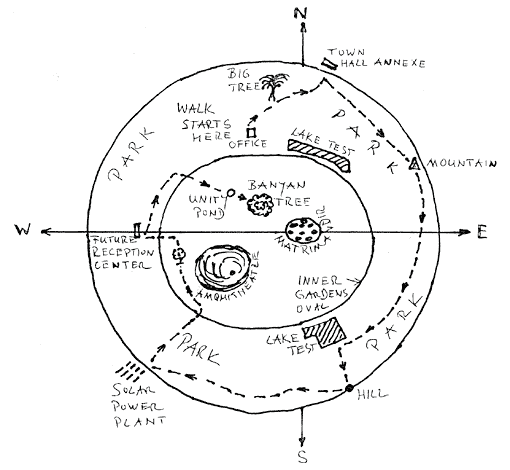
Map of the Peace Area
Town hall annex
Rounding the bend one comes to the site of
the new "town hall annex", a large structure designed
to house several Auroville services. Our guide points out that
this building sits virtually on the northern edge of the Peace
Area, about 300 meters from the sphere of the Matrimandir. In
one proposed version of the town plan for the Center area, there
would be a wide Lake stretching from the edge of the Inner Gardens
up to this building. However, in the working version which had
been agreed upon for the past 30 years there would be a narrow
lake surrounding the Inner Gardens and a Park extending up to
this limit.
There is at present an intense debate going
on within the community about these two different approaches to
the planning for the Center area, including the fundamental question
that it raises.
What should be the relation of the Matrimandir
area to the rest of the city? Mother had spoken of an "isolating
zone" around the Center, and of "tall aspiring trees"
which she said represent harmony and aspiration. These words,
and others, indicate that the concentrated quietude of the Peace
area was intended to be sheltered from the more dynamic, more
outward movement of life in the rest of the city. Mother, in her
practical wisdom, seemed to be well aware of the need to isolate
this area at the core of the city by means of a protective belt.
A 100-meter wide lake outside the Inner Gardens certainly would
not provide any noise barrier and would leave no space for a Park.
On the other hand a moderately sized Lake with a substantial Park
area around it would create this isolating zone.
"Mountain" area
We leave the town hall and proceed on the
walk along the road arriving soon at the service entrance to the
workshop area of Matrimandir. Here, to our left we see the beginning
of a mountain - a huge pile of red and yellow earth that has been
built up over the last 10 years with earth from several sources.
The bottom layer consists of soil from the excavation of the crater
of Matrimandir in 1971-72. At that time up to 480 men had labored
over months to dig out the foundations for the building. Some
14,000 cubic meters of earth were removed. Much of that original
pile has since been spread around in the Inner Gardens to create
the wave-like contouring that the general plan of the gardens
calls for. The remainder has been used to start the "mountain"
Another source of earth for the growing mountain
has been that which was removed during the excavation of two experimental
lake sections that were made in the last few years - one on the
northern side of the Inner Gardens oval, and one on the south-east.
Mother had indicated in a conversation in 1965 that indeed a mountain
would be made from the soil excavated from the lake around the
Matrimandir. And at that time, she had even said that we should
plant fir trees on this hill, for in the future there would be
snow!
Experimental lake sections
Moving on, we walk through an area filled
with wild neem and work trees behind the workshops. We pass the
gilding shed with its rows of golden discs waiting their turn
to be fixed on the structure. Soon we come to the site of the
larger of the two experimental lake sections, southeast of the
oval. This section of the lake is 50 meters wide and 60 long,
and from our position on the edge of this excavation we can easily
imagine how gorgeous the view will be when the golden dome and
the gardens will be reflected in the waters of the lake.
At this point we learn two important things
about the practicalities of making the lake. The first is regarding
the question of how to seal such a lakebed. How to prevent the
loss by seepage of the precious water that will fill the lake
one day? Throughout the world there are of course many artificial
lakes, and many methods of sealing them, but most of them rely
on costly layers of artificial plastics to do the job. Smaller
ponds are often sealed simply with concrete. For a larger lakebed
concrete is not only unsuitable due to its tendency to crack,
but also due to its cost.
More ancient and cost effective techniques
adopt the use of clay for sealing the lakebed. Recent laboratory
tests conducted in Germany of the local red soils of Auroville
have shown that this soil, when mixed with a small percentage
of bentonite and properly compacted, can yield a leak proof lakebed.
It is planned to test this method soon in a small lake here to
verify that this promising technique indeed holds the solution
for which we are looking.
Where comes the water from?
The second question to look at is the million-dollar
question: where are we going to get the water to keep this lake
full during the long hot months of the Indian summer? The surface
evaporation of water from the lake will be in the order of one
centimeter per day! For a moderately sized lake around the Matrimandir,
with a surface of 30,000 square meters, this would mean that some
300 cubic meters of water are being lost daily through evaporation.
How is it to be replaced each day? To use water from the underground
aquifers of Auroville for filling the lake is out of the question,
as that groundwater is already being extensively used just to
provide water for the daily needs of the residents of Auroville.
Given that the rainfall from the monsoon has
been deficient for the last three years it is clear that rainfall
alone is not the answer. We must look elsewhere for the water
for the lake.
There is another way to get fresh water, and
that is by desalinating the water from the sea. As early as 1965,
during her conversations about Auroville, the Mother referred
specifically to the technique of desalination for obtaining water
for the township. She knew even then that the ground water would
be inadequate to supply the entire city. Taking her hint, we have
begun investigating the techniques that are used for desalination.
These processes are not complicated, and it would seem that a
project could very well be drawn up that would provide drinking
water for Auroville and for some of the surrounding villages,
as well as for recharging the lake at Matrimandir. The next step
would be to build a small plant as a pilot project.
Park area
Walking away now, from this lake crater towards
the edge of the Peace area, we ascend another small hill. This
too has been made from the soil excavated from the lake. From
atop this hill one sees the full sweep of the Park area, with
the lake excavation and Inner Gardens and Matrimandir beyond.
Facing southeast we see the well-spaced trees that have been planted
in the Peace area over the last 30 years. These comprise some
120 varieties of trees from all over the world, and throughout
the year they flower one after the other in a beautiful rainbow
of colors, from the golden yellow of the Tabebuia, the deeper
gold of the Champaks, the white of the Indian cork tree (transformation)
to the reds of the Flamboyant tree ( realization).
Some of these forested areas will become islands
when, in future, the lake winds its way around the oval.
As the group walks now through this wonderful
park none can escape the spell of the beauty that Nature has displayed
for us.
The golden Matrimandir is sometimes concealed
and sometimes suddenly revealed by the trees spread over the gently
rolling contours that give shape to this area.
Solar power plant
After a break for lemonade at the rock garden,
we continue our walk and come soon to the solar plant at the edge
of the Peace area. This plant with its 400 solar photovoltaic
panels supplies a sizeable portion of the lighting needs of Matrimandir.
Originally planned to be near the Amphitheater, close to the Matrimandir
it was moved further away, after much debate, so as not to intrude
on the beauty of the gardens area.
Future reception center
We walk next through a grove of many varieties
of citrus trees on our way to the rose garden, the first of the
gardens to have been developed.
Continuing on we come to the West axis of the Peace area. It is
this 200 meter long pathway which will be the main entrance to
the Matrimandir in the future. At its end, just beyond the lake,
will be the future Reception pavilion. All guests and visitors,
as well as Aurovilians will pass through this center on their
way to Matrimandir and the gardens. This pavilion is yet to be
designed in detail.
Unity pond
We are almost at the end of our journey in
the Peace area. Passing a shady corner we see compost being made
lovingly from thousands of flowers and flower petals which have
been collected by hand. We arrive then at the garden of Unity
just to the west of the Banyan tree that stands next to Matrimandir.
The garden of Unity has at its center a pool lined with granite
slabs. The pool is yet to be filled with water. One feels, standing
here in the wide open spaces of the Inner Gardens that perhaps
it is time now to build this garden of Unity together. Perhaps
it is time to let Unity manifest concretely on these few square
meters of Auroville soil!
Banyan tree
Finally we arrive at the end of the walk as
we come to the banyan tree, and move silently under the wide canopy
of its high branches. Together we have seen many beautiful things
and been given the occasion to consider many thought provoking
topics, from the fundamental questions regarding the relation
between Matrimandir and the city to the technical puzzles involved
in manifesting the lake which will surround the Matrimandir. We
have witnessed the abundant beauty of the flowering groves that
already exist in much of the Park area. We have begun to appreciate
the great amount of work that remains to make the full Peace Area
the marvel that it must become. And we can already sense that
indeed this area is truly destined to become that which Mother
spoke of so long ago when she recalled her childhood visions of
a Park that was "perhaps the most beautiful thing in the
world with regard to physical, material nature."
N.B: The 80-G IT exemption renewal for Matrimandir
has finally come through.
Contact: matrimandir auroville.org.in auroville.org.in
|