 |
|
|
|
Home > The City > Matrimandir > Work update > June 2001 |
|
|
|||||||||||||||
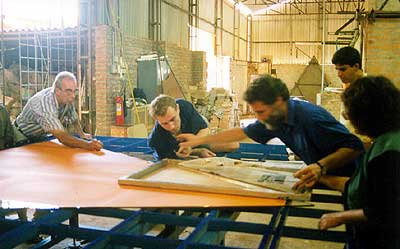
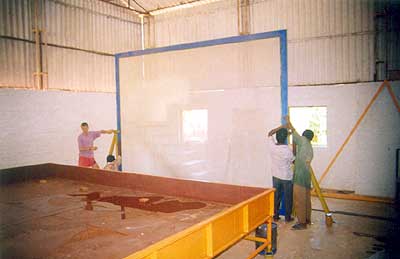
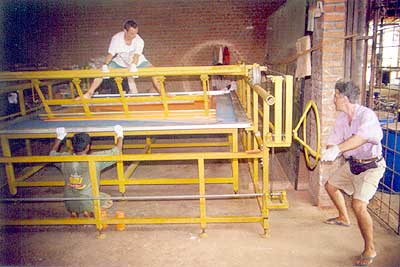
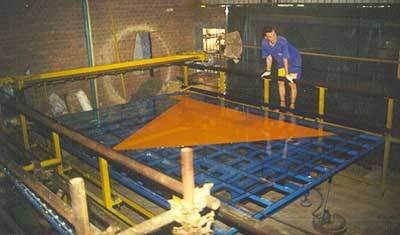
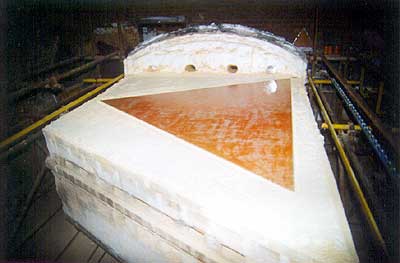
Large triangular glass panelsA large kiln, whose internal dimensions are 4 x 3 mtr x 2 mtr high, was built in 1999 for the purpose of fusing colour onto the surface of 8 mm thick float-glass panels. After being laminated to a second sheet of clear glass for reasons of safety, these panels will be used for the inner skin of Matrimandir. Some 800 panels are required, each triangular in shape and roughly measuring 3 mtr at the base and 2.4 mtr high. (Even though the height of each triangle is the same, the shapes differ considerably.) 4 x 3.6 mtr silk-screen frame
The colour being used is an oil emulsion
containing a mixture of orange and yellow cadmium and other
oxides. The emulsion is passed through a homogeniser to produce
a very fine paste suitable for silk-screen application. Work of great precision
LaminationBefore the coloured glass produced in the oven can be used, it has to be laminated with a second sheet of plain glass of the same size and shape in order to produce a safety glass. This is necessary because the spherical shape of Matrimandir's shell means that large sections of the inner glass surface will be suspended above the heads of those moving around in the building's interior. Thus safety glass is absolutely necessary. The two-glass sheets will be laminated using a resin made specially for such purposes.
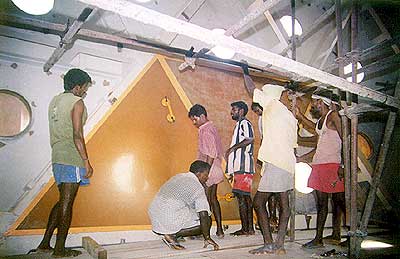
White glass from GermanyDuring the first half of this year, several preliminary samples of full-scale panels have been made and mounted inside the Matrimandir. We have been focusing on the thorough testing of the firing sequence, and details of fixation of the panels to the concrete beams which make up the space-frame of the Matrimandir. The panels will be mounted on aluminium profiles imported from Germany. As for the glass, efforts to identify the best supplier of the white glass needed to achieve the most satisfactory results in terms of the colour have directed us to Germany once again. They may soon be forthcoming. Next row of discsTo come back to the structure itself: a team is busy finishing the set of stainless steel horizontal catwalks that encircle the Matrimandir at the equator. These ladders will provide for access to the outside of the building for cleaning and maintenance for years to come. The platform on which the team is perched has been in its present position for about six months. Everyone is keen to finish work at this level and move downward: everyone wants to see the rows of discs appear beneath the equator. There is no shortage of discs, 85 % of the discs is ready, and from this, 50 % is already fixed, another 35 % is hanging in the stock. (If we can keep up the present pace of production, all discs may have been produced by November this year.) June 15, 01 |
|||||||||||||||
|
|
|||||||||||||||
|
The City > Matrimandir > Work update > June 2001 |
| Auroville Universal Township | webmaster@auroville.org.in |  |