| |
Farms
Annapurna
Auroannam
Aurogreen
Auro-Orchard
Ayyarpadi Farm
Discipline farm
Djaima farm
Kottakari farm
Kottakarai Orchard
Revelation
Service farm
Siddhartha farm
Solitude
Windarra Pannae
|
|
6th Jan '03
Annapurna
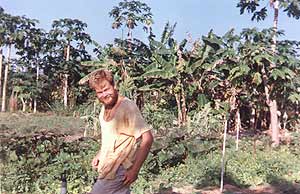 The
largest, but only partly, developed farm is Annapurna. It is located
approximately 10 km. from the Auroville city center, near Vanur, and
has heavy black cotton soil. The farm was started in 1987 and grows
mostly dry land crops such as millet, rosella, oilseeds, rice paddy
and pulses. In the monsoon time wetland rice is being grown. The
largest, but only partly, developed farm is Annapurna. It is located
approximately 10 km. from the Auroville city center, near Vanur, and
has heavy black cotton soil. The farm was started in 1987 and grows
mostly dry land crops such as millet, rosella, oilseeds, rice paddy
and pulses. In the monsoon time wetland rice is being grown.
They utilize a combination of solar and diesel powered
pumps, and are creating a series of water catchment ponds from which
they can irrigate more area, without tapping into groundwater reserves.
They also maintain a biogas converter from dairy manure, for their cooking
fuel needs.
The total area consists of 135 acres of which about half can eventually
be brought under food crops. Today the farm grows food on approximately
20 - 25 acres, the rest of the land being under firewood crops, regeneration
fodder and forest. There are still tracts waiting to be developed. Three
Aurovilians, Andre, Brooks and Tomas (Dutch/ American) are managing
the place.
Annapurna is the only existing Auroville farm where
field crops can be grown on a large scale. It still needs large investments
for the farm to reach its potential. Besides growing food for Auroville,
Annapurna is an active research center for ecological and Biodynamic
farming as well as maintaining a collection of non-hybridized local
seedstock. They keep eight cows, and a small poultry. At present, they
can provide basic accommodation for three farm volunteer workers.

AuroAnnam
Since 1997 Lucas had been
searching for a consolidated plot of land, to develop into a demonstration
site for the cultivation of organic cashew nuts. In October 1998, the
Auroville Farm Group offered the northern corner of AuroOrchard. The
total area is fourteen acres, of which 4 ½ were already under
cashew. As for the rest, there are about seventy coconut palms and some
land had been used for irrigated cultivation of soya, peanuts, gram
and cow fodder, which had become economically unsustainable.
Lucas and his team have put an additional four acres
under cashew, growing peanuts and gram in between. There is a bore well
with an electrical pump and booster pump. Existing sprinkler irrigation
is replaced by a micro sprinkler/drip system. The flood irrigation for
the coconuts will be replaced by heavy mulching, ground cover crops,
and eventually, micro sprinklers. The area already under irrigation
will be more intensively cultivated with various fruits and vegetables.
There is a bullock team for cart and plough work.
A few cows are included, to achieve an optimum ratio between acreage
and cattle, and to decrease the need for outside purchase of organic
manure. In the open fields, mainly fodder crops will be grown.
This farm is part of an
overall strategy for the promotion of organic and sustainable farming,
with a focus on cashew cultivation, and to give an example to regional
cashew farmers. Lucas (German) and Margarita (Columbian are the managers.
So far, the farm has received financial support from two German NGOs.
Lucas is also in contact with Indian NGOs working in the field of sustainable
agriculture, and he maintains links between Auroville farmers practicing
biodynamic farmers, while Margarita promotes EM technology throughout
India and southeast Asia.
Aurogreen
Aurogreen is one of the oldest farms in Auroville.
It is situated on the northeast side of the city in the Green Belt.
It was started in 1975 and is managed by Charlie and Usha (American/
German). The farm covers about 35 acres (of which 13 acres are setup
for irrigation). At the moment, due to serious drought and the great
depth of the water in the main well, no irrigation is going on. A less
deep well will be drilled this year.
Six and a half acres of mango and cashew plantation
are grown under dry land conditions. Aurogreen grows some vegetables
It has a dairy with sixteen cattle and a poultry of 475 chickens which
combine to provide Auroville with milk, cheese and eggs. The farm primarily
supplies to Green Belt residents in their immediate area, Pour Tous,
and the Solar Kitchen Since the water table has gone down drastically
over the years, solar panel pump sets have been installed, combined
with drip and sprinkler systems to replace traditional flood irrigation,
resulting in improvement in the overall dependency on state supplied
electricity and water consumption on the farm. Since the water table
has gone down drastically over the years, solar panel pump sets have
been installed, combined with drip and sprinkler systems to replace
traditional flood irrigation, resulting in improvement in the overall
dependency on state supplied electricity and water consumption on the
farm. As a community, Aurogreen relies on biogas for its cooking needs.
Auro-Orchard
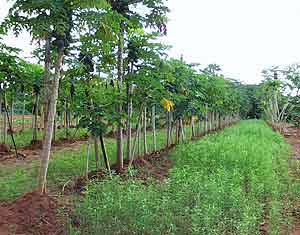 Auro-Orchard,
combined with the neighbouring community of Hope, some roads and buildings,
and a temple to the god Ganesha, comprises 45 acres of land. It was
one of the first pieces purchased, around 1965, by Mother for Auroville,
though real development started in 1969 with the connection of electricity,
enabling the installment of two extra borewells with submersible pumps.
At present, about 35 acres are cultivated: approximately 8 acres under
irrigation, growing coconuts, fruits, vegetables, fodder, peanuts, while
on the remaining 27 acres grow cashew and mango, as well as a very small
area of regenerative forest. Gerard, the original and ongoing caretaker
(Swiss) manages the place with help from Bithi (Indian). The plot of
15 acres on the north side of the road going to AV was transferred to
AuroAnnam in 1999. There is a dairy of 12 cows, heifers and calves,
and a poultry of 150 to 250 birds. Recently solar powered pumps have
been introduced, along with micro-sprinklers to reduce the cost of state
electricity and cut down on overall irrigation needs. Auro-Orchard,
combined with the neighbouring community of Hope, some roads and buildings,
and a temple to the god Ganesha, comprises 45 acres of land. It was
one of the first pieces purchased, around 1965, by Mother for Auroville,
though real development started in 1969 with the connection of electricity,
enabling the installment of two extra borewells with submersible pumps.
At present, about 35 acres are cultivated: approximately 8 acres under
irrigation, growing coconuts, fruits, vegetables, fodder, peanuts, while
on the remaining 27 acres grow cashew and mango, as well as a very small
area of regenerative forest. Gerard, the original and ongoing caretaker
(Swiss) manages the place with help from Bithi (Indian). The plot of
15 acres on the north side of the road going to AV was transferred to
AuroAnnam in 1999. There is a dairy of 12 cows, heifers and calves,
and a poultry of 150 to 250 birds. Recently solar powered pumps have
been introduced, along with micro-sprinklers to reduce the cost of state
electricity and cut down on overall irrigation needs.
"Around the end of March'02 the TNEB supply
of 3 phases current to run the pumps has been the worst in 30 years,
with only 2 to3 hours during the day and 4 to 6 hours at night - with
many shut downs during these times. It is a blessing to have 1 deep
borewell solar pump + 2 booster solar pumps. Now we are forced to reduce
more area (veg and crops) under irrigation."
The initial financial investment in 1969 was paid
by the Auroville administration, as it operated in those days, though
(with Mother's full support) from the middle of 1969 onwards Auro-Orchard
began a new experiment as a "Self-Supporting Unit" (with guidance
and instructions given directly by Mother to Gerard), developing the
farm "acre by acre" by reinvesting all farm profits over the
next 12 years.
"Facing all these difficulties, it looks that it will be near impossible
to make profits or remain self supporting ! We have to "learn to
endure and keep going" (one of Mother's guidance given to us) We
continue . . . . hoping for the best, Auro-Orchard will remain green
! !"
See also: AV
Today Jan '02
Ayyarpadi Farm
After farming for about three years in the community
of Horizon, in January 2002 Murthy moved onto the four acres of Ayyarpadi
Farm, which is located along the road to Kottakarai, behind Bharat Nivas.
Connected to the four acres are another five acres, which he uses for
seasonal crops, until the land will be taken over by the International
Zone.
Presently the farm is equipped with a house for
Murthy and his family, a solar system with submersible pump, a full
irrigation system and a cowshed. The soil is a mixture of clay and sand,
of medium quality. Murthy irrigates a total of three acres, partly with
drip irrigation, for growing cowgrass, vegetables and fruits. On the
remaining acres he grows rice, peanuts and cambu. The permanent staff
is three people plus one amma. The dairy is stocked with 30 cows, yielding
a total of 85 liter of milk daily. The dairy is supplemented with thirty
chickens. So far no biogas has been introduced. Murthy uses organic
pesticides (neem). There will be the possibility of extending the farm,
along the road to Kottakarai in the future.
Discipline Farm
Since the beginning of 1994 Jeff
(Australian) has been running Discipline Farm, which was begun by the
residents around 1968 with intensive soil-building input. Discipline
Farm is situated near the village Alankuppan, on the northern edge of
the Green Belt. It is on situated on 16 acres of land, 1-2 acres are
given over to irrigated crops such as fruits (coconut, banana, guava,
papaya, passionfruit, chikoo and citrus), and are irrigated with an
extensive drip system Five and a half acres are given over to dryland
crops, mainly mangos. There are also extensive vegetable gardens which
are watered mostly by micro-sprinklers and cow fodder which is watered
by large sprinklers. The remainder is forested There is a dairy of 6
cows which is valuable for the manure which is used for the composting.
The farm annually grows monsoon-fed red rice, sesame or black gram.
The number of fruit tree varieties is gradually being increased. As
funds become available, infrastructure such as water tanks and pumping
systems will be improved. The community has begun using a biogas converter,
donated by CSR, for its cooking fuel needs. Accommodation for farm volunteers
is available.
Djaima farm
Djaima farm is a part of the Djaima community, next
to Aurelec, on the way between Kuilapalayam and Bommaipalayam villages.
Kumar and Kala (Tamil) are in charge of the 10 acre farm, which has
very good topsoil and produces fruits and seasonal vegetables. They
have a solar panel powered pumpset on their borewell, with an electric
generator as a backup. There is a small dairy and a poultry of 200 birds.
The project is not self-supporting at this time and Kumar would like
to extend the operation with more cows and more intensive cultivation
of the land.
Kottakarai farm
A long-time agricultural area in Auroville,
Kottakarai Farm is managed by Sundaram and Amudha (Tamil) of the
Kottakarai settlement. The soil is very good, with 2 acres of irrigated
land, 2 acres suitable for dryland farming, 3 acres of orchard and some
forest. They are growing vegetables and rice, traditional millets and
pulses and some oilseeds. The farm produce goes to a lunch scheme at
Isaiambalam School, a bakery and provisions shop, and a food processing
and research center. With so many related industries in the immediate
area the farm is very much appreciated.
Kottakarai orchard
The orchard is an 1 ½ acre plot of land in the
centre of the Kottakarai area, begun in 1974. The orchard contains 93
fruit trees, with other small areas of banana and papaya. The main
harvest comes from the 25 mango trees of 6 varieties. Other fruits
include lemons, limes, pomelo, grapefruit, guava, chikoo, starfruit,
bullocks heart, pitanga, bhelfruit, kumquat, coconut and breadfruit.
There is one cow and one calf.
The orchard is bordered by canyons thick with
natural growth, forming the boundaries. The well and electric powered
jet pump can deliver 7000 litres of water per hour, and there are 2 big
tanks to store 6000 litres each of reserve. There are 3 houses, and
there is also a small guesthouse. The income from the farm is sufficient
to cover the farm's expenses in a good year, supplemented by
contributions from guests.
Revelation farm
Revelation Farm is situated in the Mahalakshmi
park area, extending between the City and the GreenBelt. It has a long
history of productivity, combining dairy, poultry, orchard, vegetable
gardening, some dryland farming and a forest preserve. The overall area
is 10 acres (red laterite soil), with a borewell and submersible pump.
The project is managed by Nathalie (French), who is also involved in the
forest work with her husband Patrick. The Revelation orchard contains a
wide variety of fruit trees, which provide most of the farm's steady
income. They have one quality guesthouse, suitable for a couple.
Service Farm
Service Farm was another of the earliest of Mother's
original land acquisitions. It is located behind Morratandi village,
on 12 acres of sandy red soil. Mechtild (German) is the caretaker, with
an all-women team of village workers, and she has been helped in the
planning and practical running by Walter, a landscape gardener with
many years of experience with plants. A wide selection of fruit trees
are grown there, though parts of the orchard were planted only in recent
years and are not yet bearing fruit.
The farm has a borewell which supplies water into
three tanks with one conventional plus one solar submersible pump. From
there the solar booster pump system irrigates 6 acres of trees, 600
of which are maintained on a 1800 drip grid. Mechtild took over the
management of Service Farm in 1990. She has been investing in it since
then from private funds and with the help of AVI Germany. The farm is
not yet self-supporting because the new orchards need years of care
before returns can be expected. Here also work has begun to improve
irrigation facilities, by installing drip irrigation, economizing water
use. They supply fruits mostly to Pour Tous and the Solar Kitchen, as
well as to the AV food processing units.
Siddhartha farm
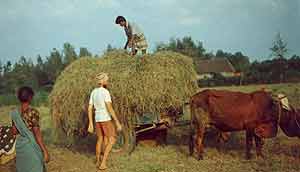 Siddhartha
Farm is located in the traditional rice growing region surrounding the
Irumbai tank system. Herbert (German, formerly Annusuya) settled there,
and is converting the open fields into an integrated farm project. There
is more land in their area offered on the market and Herbert envisions
the farm becoming a large-scale community supported project, growing
a maximum of rice and grains for Auroville. Currently Auroville makes
funds available for the growth of the farm. Siddhartha
Farm is located in the traditional rice growing region surrounding the
Irumbai tank system. Herbert (German, formerly Annusuya) settled there,
and is converting the open fields into an integrated farm project. There
is more land in their area offered on the market and Herbert envisions
the farm becoming a large-scale community supported project, growing
a maximum of rice and grains for Auroville. Currently Auroville makes
funds available for the growth of the farm.
There are a dairy, chickens,
and a bakery on site, which produces whole grain bread and biscuits
(made by Selvi, Tamil). At present the farm produces irrigated rice,
peanuts and sugarcane, but there are plans to cultivate red rice, samai,
kulu, ulundu, varagu, cambu, ragi and sesame.
Solar panels and drip irrigation
are used on most of the planted areas, though a diesel pump is used
to provide water to the paddy fields. The farm uses biogas for domestic
cooking. There is on the farm a two-room guesthouse for volunteer farm
workers.
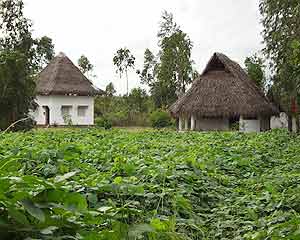 In
July 2000, Priya (English) started a vegetable garden on one and a half
acres of land, close to Herbert's farmhouse. This part of the farm is
called Buddha Garden. She grows vegetables on raised beds, using
drip irrigation and with as little external input as possible. This
means using available biomass and cow dung for making compost, as well
as using green manures of various sorts. The soil is extremely poor
and much work needs to be done to improve it. This is the main work
now, although small quantities of vegetables are being grown. Priya
and her assistant and volunteers/students carry out the regular work
in the garden. In
July 2000, Priya (English) started a vegetable garden on one and a half
acres of land, close to Herbert's farmhouse. This part of the farm is
called Buddha Garden. She grows vegetables on raised beds, using
drip irrigation and with as little external input as possible. This
means using available biomass and cow dung for making compost, as well
as using green manures of various sorts. The soil is extremely poor
and much work needs to be done to improve it. This is the main work
now, although small quantities of vegetables are being grown. Priya
and her assistant and volunteers/students carry out the regular work
in the garden.
>>Buddha
Garden website
Solitude
Solitude was started in 1996, with the building
of Auroville capsules (huts made of bamboo, casuarina and thatch) on
a segment of fallow farmland surrounding an existing open well. In the
first phase of work six acres of land are in use. Krishna (England)
and Vangadesh (Tamil) are concentrating on growing rice along the following
lines: 30% for irrigated rice, 40% semi-irrigated and 30% for dry land
crops. The water is drawn up from an open well at a depth of eleven
meters by means of a solar panel pump set.
They keep cows as well as chickens, and have begun
a demonstration compost project.
Situated opposite Siddhartha Farm on the Edayanchavadi
Road, Krishna and Vengadesh support make good use of this area's potential,
so as to provide a healthy atmosphere for food production in Auroville.
They are still in need of investment in basic infrastructure, such as
a storeroom, threshing floor and improved irrigation system.
Very basic accommodation is available for a few
guests.
Windarra Pannae

Windarra Pannae situated in the Green Belt, is a
farm of 22 acres between the villages of Alankupam and Kottakarai. (Windarra
is Australian aboriginal for 'place to live', Pannae is the Tamil word
for 'farm'). In March 1998 three Aurovilians established the farm to
grow organic food for Auroville.
As of 2001, and in accord with the season, the farm
produces a range of organic foods and a variety of vegetables. Among
the monsoon-crops are peanuts, indigenous grains (such as tennai) and
legumes (such as ulundu and kulu). Green manure crops are cultivated
to enrich the soil.
There is also a fruit orchard. Palmyra, papaya and
banana trees are already producing, and in the future there will be
harvested, among others: coconuts, guavas, jack fruit and citrus. The
farm includes parts where thorny bamboo and various indigenous forest
trees are growing.
The Windarra dairy produces milk and milk products,
and chickens supply eggs for Auroville.
Windarra Pannae get its water by means of a windmill,
a solar pump and several tanks.
The farm supplies food to the Solar Kitchen, the
Centre Guest House, the Information Centre and the Coffee Shop. Many
Aurovilians come to purchase produce directly at the farm.
Presently community members Friederike (with daughters
Leela and Priya) and Kumar (Tamil) manage the farm. Eight other people
work full time, the work including food processing, the saving of seed
and bee keeping. In the high season they work with additional workers.
The farm welcomes visitors and, in a basic set-up,
can accommodate guests who want to be involved in farm work.
|