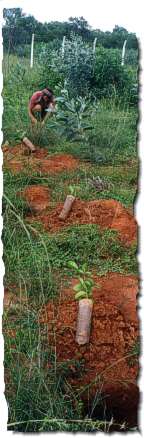
Challenges for a natural habitat
The ever-increasing population pressure on forests
and other forms of vegetation worldwide is resulting in the creation of
botanic islands and natural habitat loss. These are serious challenges
that botanical gardens amongst others are trying to address.
As the list of rare and endangered species is
growing almost daily, gardens will have to urgently locate seed sources
and speed up their conservation programmes. Botanic gardens all over the
world will have to take the lead in the conservation of wild species.
This is specially true for gardens in the tropics, where plant diversity
is highest and habitat destruction alarmingly fast.
Restocking of individual species in their former
habitats, and even reconstructing whole plant communities, will be an
important means of conserving threatened species in future. It will be
the responsibility of botanical gardens to create communities and to
safeguard species from extinction.
A re-awakened Dream
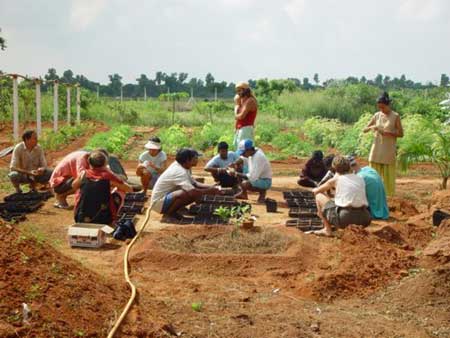
The idea of a botanical garden in Auroville has
been a dream for a long time, but due to constraints
of space the project never came to fulfilment. With the purchase of a
new large plot of some 50 acres in the southern part of Auroville's
Green Belt, the possibility of realising this dream has been
re-awakened.
The size and location, and the prospect for
turning this large area between Auroville and Pondicherry into a place
of extreme beauty and worth, gives a unique set of circumstances for the
project to flourish.
It is envisaged that, when finally complete, the
gardens will cover an area of over 150 acres. This size compares
favourably with other great botanical gardens of the world, e.g. Kew
Gardens in London (200 acres) and Perandanya in Sri Lanka (180 acres).
Four areas
The Botanical Garden will be divided into four
main areas:
-
Formal Gardens
covering about 10 acres will be a well landscaped area with
ornamental plant groups and various small specialist gardens
(orchids, ferns, cactuses, medicinal plants), situated around a view
towards a lake.
-
The Arboretum,
the largest part of the B.G., will cover 80 acres and contain up to
1,500 trees and different species from all over the tropical world
having similar climatic conditions to ours. The trees will be spaced
widely allowing each to develop to its full potential.
-
Area of
infrastructure will cover approximately 10 acres,
situated on the western side. This includes various buildings
(herbarium, information and environment centre, educational
facilities, caretaker's house, laboratory and accommodation for
visiting students), nurseries, trial plots and parking.
-
The Tropical Dry
Evergreen Forest will be about 45 acres on the eastern
side adjoining the Success Sanctuary, providing the public with an
opportunity to experience the natural vegetation of this area,
something that is near to extinction in the wild.
A green door to India and the world
If all goes to plan at least 2/3 of the gardens
will be ready for the public in 7 years time. It is envisioned that the
gardens will become an interface for Auroville, India and the rest of
the world, and as such the promotion of renewable energy will be an
important component.
The Auroville Botanical Garden will be a place
where many aspects connected with nature and plant life will be
displayed, and where information will be disseminated to influence
people's attitude towards the environment and their fellow human beings.
The plan to have an Environment Centre in the gardens to communicate
Auroville's work in the field of environmental restoration and
preservation will contribute to a growing awareness of caring for the
Earth.
At present three seasoned Aurovilians are steering
the project. As it develops, other people will become involved, either
as part of the team, or in consulting roles for various aspects of the
infrastructure, the design of specialist gardens or in research.
Of special concern
Water requirements
In the Arboretum and Tropical Dry Evergreen Forest
areas the plants will be watered for the first one to two years of their
establishment, after which they will survive on rainfall. The water
supply from the windmill will meet the requirements for this purpose.
Some areas of the formal gardens will require more water to maintain
them. Such areas of high water usage will be minimised and confined to
enclosed areas e.g. orchid and fern houses where sprinklers and
mist-sprayers will also be used to minimise water consumption. It is
felt that a lake is essential for the aesthetics of the garden, though
it is recognised that this has the potential to lose large amounts of
water through evaporation. One possibility would be to dedicate the
windmill on the small well to the lake for maintaining the water level,
along with collected rainwater.
Energy requirements
The gardens themselves will require little energy
for their maintenance compared to the buildings and for extraction of
water from the main well. As it is envisioned that the gardens will
become an interface for Auroville, India and the rest of the world, it
is recognised that the promotion and use of renewable energy is
important, bearing in mind that development in these fields should help
to provide solutions to the wider problems confronting humanity at the
same time.
Interface with the public
The gardens will be open to the public, and it is
hoped that many people will be inspired by their visit. It is a place
where many aspects connected to plants can be displayed, and where
information can be conveyed in such a way as to influence people's
attitude to the environment and their fellow human beings. The plan to
have an 'environment centre' in the gardens to interpret the role of
Auroville's greenwork, and other areas to display local knowledge and
skills, will hopefully give those aspects the recognition they deserve.
Project team
|
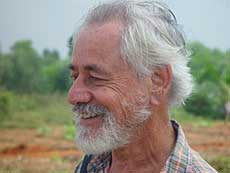
Walter Gastmans, arrived in Auroville 1978,
established Shakti Nursery, has run the Index Seminum for 10 years,
keeper of the Auroville herbarium, project holder of FRLHT (Foundation
for Revitalisation of Local Health Traditions) for the past 7 years.
|
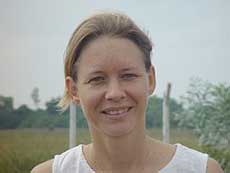 |
Auronevi
Pingel, born in Auroville, involved
with greenwork since 1990, coordinator of reforestation projects through
IDRC Canada at Auroville's 'Aranya' settelement, running a nursery for
drought resistant ornamental plants, and building a collection of
orchids for the gardens. |
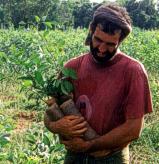 |
Paul Blanchflower, arrived in Auroville
1991, educated at Edinburgh University with B.Sc. in ecology and
forestry, project holder of Auro Eco Dat, coordinator of Forest Group
plantings since 1996. |
|