 |
|
|
|
Home > Environment & Bioregion > Villages around Auroville > AVAG > Woman Power programme > Report |
|
|
|||
|
|
A new take on Women's Day.. |
||
|
|
We've had a very interesting period in the last month, which I wanted to share with you. In the past you have received reports about our big gatherings -- 1000 children, 900 women, 650 youth, etc. It's always such a thrill to bring all the village people together, especially for them to meet each other, to feel their similarities and common challenges, to perform for each other. But this year we decided to try something new. (Actually I have to admit it is because of a shortage of funds that we came up with this, but it has really showed the way that what seems like adversity turns out to be a blessing in disguise.) A Women's Day in each 'cluster'Yes, this year we decided to run the Women's Day not in one big bash at the Auroville Visitor's Center, but to have the women arrange the Day themselves in the villages. We have, in the process of organising our work in the villages, identified eight 'clusters' consisting of 4 to 8 villages. We decided to organise a women's day in each cluster. At first the Development Workers were not really enthusiastic - they would miss the excitement of the big festival. And when they took the idea to the Women's Clubs they also were not at all convinced. They felt they would be afraid to dance in front of the people of the village like they did on the stage in Auroville, and that the men and others would interfere and make it unpleasant.
From Women's Day to Village FestivalThen Anbu stepped in with her winning ways, and reassured and encouraged them, "Make it a Village Festival that the women are organising," she advised. "Get them to involve the Youth Clubs and the Panchayat Members (elected leaders), and the natamis (traditional leaders).. and the children!" And in fact, in the great tradition of people's participation, this was done and all the obstacles were overcome, and many benefits were derived in the process. Significant achievementOne very significant achievement was regarding the 'untouchable' colonies that are located beside each official 'revenue village'. These colonies are filled with the 'dalits' whom Gandhi dubbed 'harijans' - people at the very bottom of the social ladder, who are considered unclean, pariah, outcaste. Although the prejudice is being broken down in the cities where it is not so easy to identify them, in the villages they are still denied access to the village temples and tea shop, have to perform ritual functions at funerals, and are generally oppressed and exploited. AVAG's approach of dalitsIn the early stages of Village Action Group's approach to the villages around Auroville, we looked at how we would treat these colonies, which are geographically separate as well as socially ostracised from the life of the main village, despite the fact that they are administratively a part of it. We decided to treat each colony as an independent community. In these hamlets we offer the same opportunities as in the neighboring main village - the possibility for groups of people to form a youth club, a women's club, to take up village improvement projects. In this way, the dalits who would be treated as second-rate members if they were included in the main village club, get the chance to take positions of leadership within their own community, to develop their own skills of organisation, and to feel their own capacity in building community life. Furthermore, in collective gatherings organised by Village Action they would be treated as equals, sitting, eating, and talking with the others on a par.
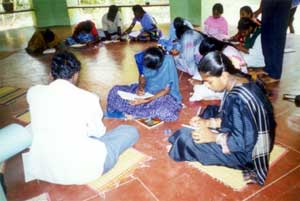
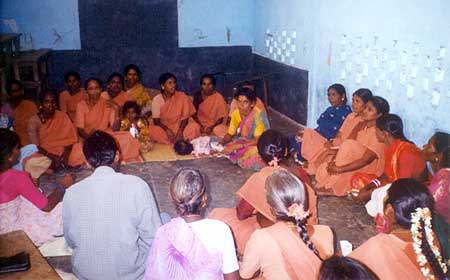
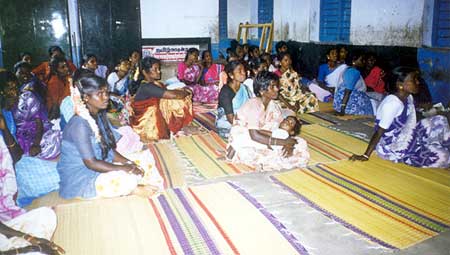
Sitting, eating, and talking togetherThis cluster level Women's Day provided just such an opportunity. It has been one thing to bring together women of all castes to the mass gathering in Auroville. It is an entirely different degree of achievement to have it happen on the village level, where the attachment to old prejudices and habits in regard to the untouchability of dalits are still very strong. Collaboration of Women & Youth ClubsThere are eight clusters in all, and Women's Clubs have been organising Village Day in their clusters for the last two weeks - on Saturday and Sunday. The results have been really gratifying. The Youth Clubs have risen with enormous helpfulness to the call of the women, erecting the stage on which to perform, arranging lights and music, telling people and gathering them. The children, who have been preparing performances in their PEP school classes and night schools, were invited to sing and dance as well. And the elected and traditional leaders took the opportunity to speak to the people. "Such a wonderful thing.."In some clusters (mostly in places farther away from Auroville, with fewer television sets and other diversions) there was an enormous turnout from all the neighboring villages and even farther away. The women painted especially beautiful kolams (an indigenous art form, geometric designs traced in chalk dust) in front of their houses. In one village, the 80+ year old traditional leader got up to speak, and with tears in his eyes said he had never thought that he would see such a wonderful thing happen in his village. The Panchayat leader clarified what he meant - he said with great appreciation, "Today I see a small India here in our village - all castes, all age groups, all genders are coming together in joy and enthusiasm. This is how we should live together." The coordinators and development workers are jubilant - they've also enjoyed working together for these celebrations, which are a clear step toward Auroville's goal of 'human unity' happening in our villages. Contact: avag@auroville.org.in10 April 2001 |
||
| Auroville Universal Township | webmaster@auroville.org.in |   |