The Auroville Kindergarten
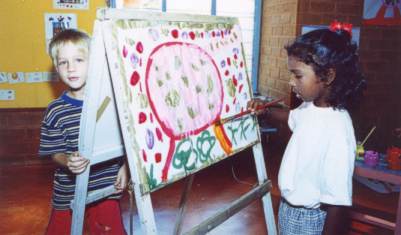
How to describe the
Auroville Kindergarten? There are approximately 46 children in
four groups. The Yellow Group is composed of three years old,
the Orange Group of four year olds, the Blue Group of five year
olds and the Green Group of six year olds. In every class, of
course, there are some children who are just coming up to a
birthday either at the early end of the age group or the latter
end. For each group there is a main teacher and an assistant. In
all the groups, the teachers come originally from France,
Germany, Italy and India. The cultural mix of children is even
more varied. They are all children of Aurovilians, but the
languages spoken at home may range from Tamil to Russian, French
to Hindi. The common language for all these groups, and the
language of instruction in the kindergarten, is English.
The place
The kindergarten is
housed in a new building, designed to their specifications, and
is located in the city area. It is a large, airy, one story
building, with the four classrooms, a dining room, a library, a
children�s toilet room and a large open activity area opening
off a central, circular entrance cum assembly hall. The building
is of warm red sand brick with deep window seats and accents of
wood, like the classroom doors, painted in bright colours.
Behind the orange door you will find the Orange Group, and so
on.
In the inviting
circular central space one wall is devoted to a large bulletin
board where volunteers have arranged that week an attractive
display to illustrate the concept of wind. On another wall there
is a very large aquarium at child�s eye level where fish float
dreamily amongst the underwater
ferns. Sometimes there will be a display of children�s work on
another wall. At the moment a frieze of elephants marches around
the base board, crayoned like elephants who have walked through
rainbows.
The physical
activity and energy needs of young children are well
accommodated. The large activity room sometimes has a dance or
movement class, otherwise children may be in there playing their
own games. The playground, in the back of the building, has
swings and a large climbing apparatus. There is a washing area
and a large contained outdoor sand area for sand play. A
swimming pool provides opportunities for welcome relief as the
days grow hotter. Flowers and small child planted gardens
surround the buildings.
It is truly a
kinder-garten, a children�s garden.
The programme
The children, not
quite old enough to cycle by themselves, come by bus and parent
transport, straggling in between 8:00 and 8:30. At 8:30 or a
little after, each class gathers for an opening circle, to share
stories, to do an activity together. Each circle begins with a
small ritual. The children sit on the floor in a circle, light a
candle, close their eyes, and meditate quietly for a few
minutes. This is �concentration�, a uniquely Aurovilian
practice which is used to start and sometimes conclude meetings,
classes, talks, etc. When observed in schools it has a
wonderfully calming and centreing effect, even on the most
active children.
After the opening
circle there is time for talking and sharing, and for planned
activities. At 10:30 there is a snack and short recess, then
lunch, served in an adjoining dining space, arrives at 12:00.
After lunch children play until it is time to leave around one o�clock.
The kindergarten curriculum has been described by the staff in
some detail and I would like to reproduce some of that
description here, organized by the five domains of the
personality identified by The Mother as the physical, the
mental, the vital, the psychic and the spiritual.
The psychic and spiritual being
-
The atmosphere
in the school is warm and loving, simple and beautiful. The
children feel very secure and at ease and experience in
their own way that the place is there for them, to meet
their needs.
-
The whole school
often chooses to follow one topic together at the same time,
which brings about a sense of sharing and oneness.
-
A natural
friendship develops between children of different cultures
and nationalities thereby promoting a sense of human unity.
-
Each morning
there is a basket of flowers with which to make a kolam, a
traditional Tamil flower design, in the centre of the
entrance hall. Children spontaneously start making the kolam
or help a teacher in doing so. Allowing children to play
with flowers brings out a special sensitivity in them.
-
All the teachers
get a chance to interact with all the children at some point
during the day or the week.
This helps to create a sense of wholeness and integration in
the relationships between teachers and children,
with the result that no sharp break occurs when they move
from one group to another.
-
Each group
visits the homes of all the children in the group. This
narrows the gap between home and school and helps the
children know each other and make friends more easily. The
emotional climate of the class improves greatly.
-
Teachers are
alert in observing the children and periodically share their
observations among themselves and with the parents, in order
to foster greater consciousness of the uniqueness of each
child. Teachers have found that as they learn more about the
unique characteristics of each child they are better able to
help that child�s growth.
-
A subtle balance
is maintained between leading the children into
teacher-directed activities and leaving the children free to
choose between a set of activities offered to them.
The physical being
Sri Aurobindo and
Mother have underlined the importance of physical culture, the
ultimate aim of which is to infuse a higher consciousness into
the cells of our bodies. Mother said, �If we cultivate the
body by clear sighted and rational methods, at the same time we
are helping the growth of the soul, its progress and
enlightenment.�
At the kindergarten
the following physical activities take place.
-
For about twenty
minutes after snack in the middle of the morning the
children are free to play in the playground, where there are
slides, swings, a see-saw and a set of tunnels along a
raised passage. While they are under observation, teachers
leave them completely free to play together in groups or
singly. Qualities of leadership and acting in concert
develop spontaneously.
-
The children are
taken to an adjacent playground where they practice walking
on a pipe, crossing a monkey-bridge both from on top and
while hanging, somersaulting on a raised bar at different
heights, and climbing on a chain wall. In their last year at
the school they also learn to skip and play many children�s
games like tug-o-war.
-
Periodically a
dance teacher works with the children doing movements
presented as games and simple exercises, which often leads
to a marked change in their body consciousness.
-
Two teachers
lead the children in body awareness work once a week from
their second year in kindergarten. The exercises and games
encourage concentration and lead the children to awareness
of all parts of the body.
-
The children
also go to the swimming pool at least twice a week and learn
through games many exercises that are preliminary to
learning to swim.
The vital being
Sri Aurobindo and
Mother have pointed out the fact that training for the vital in
the personality is presently carried out unscientifically, if at
all. They have put particular emphasis on developing and
training the responses of our sense-organs to be exact and
precise as a preliminary to the discovery of the inner sense.
Importance has been given to developing the aesthetic sense, the
sense of beauty, harmony and order. The emotional personality
can be easily distorted if proper conditions are not created for
a child�s growth.
In the turbulence of modern life many emotional problems show up
in children. Some of the practices in the kindergarten to
cultivate the vital being are:
-
A set of simple
habits is insisted upon gently until they come naturally to
the children.
When coming into the building they are expected to arrange
their sandals in an orderly line. If they use any book or
game they are expected to put it back in place; neatness in
all work is expected as well as not interrupting an adult or
another child; eating without making a mess; washing hands
before and after eating; brushing teeth after lunch and
rinsing the mouth after a snack. Children are encouraged to
at least try all the food items offered. Here the teachers
do not force but gently insist if they see a child rejecting
food out of caprice and not from innate revulsion.
-
An important
though difficult area is the interactions among the children
themselves.
Being mean to another, aiming nasty remarks, not sharing,
violence, and playing favourites are all behaviours which
appear in some of the children from time to time. Teachers
watch the children closely and find appropriate forms of
conflict resolution to deal with these tendencies when they
appear. One of the responses, for instance, is to separate
the fighters, get down at eye level with them, and make each
explain the what and why of the conflict. The attempt is not
to suppress the energy of the children but to redirect it in
a positive way. The children are never judged �bad�; it
is only the specific behaviour which is unacceptable.
-
There are many
opportunities for free creative and expressive activities
such as big blocks, Lego, drawing, painting and drama.
Simple dramatic exercises help the children to sharpen their
sensory responses, encourage the development of the
imagination, and increase consciousness of the vital being.
Acting out different emotional states such as anger or fear
fosters the capacity to create distance between the self and
the emotions, and with that the ability to have greater
control over the emotions.
-
Games to develop
the sensory faculties are regularly introduced. Good games
are commercially available for training the vision, but we
have developed many other simple games using common objects
such as fruits and seeds to strengthen the perception of the
other senses.
-
The children
learn many songs in English Tamil, French and Sanskrit, and
the oldest group begins to learn musical notation.
-
Many children,
particularly from separated parents, show a lack of
self-esteem. The staff pay special attention to these
children and take care that other children do not use
put-down statements to them.
-
Competitiveness
can be strong in some children
and often adversely affects the whole group. The staff tries
to identify the causes and find appropriate ways to work
with them. They encourage an understanding that children are
not all good at the same thing - some are good at sports,
others at painting, or music, and so on - and play many
games which have no competitive elements to foster
cooperation.
The mental being
Mother said that as
a general rule, before the age of seven, the child is not
conscious of himself and doesn�t know why he does things: �that
is the time to cultivate his attention, teach him to concentrate
on what he does, give him a minimum of knowledge sufficient for
him not to be like a little animal, but to belong to the human
race through an elementary intellectual development�.
She also said, �Understand and see clearly why this
movement took place, why that impulse, what the child�s inner
constitution is, which point needs to be strengthened and
brought to the fore. That�s all you have to do, and then leave
them: leave them free to blossom, just give them the opportunity
to see many things, touch many things, do as many things as
possible. It�s great fun. And above all, do not try to impose
on them something you think you know.�
-
There is no
stress on abstract mental reasoning in the kindergarten.
Everything is concrete and tangible. The children are
exposed to and invited to be conscious of the world around
them. They take many trips to the farms, beaches, forests,
canyons and lakes in and around Auroville. The children
learn to appreciate nature and its diversity from their
experience in it.
As part of the nature study many animals and birds are
brought into the school: turtles, snakes, lizards and other
common species are brought to school so that children can
learn the proper way of handling them.
The children do simple cooking and gardening activities.
They celebrate the holidays of Christmas, Ganesh Chaturthi,
Deepavali, and also the birthdays of Sri Aurobindo and
Mother.
-
At the
kindergarten the children are exposed to four languages:
English, Tamil, French and Sanskrit. English is the medium
of instruction and they learn simple songs, numbers and
words in the other languages. Children of this age are
particularly receptive to the sounds of other languages; if
they learn to reproduce those sounds when their vocal organs
are most plastic they can come to fluency more readily when
they are older.
-
All children are
involved in the sensory activities which provide a strong
foundation for the later development
of reading and writing skills.
As individuals show their developmental readiness they are
encouraged to do more with reading and writing.
-
In the younger
groups mathematical concepts are introduced through sorting,
grouping, algorithms, comparisons, manipulating numbers from
0 to 12, always apprehending with the body as well as with
the mind. The older children learn mathematical concepts
through games, working with numbers up to 50, with simple
addition, subtraction and occasionally even multiplication
and division. An understanding of weight, volume, time and
area is developed through the use of games and simple but
appropriate materials.
Through conscious
attention to the psychic and spiritual being, physical culture,
education for the vital, and an emphasis on experiential
learning rather than on abstract thinking, the kindergarten is
consistent throughout as an example of integral education for
young children.
Balance
It is easier to
describe the place and the programme than to describe the
feeling which permeates the kindergarten. �Balance� is the
word I heard myself saying to my friend. Balance. There is a
strong but subtle balance between meeting the needs of the
individual child and meeting the needs of the group. Children
have many opportunities for self-expression, and for the
exploration of their own interests, but they are also expected
to be respectful and considerate toward each other, to act
without license in the environment, to listen, to contribute and
to share.
There is a similar
balance in the rhythm of the day which alternates between
vigorous activity and quiet activity, directed activity and free
choice activities.
A somewhat unusual aspect of the kindergarten curriculum is the
emphasis on observation and concentration, developing the senses
in different ways. The physical, vital, intuitive, social, and
spiritual aspects of the growing child each have a place for
play (which is the work of children) in this kindergarten. This
is completely consistent with the aim of the kindergarten, which
is to nurture the child�s growth in all aspects and toward the
divine consciousness. I have seen kindergartens which excel in
their focus on social development, or on cognitive skills, but
rarely a kindergarten which achieves a balance between all the
aspects of the growing child, including the psychic and the
spiritual.
One of the specific
features of the kindergarten which I found admirable is the body
work in movement which Joan and Aloka are doing in all the
Aurovilian schools. I surprise myself at how readily the
superlatives come to mind when I see their work. From the
youngest to the oldest children they have developed exercises
and activities which draw out and strengthen the non-verbal
qualities in the developing child. And they do it all with what
seems an intuitive sense of timing, of building from one small
accomplishment to the next and the next, in ascending levels of
difficulty. Children become conscious of their bodies, of where
they are in space, of how they move, and of where their centre
of gravity is, by many different activities. They may experiment
with walking in different ways, fast, slow, dragging, skipping,
walking on a line, walking on a plank, walking up and down over
a series of obstacles, walking up
a ladder, walking blindfolded, walking to music; each time I am
there it is something different, and yet each time I can see the
connection between activities and the increasing competence and
self-confidence
in the children.
Joan and Aloka have
combined their backgrounds in dance and physical therapy and
created a synthesis which addresses the developing physical
skills of the growing child. Here, I think, the word unique may
properly be applied. I have never seen such care and
concentration in movement among children in other schools. I
have seen a similar understanding and control of the body
sometimes in dance and gymnastics classes, but never across the
board with all the children who happen to be in the school.
(Note: the Body Awareness work is described in more detail in
SAIIER�s Research Letter #2 for 1997-98.)
Their achievement
may be aided by the fact that Auroville children are raised in
an active environment. They cycle and walk for the most part to
get around,
and generally have a great deal of freedom in movement both
within the house and without. There is an emphasis on sports and
healthy outdoor activities, and Auroville is a relatively safe
place for children; they may roam freely, and often do.
Another admirable
feature of the kindergarten is the respect for language
differences. All children learn to speak in English, but they
also have classes in French, Tamil and Sanskrit where they learn
songs, games and simple phrases, enough to begin learning how to
form the sounds of the language when they are at the optimal age
for hearing, reproducing and remembering linguistic sounds.
Although this is a
rather brisk tour through the kindergarten, I hope it will
provide enough of a guide for readers unfamiliar with the
kindergarten programme to assist them in making comparisons
during the philosophical overview which follows.
|