Philosophical assumptions
determine nature of the school
In our first
seminar we talked about the differences between different compatible approaches to
kindergarten, and to set the stage reviewed briefly the philosophical foundations for these approaches. Any real
understanding of an educational philosophy must go back to very
basic assumptions about the nature of humankind, the universe,
and the purpose of life as we know it. Why are we on this earth?
What is the nature of human beings? Are we born inherently good,
inherently evil, or morally neutral? What is the relationship
between human beings and the Divine? The answers we give to these basic philosophical questions shape
the answers we give to questions about the aim and form of
education.
If one believes, as the Calvinists did, that children are born
in original sin, and have an inherent disposition to evil, then
the task of education becomes training or requiring the child to
be good, against his or her natural inclinations.
If one believes that humans are born inherently good, as
Rousseau did, then the task of education is primarily to see
that the natural inclinations of the child are not curtailed and
that the restrictions of personal freedom necessary for living
in a society are kept to a minimum.
If one believes with Dewey that children are born neither good
nor bad but learn right and wrong from their interaction with
the environment in which they grow, then the nature of the
environment, which means also the people and the experiences of
the child�s life, are of great importance.
These greatly oversimplified statements are offered only to show
that even the most practical decisions in schools are ultimately
governed by the assumptions we make about the nature of the
universe. Having said this I hasten to add that no school is a perfect exemplification of
one philosophy, since even within the �purest� schools there
are small variations in personal beliefs, and, yet more likely,
in the way in which similar beliefs are executed. So, for
example, even though we all believe that freedom of expression
is essential for children, one person�s way of encouraging
freedom of expression for the child may look quite different
from the way it looks to another person.
In a little book
called Issues and Alternatives in Educational Philosophy George
Knight suggests one way to understand how different assumptions
may be reflected in practice. He examines each philosophical
school of education in four categories: the role of the teacher,
the role of the student, the role of the curriculum, and the aim
of education. As an example, in schools of the traditional or
Calvinist approach, operating on the assumption that children if
left to their own devices will grow up as little savages, The
Lord of the Flies is a good example of this philosophy. The role
of the teacher is to direct students in the right ways to think
and behave, and the role of the student is to be obedient,
respectful and industrious. The curriculum should be composed of
basic skills, instruction in values, and training for the mind.
In �free schools�, where the founders believe that children,
left to themselves, will flourish and turn naturally toward what
is good and true, the role of the teacher is to facilitate, to
stand aside, and to intervene only when necessary. A.S. Neill,
head of Summerhill, one of the most famous free schools, said
that at Summerhill there were only two rules: you could not do
anything which would hurt someone else, and you could not do
anything which would hurt yourself. Of course there is a wide
space for disagreement there over what constitutes �hurt�,
but in general Neill intervened only when the injury was likely
to be physical and long lasting, either to the person or the
environment i.e. you could not burn down a building or throw
rocks at a passer-by, but you could spend all day building a
tree fort and never go to class, and you could eat/sleep/work
whenever you wanted. Neill argued that after a period of
experimentation children would naturally establish healthy
patterns of work and play. The role of the student is to develop
his or her own potential without interference.
When Sri Aurobindo said �Mind must be consulted in its own
growth�, I believe the word �consulted� indicates that the
children must participate in decisions about their own learning,
but it does not mean they should be left to their own devices.
At the kindergarten seminar we positioned ourselves somewhere in
the middle between these extremes, though with perhaps more
sympathy for the latter than the former, and looked at three
contemporary approaches to early childhood education which
seemed most likely to fit within our own belief system and which
might be instructive for this kindergarten programme.
Three
philosophically compatible approaches
The three
approaches - Montessori, Waldorf and the Progressive movement -
have several significant features in common. All three value the
uniqueness and integrity of the child as a person, and of
childhood as a state of being. All three value the child as a
whole person, one with developing abilities in the physical, the
social, the mental and the emotional realms. (One distinguishing
difference between these generally compatible approaches is the
difference in emphasis on the spiritual and intuitive faculties
of the child, a topic I will address later.) All three believe
that the child grows through active engagement with the
environment, and that the role of the adult as mentor and model
can not be overstated.
Finally, all three approaches are consistent with developmental
stage theory, even though their founders could not have been
acquainted with the explosion of research into children�s
thinking which has characterized the last sixty years. Certainly
they are all one in seeing childhood as unique, and as a period
of exceptionally rapid growth in all the domains.
Montessori
Schools
Maria Montessori
was born in Italy, and after training as a teacher and
psychologist she was chosen, in 1906, to establish schools for the tenement children in one
of Italy�s worst slums. These �children�s houses� were
part of a �scientific experiment� on behalf of children. The
method and materials piloted there are now famous around the
world, and there are Montessori schools on every continent.
Montessori said �the aim of education is life itself, not
preparation for life�. She felt it was imperative that a
school allow a child to develop naturally, but not with
undisciplined freedom, and she saw the role of the environment
as critical in directing the natural development of the child.
In Montessori schools the role of the teacher is that of guide,
observer, coach, facilitator and overall manager. The Montessori
teacher does little explicit teaching, but must be very
observant, watching the children as they work with the
materials, guiding them when they are confused, making sure the
sequence is appropriate, preparing the classroom,
and organizing the activities.
Perhaps because
she began working initially with slum children living in
squalor, Montessori stressed the importance of cleanliness and
good health habits.
As a part of the curriculum, all children participate in
cleaning the classroom, setting out the meals, and cleaning up
afterwards. They learn to wash their hands and brush their
teeth. In the play areas there are little wash tubs, ironing
boards and housekeeping equipment for the children to learn
domestic skills through play.
Another emphasis in Montessori schools is on the development of
sensory awareness. Children are taught through all the senses,
with a special emphasis on the kinesthetic, and the curriculum
encourages consciousness of the senses through the use of
specially prepared materials. Montessori materials are famous
around the world, and the concept of using materials to teach
specific skills and concepts has spread with the materials.
There are graduated cylinders to teach an understanding of
shapes and graduated sizes, vials for sniffing, closed
containers for sound discrimination, sandpaper letters to teach
the form of the letters through the fingers, and much more. The
aesthetic sense of the child is nurtured by the pleasing quality
of the classroom and the materials, which are clean, orderly,
simple, and beautifully conceived. Although the teacher may need
to manage behaviour at first, the aim and expectation is always
that discipline should come from within.
In a Montessori school the role of the teacher is essential but
discreet; the role of the environment as an educational tool is
of prime importance; the role of the child is to be active in
exploration and expression within the educational environment,
and tidy and considerate in behaviour. Perhaps it would be
helpful to note that this description is drawn from my
experience with Montessori schools in the U.S. and through
reading. Actual Montessori schools in India and elsewhere may
have evolved in directions which no longer exactly match this
description.
Waldorf Schools
It is interesting that the Waldorf school movement began in a
way similar to that of the Montessori movement. Rudolf Steiner,
a German educator and philosopher, was asked to start a school
for the children of the workers in a Waldorf factory in
Stuttgart. Steiner was born in Germany in 1861. He described a
school of philosophy known as Anthroposophy: the wisdom of the
human being. Anthroposophy, though oriented toward the Christian
faith, is primarily concerned with the acknowledgement and
development of spirituality in the person and the universe. The
Waldorf movement is the fastest growing private school movement
in the world today.
One of the most interesting features of the Waldorf School is
the structure: teachers stay with their classes from first grade
through 8th. Obviously a class becomes very much like a family;
less obviously the challenge for the teacher is to master all
the subjects in the elementary curriculum. As Torin Finser
admirably illustrates in School as a Journey, his account of
teaching for eight years in a Waldorf school, the teacher also
comes to know from personal experience the extraordinary
developmental changes which take place in children during those
formative years.
In the Waldorf schools every effort has been made to make the
overall plan for the curriculum fit the evolving interests of
children. So in the kindergarten, a time of rich fantasy life,
fairies, elves and goblins appears in the teacher�s stories
and the children�s play; at sixth grade when children are
beginning to venture out on foot and cycle to explore the world
around them, explorers become the focus of the curriculum. There
are many such examples.
As with Montessori, all of the senses are cultivated and
engaged, but in Waldorf schools this is done primarily through
art, ritual, song and movement. Math is taught with rhythms and
movement. Children learn to recite chants and verses. The
teacher greets each child at the door with a handshake, and
inevitably there will be another small ritual around snack or
lunch. There are festivals at set times of the year: a Christmas
pageant, a Maypole dance. The environment is carefully
structured so that it is aesthetically pleasing, soft,
harmonious, and not overly stimulating. Pastel colours and
swirling shapes are common in Waldorf drawings, and only natural
materials such as wooden toys and beeswax crayons are used.
Unlike Montessori schools or the schools within the Progressive
tradition, Waldorf schools are teacher centred. They are not
oppressive; great care and respect is accorded the children, but
the curriculum is determined by the teacher within the
prescribed Waldorf traditions. Materials, festivals, and the
sequence of activities are teacher directed. All ten year olds
will study Norse myths; ancient cultures and attention to the
Maypole dance are essential in every fifth grade class. Each of
these curricular selections has a rationale rooted in Steiner�s
understanding of the developing interests of the child, and are
often inspired, in my opinion, but also absolute. There is
little room for deviation.
Waldorf teachers believe young children need to be directed in
their expressive efforts so that later they will be better able
to create their own work. In a Montessori school the materials
and the curricular expectations guide the children, but the
children have more choice in the selection of activities and the
means of expression. In the student centred progressive schools
the environment will be �messier�; children will be
presented with a wide variety of materials to work with,
particularly openhanded materials which they may bend to their
own discoveries; and they will be encouraged to make their own
choices in materials and activities.
Progressive
Schools
Progressive schools are more difficult to describe, because �Progressive�
is a general set of characteristics, suggesting a basic
orientation to the world which extends far beyond schooling,
into politics, economics, labour relations, human rights and the
arts. Montessori schools, for example, fall within the broad
definition of progressive education. Montessori and Waldorf
schools, being in the private domain, may exercise some
authority over the schools which bear their name to keep them
within the accepted practices of the approach. Not so
progressive schools. Some progressive schools are private
schools, and those like The City and Country School in NY, or
Mirrambika in Delhi, are relatively �pure� manifestations of the philosophy, but
there are progressive teachers in non-progressive schools and
non-progressive teachers in progressive schools, and some
aspects of progressive practice have changed from being
revolutionary to being common place in American and British
schools. On the political football field of American education
today, �progressive� has been misinterpreted to mean
something like the free school movement I described above in its
most chaotic and unruly manifestations, in contrast to a �back to basics� movement with its emphasis
on facts, drill and examinations.
Consequently, to avoid the aversive associations with the label
�progressive�, some schools firmly within that tradition
identify themselves with other names, such as the open
classroom, integrated day, constructivist,
or student centred.
John Dewey, the great American educational philosopher, and the
man most closely associated with the concept of progressivism in
education, strongly repudiated the free school interpretation of
progressivism in one of his last works, a little book called
Experience and Education. Dewey believed that children are born
neutral, that healthy development is the aim of education, that
we all learn and grow from interaction within the environment -
which includes people as well as things, that in fact all that
we learn comes from experience; but it is not experience alone,
it is the meaning we make of it which directs our perceptions
and our actions. Out of these beliefs Dewey postulated a
curriculum which must begin with what is relevant, what matters
to the child, but which continually draws us on. As Sri
Aurobindo said, teaching must be from the near to the far.
Humans are curious creatures, and through our explorations we
learn more and more about the world and about ourselves. One of
the goals of education must surely be to cultivate the spirit of
enquiry so that education never ends.
Auroville
Schools/Education
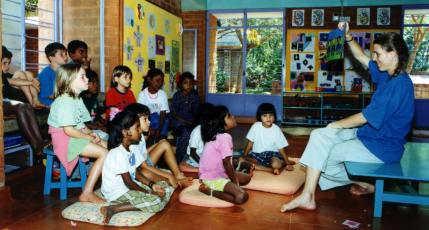
Where does the Auroville Kindergarten fit in this medley of
approaches? The kindergarten seems to me to be a true
exemplification of the progressive approach.
It is student centred; experiences are carefully constructed to
be relevant, developmentally appropriate and educative; the
whole child is addressed; there are many opportunities for
choice but not license; and children learn from an active engagement with the
environment. On the other hand, the emphasis in observation,
concentration and the development of the senses reminds me of a
Montessori school, and the attention to the spiritual climate of
the school, with rituals and the awareness of the presence of Sri Aurobindo and Mother remind me of the Waldorf schools I have
seen. In each of the approaches I have described there is much
of value. What we take from them depends in part on our own
philosophical inclinations and our own intuitive sense of what
is right for these children in this place.
The Auroville Kindergarten resonates with the three simple but
profound principles enunciated by Sri Aurobindo: �Nothing can be taught. Work from the near to
the far. Mind must be consulted in its own growth. �Children
learn by doing, not by �being taught�. All activities begin
with the known and the concrete before moving to new forms and
structures. Children are presented with appropriate choices, and
encouraged to solve their own problems. Mother said, �To love
to learn is the most precious gift that one can make to a child:
to love to learn always and everywhere.� In this kindergarten
children love to learn.
Some of the unique features of this kindergarten, features which
may distinguish it from each of the other educational movements
with a compatible philosophy, have been described: the emphasis
on observation and concentration, the development of sensory and
body awareness, the cultivation of all five domains of the being
including a direct address to the vital, psychic and spiritual
domains, the attention to early language development, and the
integrity of the environment.
The purpose of education in Auroville is, in the words of Sri
Aurobindo, to help the growing soul draw out the best in itself:
�Everyone has in him something divine, something his own, a
chance of perfection and strength in however small a sphere
which God offers him to take or refuse. The chief aim of
education should be to help the growing soul to draw out that in
itself which is best and make it perfect for a noble use.� |