Conclusion
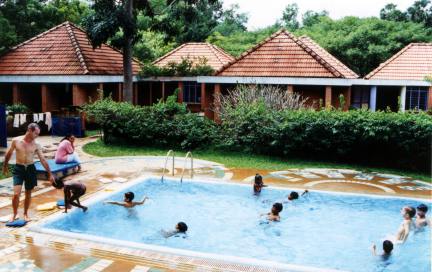
The kindergarten is
not perfect, of course.
In our discussions we found areas where the teachers would like to make small changes,
or areas they want to explore further, and, as we all know, it takes a lot of hard running just to stay in
place. There is no reason for complacency; a balance implies
that there may always be imbalance tomorrow, or at any minute.
Balance takes concentration on the goal, continuous
self-reflection, and subtle adjustments of tension simply to
remain as one is.
I have seen a
videotape of some of the work of Joan and Aloka with the
children. In these scenes the children move with amazing
concentration and balance up a ladder and down a ladder,
balancing a tin plate on the point of a pencil. They move
gracefully and with total concentration. They move together.
Sometimes one child transfers the balancing plate to another
without dropping it or losing the posture, sometimes not.
As I watched the
videotape I thought of the kindergarten balance. It is true that
not all children are well-centred all the time. It is true that
sometimes the parts do not weave perfectly into each other.
Nonetheless the coming together excites our admiration. I have
had that feeling about the kindergarten.
The kindergarten is not perfect, but it is a very special place.
Without detracting from the specialness of the kindergarten I
should also say that kindergartens in general are easier to
manage for several reasons. Children at this age are extremely
open and plastic, hungry for learning; they have not yet had
aversive school experiences to �turn them off�; parents and
the larger society have fewer external expectations. We do not
expect kindergarten children to pass examinations, and although
the pressure to prepare for some higher form of schooling exists
it is not strident. There is more unanimity among parents and
the community about what a kindergarten should provide than at
any other level of education.
However, these
observations are not intended to minimize what is happening with
these young children. They may be learning faster than they will
ever learn again. Daily their vocabulary expands, and not just
in one language but in two or three. Every day they are learning
and practicing social skills, and, like the mind, the young
bodies are developing new capacities.
There is a much quoted book in the U.S. entitled, Everything I
Ever Really Needed to Know I Learned in Kindergarten, in which
the author describes how in kindergarten he learned to listen,
to speak, to clean up, to share, to express himself, to ask good
questions, to trust and be trusted. Auroville children would
know what he means.
References
Dewey, John. (1938)
Experience and Education. Macmillan. NY
Finser, Torin. (1994) School as a journey. Anthroposophic Press.
NY
Fulgrum, Robert. Everything I Ever Really Needed to Know I
Learned in kindergarten.
Knight, George. (1989) Issues and Alternatives in Educational
Philosophy. Andrews University Press. Michigan
Montessori, Maria. (1967) The Discovery of the Child. Ballantine
Books. NY
Pratt, Caroline. (1948) 1 Learn from Children. Simon and
Shuster.
NY
Sri Aurobindo and The Mother. On Education.
Wood, Chip.(1994) Yardsticks: Children in the Classroom Ages
2-12. Northeast Foundation for Children. Pittsfield, MA |