 |
|
|
|
Home > The City > Matrimandir > Construction phases |
|
|
|||||||||||||
Construction phases
|
|||||||||||||
|
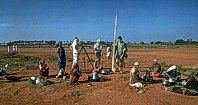
Matrimandir site survey
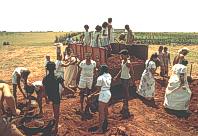
Beginning of excavation
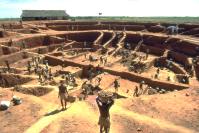
Final stage of excavation
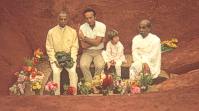
Foundation laying ceremony
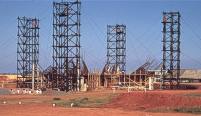
Scaffolding for the pillars
The pillars coming up...
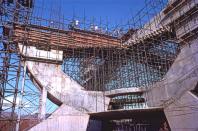
Inner chamber work
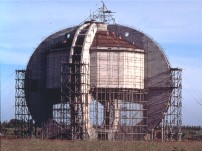
Space frame structure
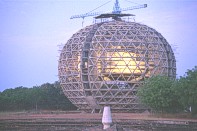
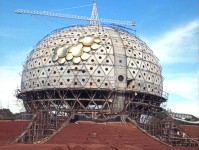
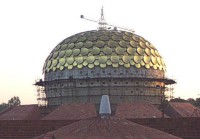
Outer skin
Gold discs |
1970It all began with a vision the Mother had in January 1970, which was taken up by Roger Anger, the French architect she chose for the project. After this, Roger presented her with various possible designs, and in 1971 the final, approved globe model for the structure was presented to the Mother and to the residents of Auroville, and work could start. The foundation stone was laid on February 21st 1971, and the practical work of overseeing the engineering requirements for the construction was given to the Aurovilian architect/engineer Piero Cicionesi who lead the development up till the completion of the Inner Chamber. From 1971 - 1973Excavation and foundationsResearch into the design of the structure went on simultaneously with the excavation of a ten metre deep crater at the centre of Auroville for the foundations. Consultancy for the structural design was graciously given by Dr. T.K. Santhanam of SERC (Structural Engineering Research Centre), Chennai. The detailed construction drawings, the design and fabrication of the staging and shuttering, as well as the overall organisation and execution of the construction, were done by the Aurovilians under the guidance of Piero. The foundation stone was laid at sunrise on 21st February 1971 - the
Mother’s 93rd birthday. The excavation was started in March by
Aurovilians and Ashramites, but was later taken over by a paid local
work force more equal to the task. From 1974 - 1979The pillarsDuring January and February of 1974 preparations
proceeded for concreting the first layers of the four pillars which
would form the framework of the sphere. Casting of the second level slab
was completed in March 1974. During the autumn of 1974 construction
entered a new phase with work on the four pairs of cantilevered
arm-brackets joining together the four rib pairs in a ring-beam at the
centre; situated more than 14 metres above ground level, these brackets
and this ring-beam would support the floor of the inner chamber. This
beam was cast in December 1974. At 29 metres above ground level a final ring-beam
supports the roof of the interior chamber. In June 1976 the pipe
scaffolding was taken down and for the first time the interior space of
the Matrimandir was visible. From 1979 - 1987The space frameThe space-frame to support the skin of Matrimandir is a grid of triangles of varying sizes which runs the length and breadth of the sphere. It allows for a double skin, and though many possible materials could be used to cover the triangles of the space frame, the original plan was for cement inside and outside (subsequently, ferrocement was chosen as the most adaptable material for the outer skin and tinted glass for the inner skin). The outer skin will finally be covered by golden discs. Precasting of the 1,200 concrete beams that form the grid began at the end of 1979. Fitting them took 8 years, and was completed on 15th August 1987, Sri Aurobindo’s birthday, making that one of the most spectacular aspect of the structure. Meanwhile, the ramps were completed and underwent
a successful loading test of 20,000 kg on the first ramp. In 1985 news
came from AVI Netherlands that Zeiss (Germany) would be able to
manufacture the crystal globe planned for the focal point of the Inner
Chamber. During the same period the Italian marble quarried in 1977 from
the mountains of Lasa, near Bolzano in northern Italy, and destined to
grace the walls of the Inner Chamber, arrived. These pure white slabs of
marble were stored underground in the amphitheatre for several years,
before finally being mounted on the walls of the Chamber. An enlarged
planning team was also working on the design of the inner gardens. From 1988 - 1991The Inner ChamberDuring three years of concentrated work the Inner Chamber took shape. After years of research into the best materials for the Chamber - and raising of the funds needed - all the various elements found their place:
Meanwhile initial research into the Chamber’s air-conditioning system was done, plus experimenting on the mirror of the heliostat to eventually safely direct light onto the crystal globe. During 1990 the twelve columns were given a lengthy treatment to give them the perfectly white matte finish desired. The first stages of preparing the symbols - to support the crystal globe - went on simultaneously with laying of the marble on the floor. Over 1,200 of slabs of white marble were mounted, and slowly the colour of the lower reaches of the twelve-sided Chamber was changed from cement grey to dazzling white. Staircases that enter the building through each of the four pillars up to the first level were meanwhile under construction. A new spiral staircase was begun, to connect the first level to the second, where the spiral ramps that lead to the Inner Chamber begin. Each of the four pillars required a substantial extension at the base. This had already been done for the Mahakali pillar (to the north) and in June 1990 the concrete was poured for the Maheswari pillar (to the south). Then came 1991, the year of the crystal. It was hoisted in a wooden crate with a plexiglass top, visible to all, and on August 15th that year - Sri Aurobindo's birthday - the Chamber was opened. By then all the construction materials that had been cluttering the room for years had been removed, though the crystal was not yet in place. It was finally put in its correct position, on a gold plated mount comprising four Sri Aurobindo symbols, on August 22nd. Special consultancy and support for this work was given by Paolo Tommasi who has been involved in the conception of Matrimandir and its Chamber from the very outset. Three major worksIn the meantime work on the concrete reservoir for rainwater under the sphere of Matrimandir had been ongoing. Fine white marble was being purchased for the mosaic finishing on the first and second levels of the structure and for the double spiral staircase which connects the two levels. A large Auroville construction group took up the three major works of producing the ferrocement elements for the outer skin, building the twelve outer petals, and tiling the existing Amphitheatre with natural red stone from Agra.
>> From 1992 - 2000 |
||||||||||||
|
The City > Matrimandir > |
|
|
Soul of the City | Symbolism
| Sacred geometry | The gardens
| Construction phases
| Technical details |
| Auroville Universal Township | webmaster@auroville.org.in |   |