Air conditioning
Much research was done on the air conditioning
plant which has been installed under the eastern edge of the
Amphitheatre. Various types of systems were rejected in favour of what
is called the Freon R-22 system. Chilled water is transported by
underground pipes to the Matrimandir and up the north and south pillars
to air cooling coils near the Chamber.
The cooled air is blown into the Chamber through four grilles located in
the ceiling, and will leave the Chamber through slots at floor level,
into ducts leading to the north and south pillars where the air-handling
unit will return the filtered air mixed with some outside air. It will
then pass through the chilled water coil to be re-cooled and
dehumidified and eventually be sent back to the grilles by two fans.
The columns
The columns arrived at Matrimandir in the
beginning of January 1990.They were 24-inch diameter, galvanised,
seamless steel pipes, 8.65 mtr long, weighing 830 kg each. The painting
job appeared straightforward and the first two were done completely in a
couple of months. A dedicated team started putting in extra time, a few
infra-red lights appeared to help the drying, and then even an electric
polishing machine arrived to speed up the work. There are an average of
15 coats of paint on each column with finer and finer sanding between
coats after which the final polishing was done.

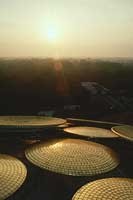
The gold discs
| Disc frame: |
- |
Stainless steel tubes |
|
Disc material: |
- |
stainless steel sheet |
|
Gold leaf: |
- |
28 gm of gold per 1000 leaves |
|
Leaf size: |
- |
85 x 85 mm |
|
Total number of discs: |
- |
1415 |
| Small convex discs: |
- |
954 |
| Large concave discs: |
- |
461 |
|
Average diam. (large discs): |
- |
2.3 meter |
|
Average diam. (small discs): |
- |
1.5 meter |
The carpet
The carpet in the meditation chamber was woven in
Agra using a blend of the finest Merino wool imported from New Zealand.
This project was completed under the skillful guidance of Mr. Meattle of
India Carpets and Furnishing Company, one of India's top carpet makers.
It took 6 months to weave the twelve sections (and two spare pieces)
which cover the entire floor area of the Chamber.
The manufacturing was done on a specially designed handloom using the
Wilton weaving system. This system gives a carpet all the good qualities
of a machine-made carpet as well as the special qualities of a handmade
one.
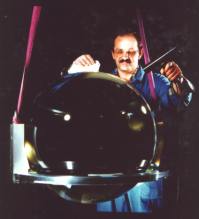
The crystal globe
The crystal for the Matrimandir arrived in
Auroville on 26-4-91 at 10.15 p.m. It was moved into the Matrimandir's
Inner Chamber the very next day at 09.45 a.m.
The size of 70 cm diameter was marked on the
original plan that Mother had drawn for the central object in the
Chamber. In July 1983, the searchlight fell on the firm of Schott in
Mainz, and somewhat later on Zeiss in Oberkochen, both in Germany. These
firms proposed the type of crystal - optically perfect glass - with the
name of Bohr Kron 7. On the 8th of June 1984, Zeiss presented the study,
and gave the estimate: approx. 230,000 German Marks.
On May 12 1987, Schott wrote to Zeiss that the cast has been done, and
that the mould was being cooled. When two months later a visit to Zeiss
was made, it appeared that this casting was the second one, - the first
one having failed for unpublished reasons.
The casting at Schott's in Mainz lasted 15 hours,
and was done in a special form of refractory stone, held together by
seven metal bands, which was placed on top of a platform built of iron
and steel. During the casting process the glass in the form was kept at
a constant temperature. After 15 hours the rough casting in the form of
a massive dome with a diameter of 80 to 85 cm and a weight of 1100 kg
was finished, after which it was cooled down extremely slowly (to avoid
tension) in an annealing furnace for a period of 5 weeks. The rough form
had to be polished on two sides, in order to test the quality of the
glass. Finally, at the beginning of 1991, it became clear that the
process to deliver the globe could be started, and in April of the same
year it reached its destination, the Chamber.
The Heliostat and Lens
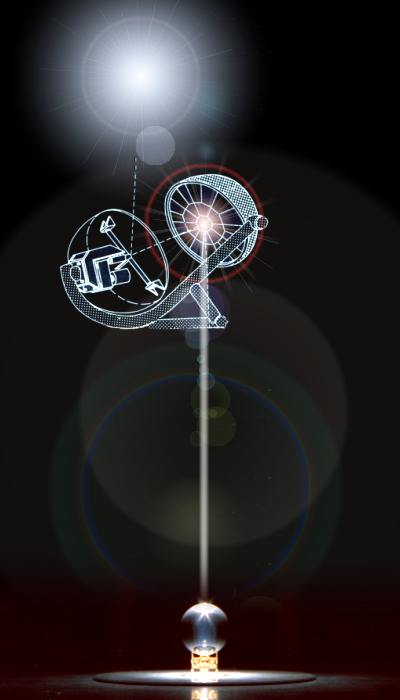
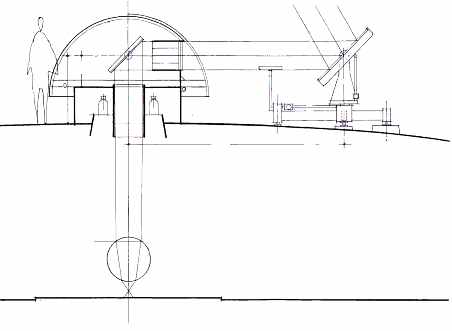
The heliostat is controlled by a computer program,
which moves a mirror across the sun's path every day. This mirror
projects sunlight into a lens, that projects the single sun ray down on
the crystal. To make sure that the ray
strikes the crystal exactly in the centre, a photo sensor is installed in the path of the ray itself and relays the
data on the ray's position to the computer, which in turn will adjust the
ray to the correct position if necessary.
Technical information about the lens
| Focal length, first lens: |
- |
30 m, diam, 45 cm |
|
Focal length, second lens: |
- |
5 m, diam. 25 cm |
|
Diameter of sun-spot on the globe: |
- |
180 mm |
|